
What Is a Staff Software Engineer?
A Staff Software Engineer is an experienced individual contributor who operates at a broader technical scope than a typical team-level engineer.
A Staff Engineer may still write code, review pull requests, debug production issues, and design systems. However, much of their impact comes from problems that don't fit neatly into one team's backlog.
For example, instead of improving one service, a Staff Engineer might identify a reliability problem affecting several services and help multiple teams adopt a common solution.
The important distinction is scope.
A Staff Engineer doesn't necessarily own the most code. They often own some of the hardest technical problems.
Staff Engineer in Simple Terms
A Staff Engineer is a senior individual contributor who solves complex technical problems across teams, influences architecture and technical direction, and helps other engineers make better technical decisions. Unlike an Engineering Manager, the role does not necessarily involve direct people management.
In simple terms, a Senior Engineer is often focused primarily on solving problems within their team, while a Staff Engineer is expected to create technical impact across a broader part of the organisation.
What Does a Staff Software Engineer Actually Do?
The exact role varies between companies. Some Staff Engineers are deeply involved in architecture, while others focus on infrastructure, developer productivity, reliability, or technical strategy.
Common responsibilities include:
- Leading complex technical initiatives
- Designing and reviewing large-scale systems
- Making architectural decisions
- Identifying cross-team technical problems
- Establishing engineering standards
- Mentoring senior engineers
- Improving reliability and developer productivity
- Communicating technical trade-offs
- Working with engineering and product leadership
- Driving projects where ownership spans multiple teams
The role is usually defined by impact and scope, not by a fixed list of tasks.
Staff Engineer and Technical Leadership
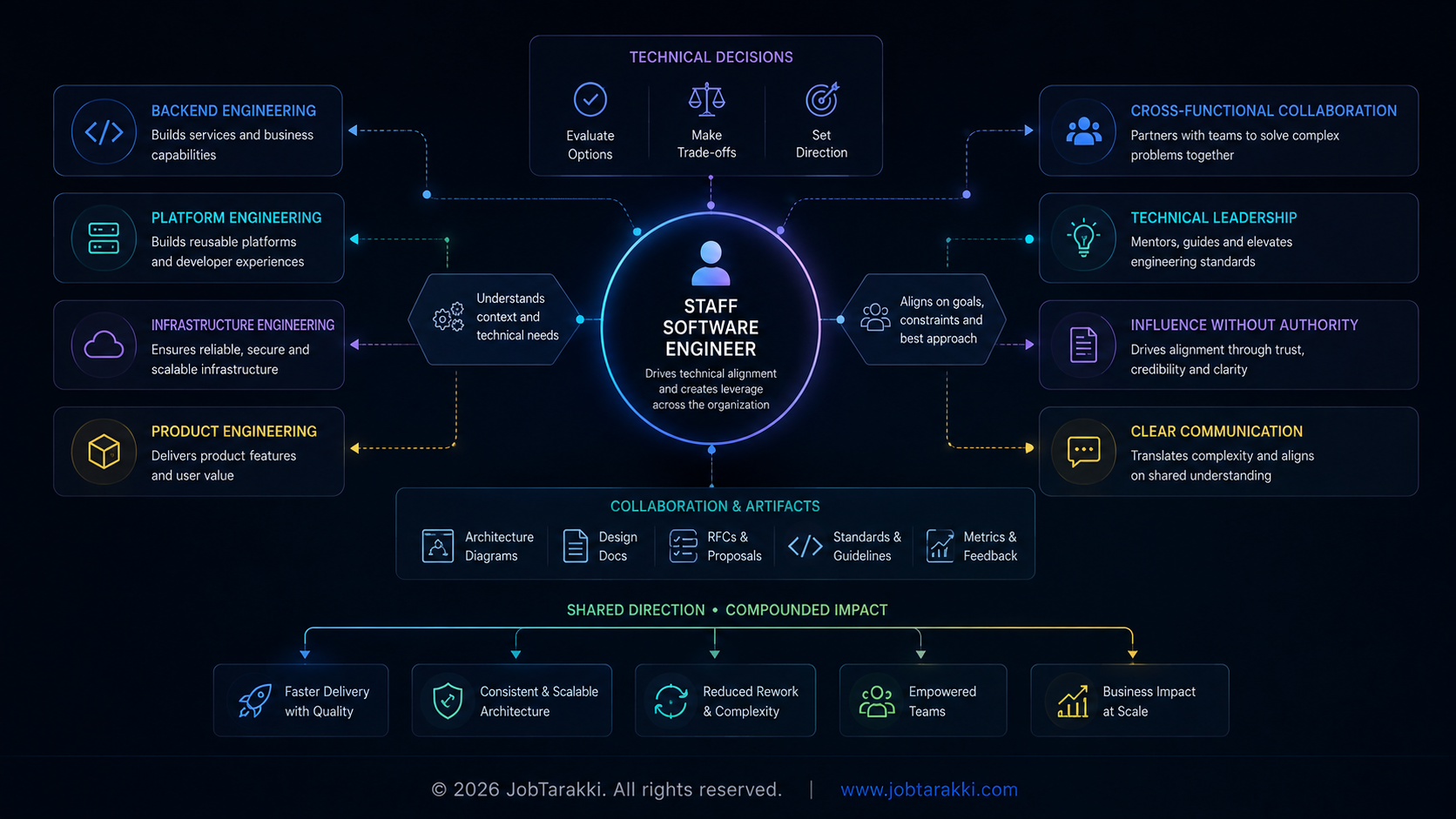
Technical leadership is one of the most important parts of Staff-level work.
A Staff Engineer may not have direct authority over another team, but they still need to influence technical decisions.
Imagine three teams are building services that communicate through different patterns.
Each team's implementation works independently, but the overall platform is becoming difficult to maintain.
A Staff Engineer might:
- Identify the underlying problem.
- Gather input from the affected teams.
- Evaluate possible approaches.
- Document the trade-offs.
- Propose a technical direction.
- Help teams adopt it.
- Measure whether the change actually improved the system.
That's technical leadership without becoming everyone's manager.
Architecture Is More Than Drawing Diagrams
Staff Engineers are often associated with architecture, but architecture at this level isn't simply creating impressive system diagrams.
The difficult part is deciding what not to build.
A Staff Engineer needs to consider:
- Reliability
- Scalability
- Operational complexity
- Development speed
- Cost
- Security
- Team ownership
- Future maintenance
For example, introducing another distributed service might technically solve a scaling problem while creating additional operational complexity.
A strong Staff Engineer asks:
"What is the simplest architecture that solves the actual problem?"
That mindset is often more valuable than choosing the most sophisticated technology.
Staff Engineers Create Leverage
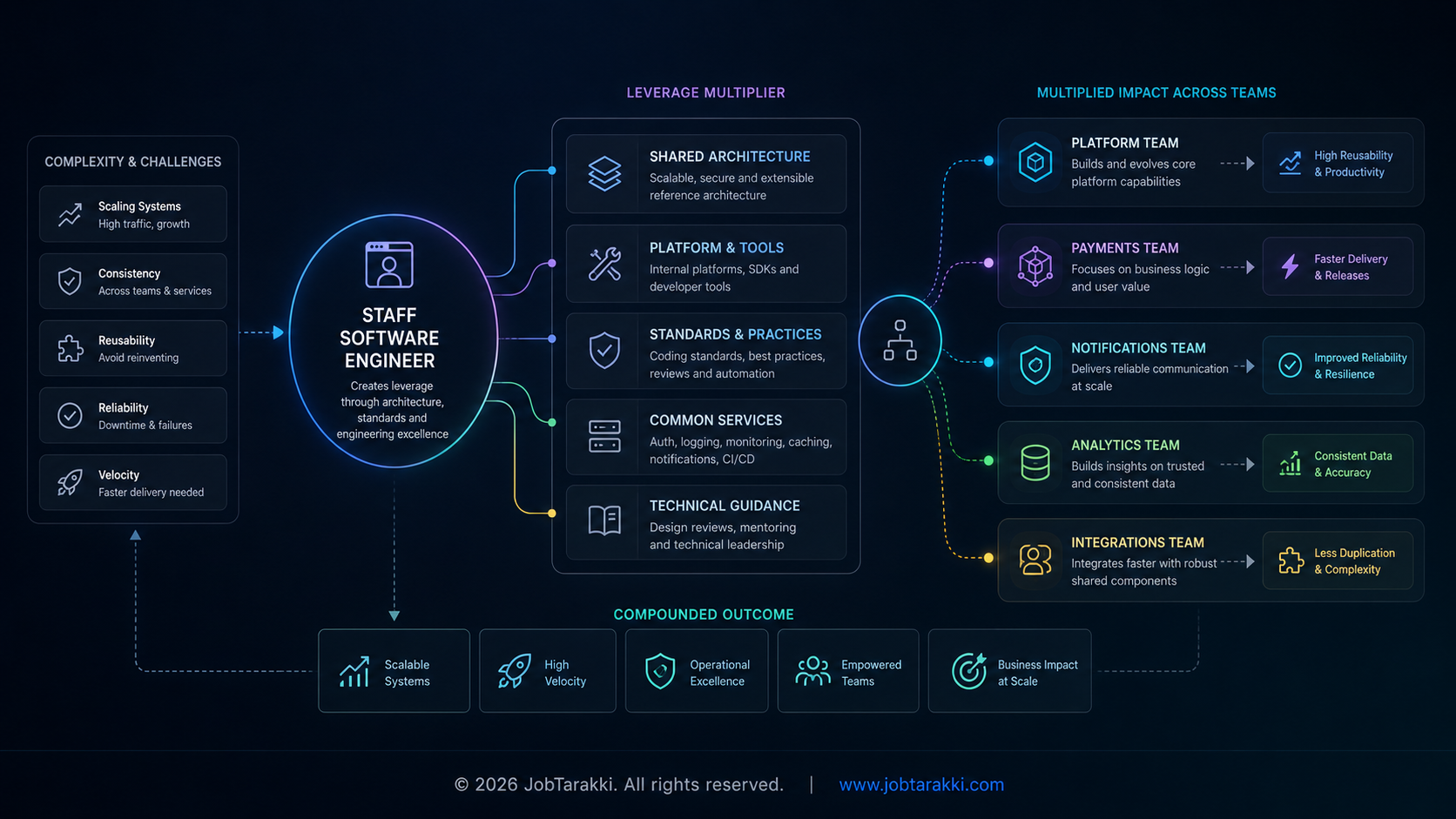
One of the clearest ways to understand Staff-level impact is through leverage.
Consider two approaches.
Approach A
An engineer fixes the same class of problem in five services.
Approach B
A Staff Engineer identifies why the problem keeps occurring and helps create a shared library, standard, tooling, or architectural pattern that prevents it across many services.
Approach B can create much larger long-term impact.
This doesn't mean Staff Engineers should avoid implementation.
Sometimes the fastest way to influence an organization is to build the first working solution yourself.
The goal is not to write less code.
The goal is to make your technical work multiply beyond yourself.
Mentoring at Staff Level
Staff Engineers often mentor senior and mid-level engineers, but effective mentoring isn't about reviewing every decision.
Instead, they help engineers develop better decision-making skills.
For example:
Instead of saying:
"Use this architecture."
A Staff Engineer might explain:
"Here are the constraints we're dealing with. These are the three approaches we considered. Here's why I would choose this one."
That teaches the reasoning behind the decision.
Over time, the engineer becomes capable of making similar decisions independently.
That's much more scalable than being the person everyone has to ask.
Communication Becomes a Technical Skill
At Staff level, technical ability alone isn't enough.
A Staff Engineer may need to explain the same technical problem to:
- Backend engineers
- Platform teams
- Product managers
- Engineering managers
- Architects
- Engineering leadership
The level of detail changes, but the underlying reasoning must remain consistent.
Good Staff Engineers can explain:
What is the problem?
Why does it matter?
What options do we have?
What are the trade-offs?
What do we recommend?
What happens next?
Clear communication makes technical leadership much more effective.
What a Staff Engineer Is Not
The title can be misunderstood.
A Staff Engineer isn't necessarily:
- An Engineering Manager
- The architect of everything
- The most senior person in every technical discussion
- Someone who makes every technical decision
- Someone who stops writing code
- Someone who needs to attend every meeting
Different companies define Staff roles differently.
Some Staff Engineers are highly hands-on. Others spend more time on architecture, strategy, and cross-team initiatives.
The common thread is technical impact at broader scope.
If you're currently a Senior Software Engineer and trying to understand what changes at the Staff level, see our Senior Software Engineer to Staff Software Engineer career guide.
Staff Engineer Skills That Matter
A strong Staff Engineer typically combines several types of capability.
| Skill | Why It Matters |
|---|---|
| System design | Handle complex technical problems |
| Architecture | Make sustainable technical decisions |
| Technical judgment | Choose appropriate solutions |
| Communication | Align engineers and stakeholders |
| Influence | Drive decisions without formal authority |
| Mentoring | Multiply engineering capability |
| Problem solving | Address ambiguous problems |
| Business awareness | Connect technical work to outcomes |
| Execution | Turn technical direction into results |
Technical depth remains important.
But at Staff level, judgment and influence become increasingly important alongside technical expertise.
Preparing for a Staff Engineer role? Start with the JobTarakki Resume Analyser to see how clearly your experience, skills and impact are represented on your resume.
A Realistic Staff Engineer Scenario
Imagine a company is experiencing frequent production incidents across several backend services.
A team-level response might be to fix each incident individually.
A Staff Engineer might step back and ask:
Why are these incidents happening repeatedly?
They discover inconsistent observability, different deployment practices, and unclear service ownership.
Instead of fixing only the latest incident, they work with several teams to establish:
- Common observability standards
- Clear ownership
- Better deployment practices
- Shared reliability guidelines
- A repeatable incident-review process
The result isn't simply one fixed bug.
The organization becomes better at preventing and handling similar problems.
That's the kind of leverage Staff-level engineering can create.
How Staff Engineer Impact Is Measured
There isn't one universal Staff Engineer performance metric.
Depending on the company, impact might appear through:
- Successful large-scale technical initiatives
- Reduced operational problems
- Improved engineering productivity
- Better architectural consistency
- Faster delivery across teams
- Stronger technical decision-making
- Successful mentoring
- Reduced technical risk
- Better long-term system health
The important point is that Staff-level impact often isn't visible in a simple commit count.
A Staff Engineer can have enormous impact through a decision, design, standard, tool, or technical direction that enables many other engineers.
Not sure whether you're operating at the Senior or Staff level? Use JobTarakki's Career Check to assess your current career position and identify where you may need to grow next.
Staff Engineer vs Engineering Manager
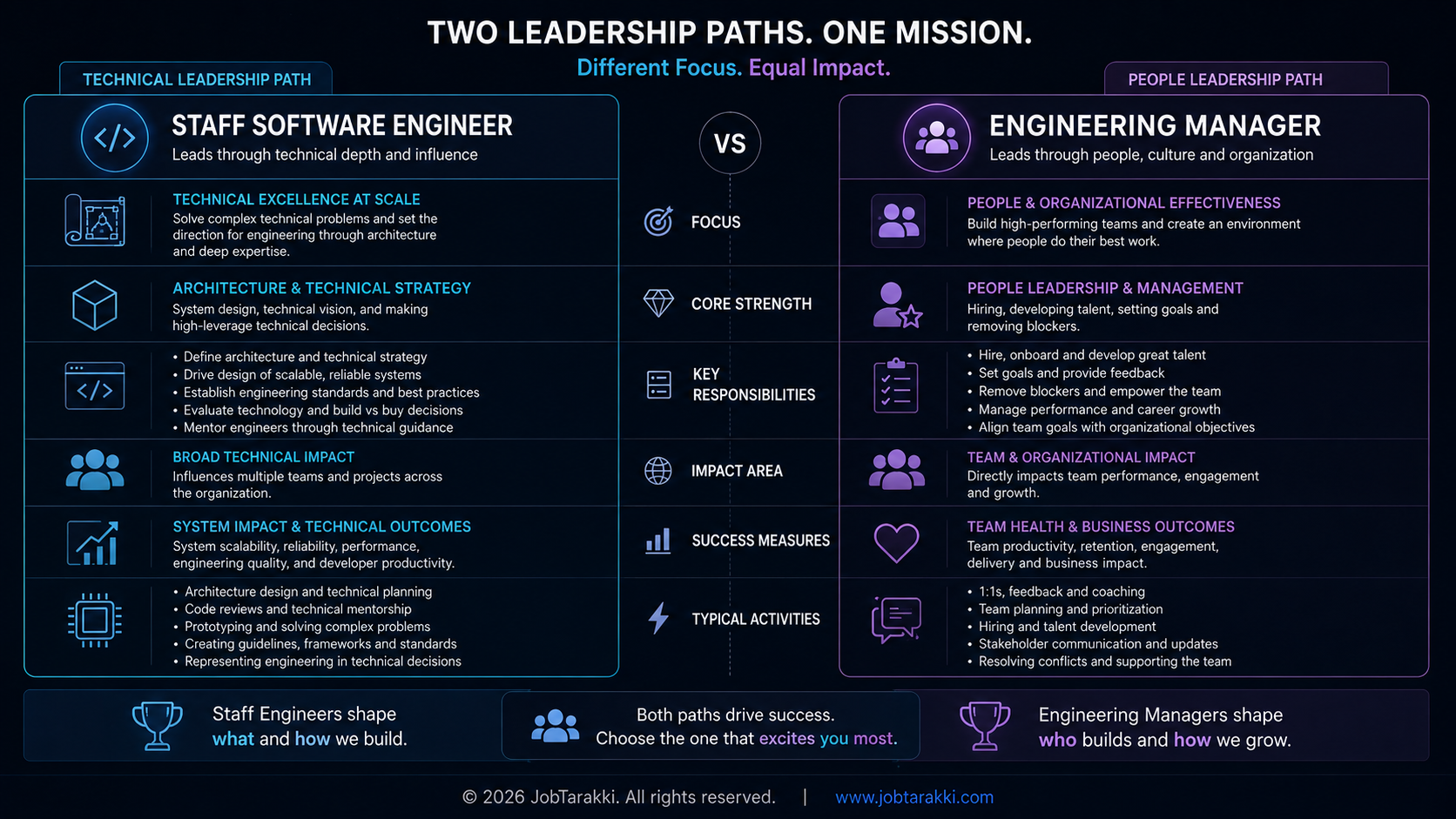
These roles can work closely together but have different primary responsibilities.
| Staff Engineer | Engineering Manager |
|---|---|
| Technical leadership | People leadership |
| Architecture | Team health |
| Technical strategy | Hiring and staffing |
| Engineering standards | Performance management |
| Technical mentoring | Career management |
| Cross-team technical influence | Organizational coordination |
The boundaries vary between companies, but the distinction is useful:
Staff Engineers primarily lead through technical expertise and influence.
Engineering Managers primarily lead through people and organizational responsibility.
Staff Engineer: The Core Idea
The Staff Engineer role is not simply the next title after Senior Engineer.
It represents a different scale of responsibility.
The most important shift is from:
"How do I solve this technical problem?"
to:
"How do we solve this class of problems effectively across the organisation?"
That's why Staff Engineering combines technical depth with architecture, judgment, communication, influence, and leverage.
5. FAQs
What does a Staff Software Engineer do?
A Staff Software Engineer solves complex technical problems, influences architecture and technical strategy, mentors engineers, and drives initiatives that often span multiple teams.
Is a Staff Engineer a manager?
Not necessarily. Staff Engineers are generally individual contributors who provide technical leadership without direct people-management responsibility.
What skills does a Staff Software Engineer need?
Important skills include system design, architecture, technical judgment, communication, influence, mentoring, problem solving, and execution.
Do Staff Engineers still write code?
Yes. The amount of coding varies by company and role. Some Staff Engineers remain highly hands-on, while others spend more time on architecture and technical strategy.
What is the difference between Senior and Staff Engineer?
A Senior Engineer commonly operates with strong ownership within a team or service. A Staff Engineer typically operates across broader technical and organizational boundaries.
Is system design important for Staff Engineers?
Yes. Staff Engineers frequently deal with complex systems and architectural trade-offs, making system design and technical judgment important parts of the role.
Do Staff Engineers need management skills?
They need strong leadership and communication skills, but they don't necessarily need people-management responsibilities.
How does a Staff Engineer create impact?
Staff Engineers create impact through architecture, technical strategy, standards, tooling, mentoring, cross-team initiatives, and solutions that improve engineering effectiveness beyond their immediate team.
Are Staff Engineers more senior than Engineering Managers?
Not necessarily. They are generally different career tracks. A Staff Engineer follows a technical individual-contributor path, while an Engineering Manager follows a people-management path.
What comes after Staff Engineer?
Depending on the company, the next technical level may be Senior Staff Engineer, Principal Engineer, or another equivalent title. Career ladders differ between organizations.
6. Conclusion
A Staff Software Engineer is more than an experienced developer with a larger title.
The role combines technical depth, architecture, judgment, communication, influence, and leverage.
The strongest Staff Engineers don't try to become the person who solves every difficult problem.
They help create systems, decisions, and engineering practices that allow many people to solve difficult problems better.
That is what makes Staff-level engineering different.
Ready to see where you stand?
Take the free JobTarakki Career Check and understand your current career level and next growth areas.