Introduction
For many Indian engineers, a Google offer is still the big goal.
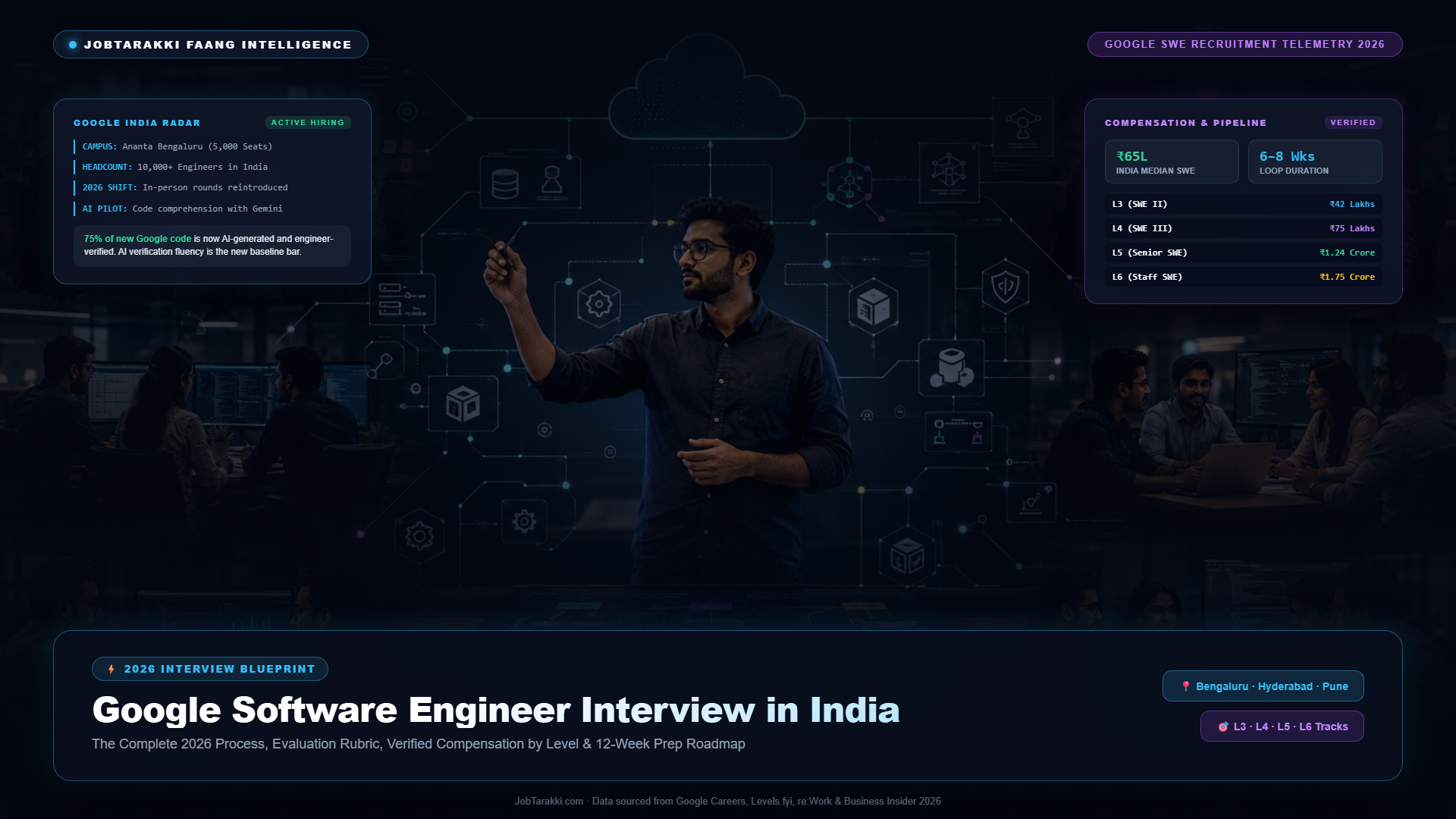
Google has more than 10,000 employees in India, with offices in Bengaluru, Gurugram, Hyderabad, Mumbai and Pune. Its Ananta campus in Bengaluru, opened in February 2025, seats 5,000 people (Business Standard).
But the interview itself is changing.
- In-person rounds are back. In August 2025, Sundar Pichai told employees that some interviews should happen in person, amid concerns about AI cheating in remote interviews (Storyboard18). Google’s interview page now says it has reintroduced in-person interviews for some roles (Google Careers).
- AI is entering the interview, on Google’s terms. Google says 75% of its new code is now AI-generated and approved by engineers (Fast Company). In 2026 it began piloting a “code comprehension” round in which junior and mid-level candidates on select US teams read, debug and improve existing code with Gemini’s help (Business Insider, via NewsBytes). By October the new formats had spread more widely, though Google still calls them a pilot (Business Insider, via DNYUZ).
- Everywhere else, AI is off-limits. Google’s hiring page says AI tools are not permitted during interviews (Google Careers).
The competition is also tougher than most people think. On 3 November 2026, Google’s careers site listed 72 software engineer roles in India. Only 4 were tagged Early (entry level); 29 were Mid and 38 were Advanced (Google Careers).
So the real question is not “can I get lucky?” It is “am I ready for the rounds Google runs today?”
This guide covers the 2026 process step by step, what each round tests, pay by level in India, how to get the interview call, and a 12-week plan to prepare. Every number comes with a source you can check.
The Google Interview Process in 2026, Step by Step
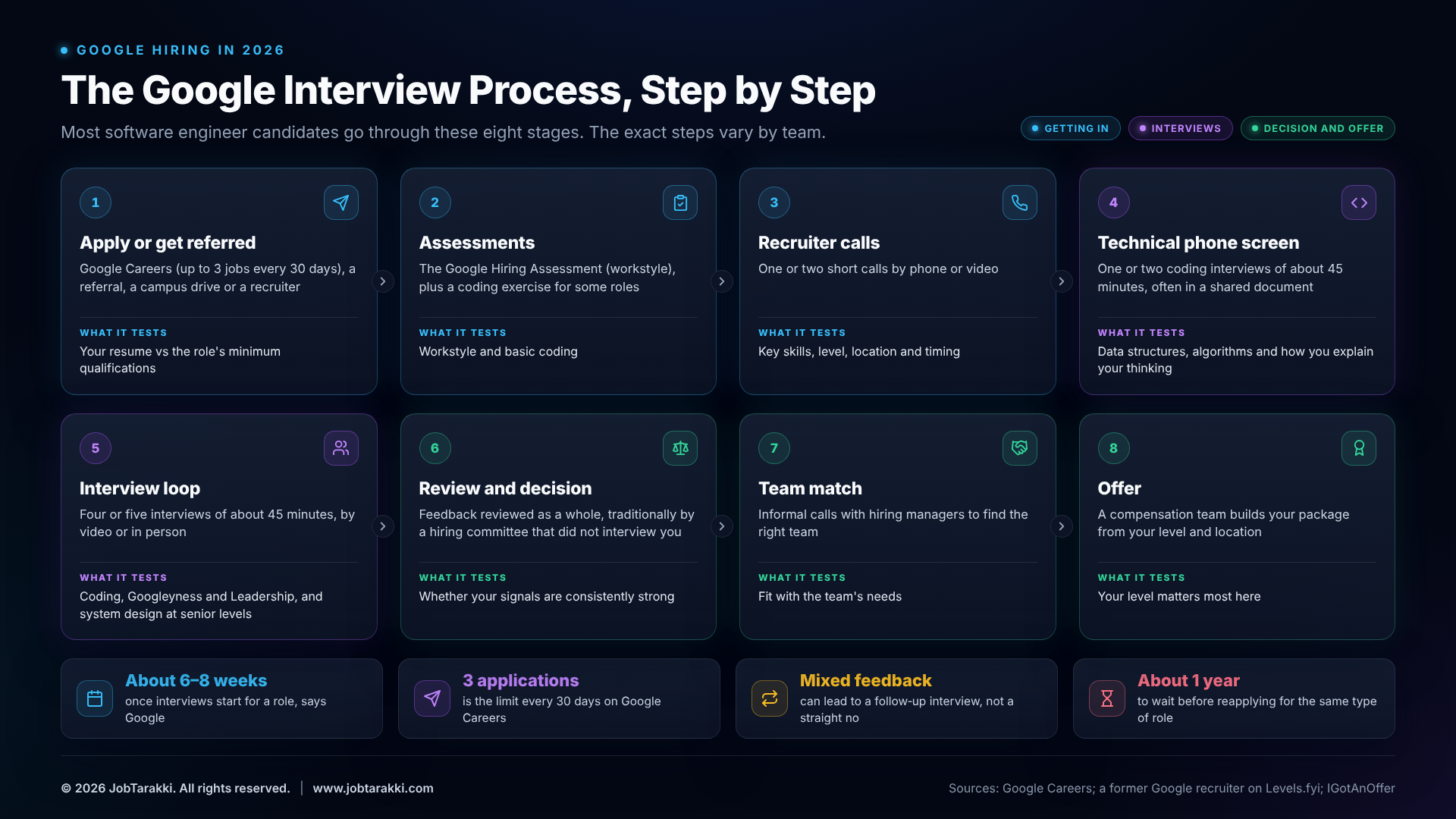
Google says the process usually takes about 6–8 weeks once interviews start for a role (Google Careers). The exact steps vary by team, but most software engineer candidates go through these eight stages.
| Stage | What happens | What it tests |
|---|---|---|
| 1. Apply or get referred | Apply on Google Careers (up to three jobs every 30 days), or come in through a referral, a campus drive or a recruiter who finds you | Whether your resume clearly meets the role’s minimum qualifications |
| 2. Assessments | You may take the Google Hiring Assessment, a workstyle test, and for some roles a coding exercise | Workstyle and basic coding |
| 3. Recruiter calls | One or two short calls by phone or video | Key skills, level, preferred location and timing |
| 4. Technical phone screen | Usually one or two coding interviews of about 45 minutes each, often in a shared document | Data structures and algorithms, and how you explain your thinking |
| 5. Interview loop | Usually four or five interviews of about 45 minutes each, by video or in person | Coding, Googleyness and Leadership, and system design at senior levels |
| 6. Review and decision | Your feedback is reviewed as a whole, traditionally by a hiring committee of people who did not interview you | Whether the signals across rounds are consistently strong |
| 7. Team match | Informal calls with hiring managers to find the right team | Fit between your skills and the team’s needs |
| 8. Offer | A compensation team builds your package from your level and location | Your level matters most here |
Sources: Google Careers, a former Google recruiter writing on Levels.fyi, and IGotAnOffer.
Three details trip up many candidates:
- Mixed feedback is not always a no. If your loop gives mixed signals, Google may ask for a follow-up interview before deciding (Levels.fyi).
- Team match can take time. According to the same former recruiter, interview scores stay valid for a year, so a slow match does not mean starting over.
- A rejection has a cooling-off period. Google usually asks candidates to wait at least a year before reapplying for the same type of role (Google Careers).
What this means for you: prepare for the whole loop before your first recruiter call. Once interviews start, the steps move quickly, and a weak phone screen can end the process early.
What Google Actually Evaluates
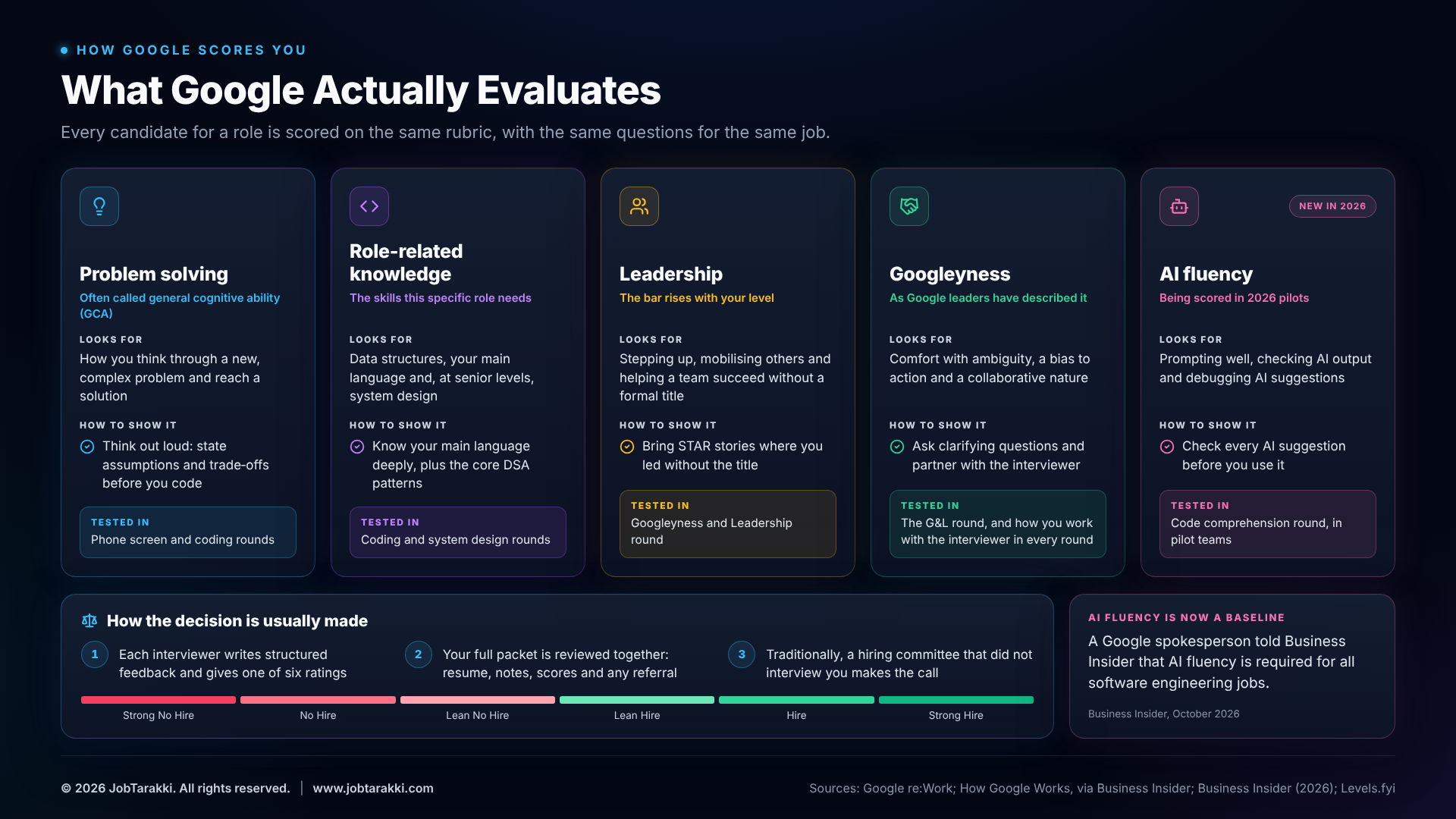
Google scores every candidate for a role against the same rubric, so the bar is set before you walk in. Its re:Work guide says interviewers use the same questions for the same job and standard rubrics to rate the answers (Google re:Work).
These are the qualities that rubric looks for:
| Quality | What interviewers look for | Where it is tested |
|---|---|---|
| Problem solving (often called general cognitive ability, or GCA) | How you think through a new, complex problem and reach a solution | Phone screen and coding rounds |
| Role-related knowledge | The skills the role needs, such as data structures, your main language and, at senior levels, system design | Coding and system design rounds |
| Leadership | Stepping up, mobilising others and helping a team succeed without a formal title; the bar rises with level | Googleyness and Leadership round |
| Googleyness | Comfort with ambiguity, a bias to action and a collaborative nature | Googleyness and Leadership round, and how you work with the interviewer in every round |
| AI fluency (new in 2026) | Prompting well, checking AI output and debugging AI suggestions | Code comprehension round, in pilot teams |
Sources: Google re:Work for the first three; Business Insider, quoting former Google leaders, for Googleyness; and Business Insider’s 2026 reporting (via Moneywise) for AI fluency.
AI fluency is becoming a baseline, not a bonus. A Google spokesperson told Business Insider that it is required for all software engineering jobs (Business Insider, via DNYUZ).
Here is how the decision is usually made:
- Each interviewer writes structured feedback and gives one of six ratings, from Strong No Hire to Strong Hire.
- Your full packet, including your resume, every round’s notes and scores, and any referral, is reviewed together.
- Traditionally, a hiring committee of senior engineers who did not interview you makes the call.
That is how a former Google recruiter describes it on Levels.fyi. Google itself says only that it takes “a number of perspectives” into account (Google Careers).
What this means for you: interviewers score how you think, not just whether you reach the answer. Google’s interview tips say the interviewer is looking at your thought process, so say your assumptions and trade-offs out loud (Google Careers).
The Coding Rounds: What to Expect
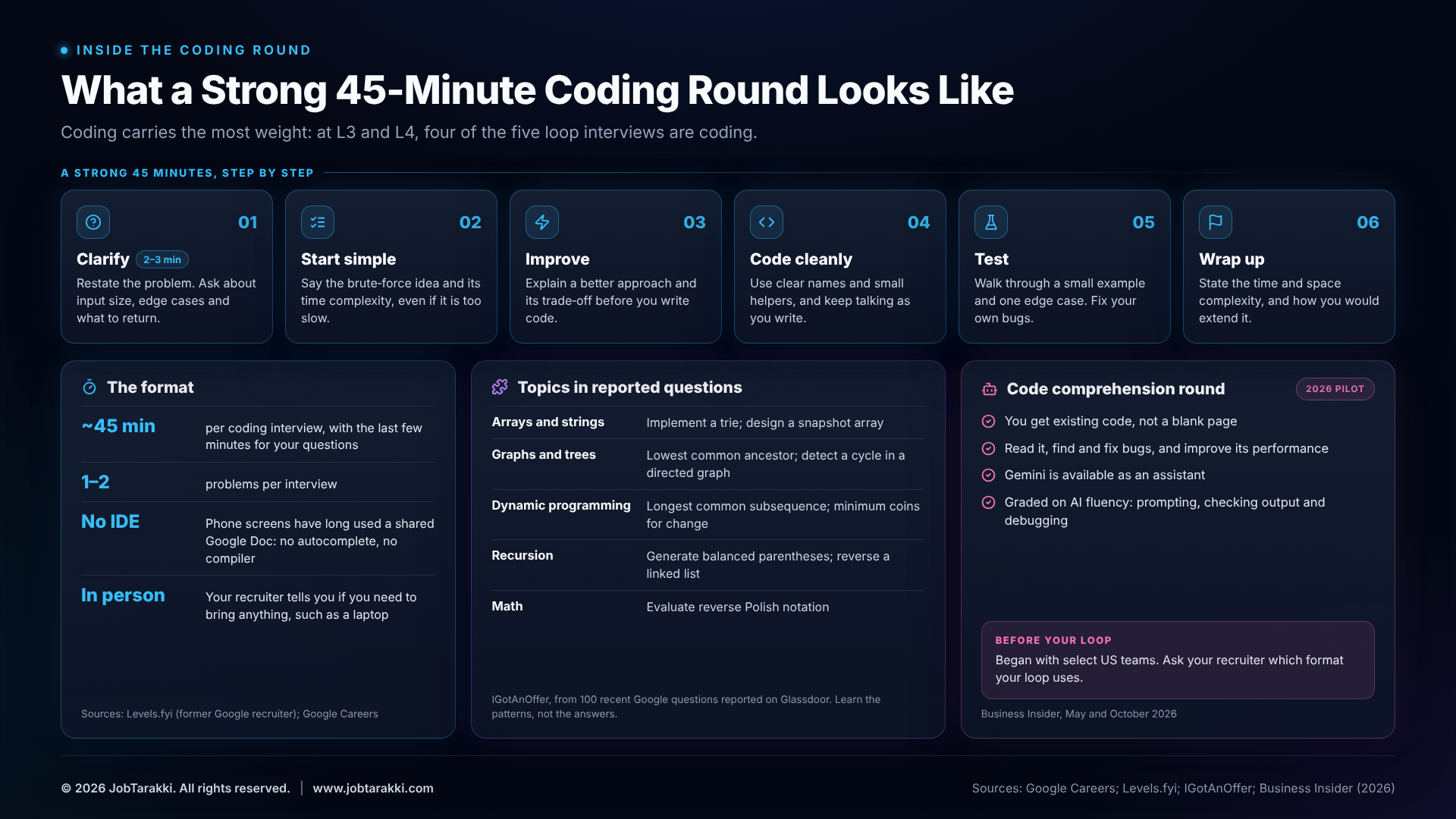
Coding carries the most weight in a Google software engineer loop. At L3 and L4, a typical loop has four data structures and algorithms rounds and one Googleyness and Leadership round (Levels.fyi).
The format. Each coding interview lasts about 45 minutes. You usually get one or two problems, and the last few minutes are for your questions. For years, phone screens have used a shared Google Doc, so there is no autocomplete and no compiler to catch your mistakes (Levels.fyi). For in-person rounds, Google says your recruiter will tell you if you need to bring anything, such as a laptop (Google Careers).
The topics. IGotAnOffer analysed 100 recent Google software engineer questions reported on Glassdoor and grouped them into five topics (IGotAnOffer):
| Topic | Example questions reported |
|---|---|
| Arrays and strings | Implement a trie for prefix matching; design a snapshot array |
| Graphs and trees | Find the lowest common ancestor of two nodes; detect a cycle in a directed graph |
| Dynamic programming | Find the longest common subsequence of two strings; find the minimum coins to make change |
| Recursion | Generate all balanced parentheses; reverse a linked list |
| Math | Evaluate an expression in reverse Polish notation |
Treat these as a guide, not a promise. Google says it asks open-ended questions and no brainteasers (Google Careers), so learn the patterns behind these problems, not the answers.
What a strong answer sounds like. Google’s interview tips say many questions leave room for clarification, and that interviewers watch your thought process more than the final answer (Google Careers). In practice, a strong 45 minutes looks like this:
- Clarify (2–3 minutes). Restate the problem. Ask about input size, edge cases and what to return.
- Start simple. Say the brute-force idea and its time complexity, even if you know it is too slow.
- Improve. Explain the better approach and its trade-off before you write any code.
- Code cleanly. Use clear names and small helper functions, and keep talking as you write.
- Test. Walk through a small example and one edge case. Find and fix your own bugs.
- Wrap up. State the final time and space complexity, and how you would extend the solution.
The new code comprehension round. In the 2026 pilot, this round gives you an existing codebase instead of a blank page. You read it, find and fix bugs, and improve its performance, with Gemini available as an assistant (Business Insider, via NewsBytes). Interviewers grade your AI fluency: how well you prompt, check the AI’s output and debug its suggestions (Business Insider, via Moneywise). The pilot began with select US teams, and Google has not said when or whether it will reach India. Ask your recruiter which format your loop uses.
What this means for you: practise in a plain document, out loud, with a 45-minute timer. And spend part of your prep reading and fixing code you did not write.
System Design and Googleyness Rounds: What Changes by Level
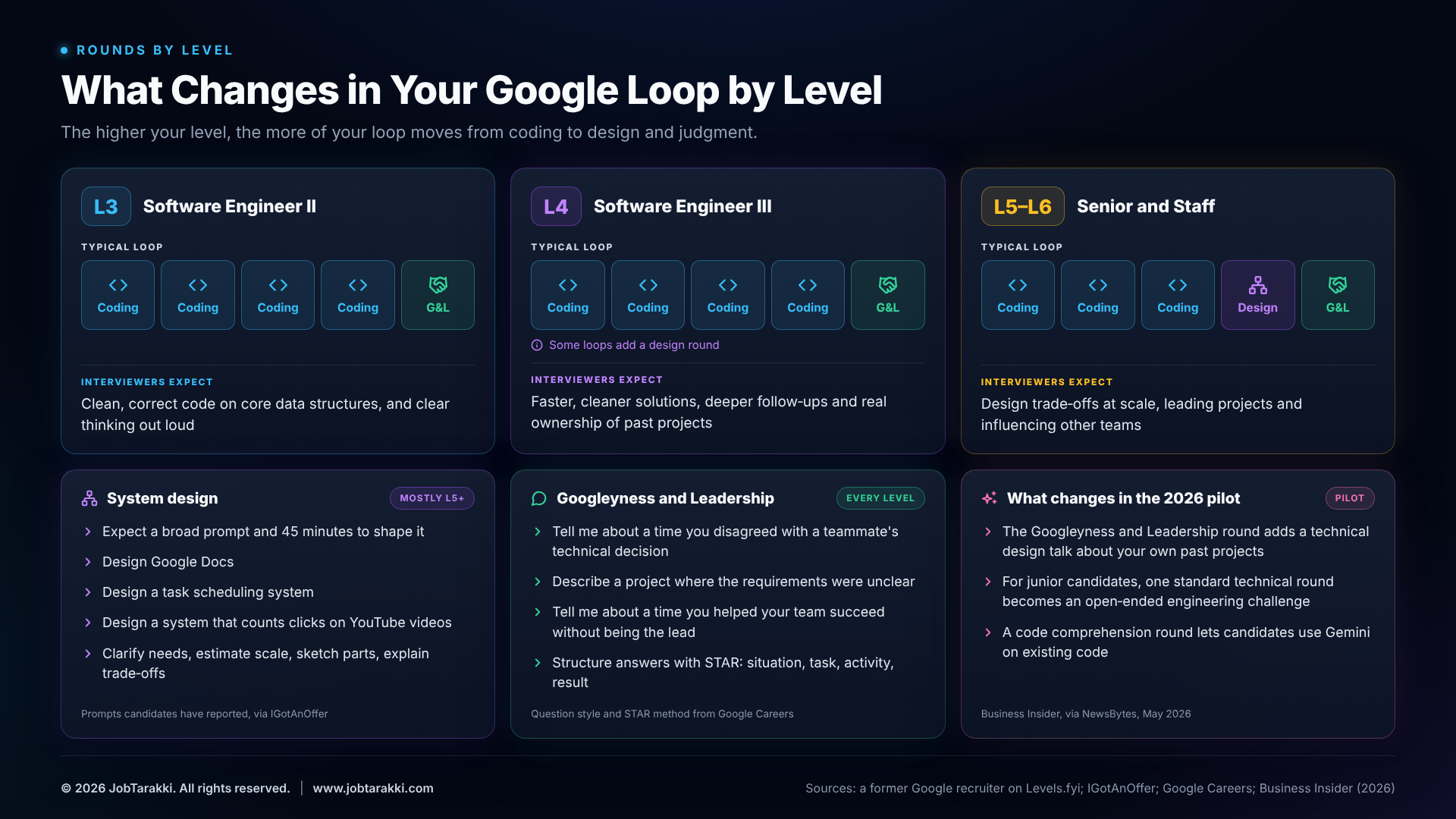
The higher your level, the more of your loop moves from coding to design and judgment.
| Level | Typical loop | What interviewers expect |
|---|---|---|
| L3 (Software Engineer II) | Coding rounds plus one Googleyness and Leadership round | Clean, correct code on core data structures, and clear thinking out loud |
| L4 (Software Engineer III) | Coding rounds plus one Googleyness and Leadership round; some loops add a design round | Faster, cleaner solutions, deeper follow-ups and real ownership of past projects |
| L5–L6 (Senior and Staff) | Three coding rounds, one system design round and one Googleyness and Leadership round | Design trade-offs at scale, leading projects and influencing other teams |
Sources: a former Google recruiter on Levels.fyi for the loop structure, and IGotAnOffer, which notes that some mid-level loops add a design round.
System design (mostly L5 and above). Expect a broad prompt and 45 minutes to shape it. Questions candidates have reported include designing Google Docs, a task scheduling system and a system that counts clicks on YouTube videos (IGotAnOffer). A strong answer clarifies requirements, estimates scale, sketches the main components and explains its trade-offs. There is no single right design.
Googleyness and Leadership (every level). This is Google’s behavioral round. Google’s interview tips say many questions start with “Tell me about a time when…”, and suggest the STAR method (situation, task, activity, result) to structure your answers (Google Careers). Prepare for questions like these:
- Tell me about a time you disagreed with a teammate’s technical decision. What did you do?
- Describe a project where the requirements were unclear. How did you move forward?
- Tell me about a time you helped your team succeed without being the official lead.
- What is a mistake you made at work, and what did you change afterwards?
What changes in the 2026 pilot. The Googleyness and Leadership round now includes a technical design conversation about projects you have worked on. For junior candidates, one standard technical round is replaced by a more open-ended engineering challenge (Business Insider, via NewsBytes).
What this means for you: write down six to eight real stories before you apply, each with numbers, and be ready to go deep on the design of at least two of your own projects. If you are applying for L5 or above, practise full 45-minute designs out loud.
Google Levels and Pay in India
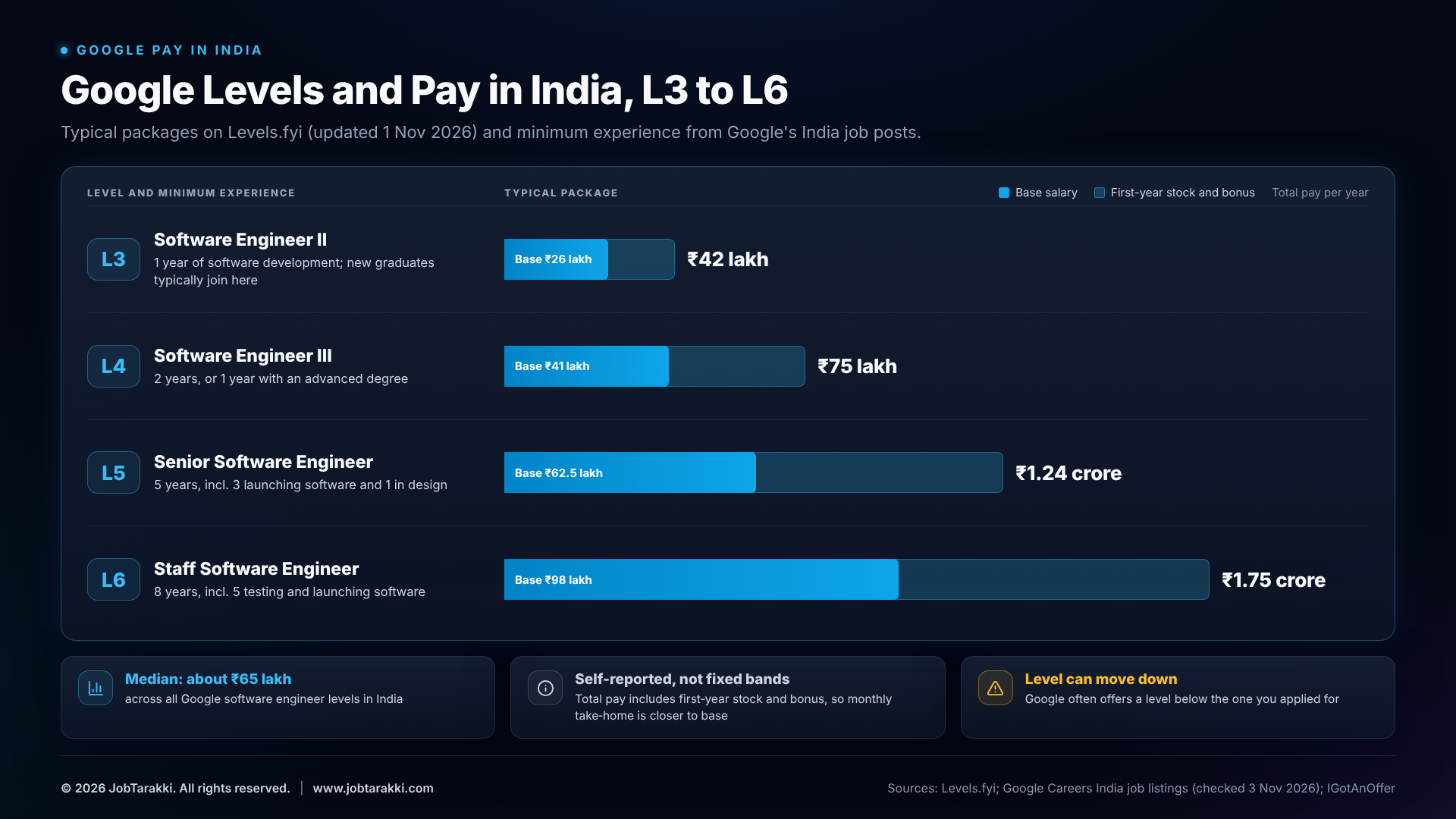
Your level decides your pay band, your interview loop and what is expected of you from day one. Here is how the main software engineer levels compare in India.
| Level (title) | Minimum experience in Google’s India job posts | Total pay per year | Base salary |
|---|---|---|---|
| L3 (Software Engineer II) | 1 year of software development; new graduates are typically hired at this level | About ₹42 lakh | About ₹26 lakh |
| L4 (Software Engineer III) | 2 years, or 1 year with an advanced degree | About ₹75 lakh | About ₹41 lakh |
| L5 (Senior Software Engineer) | 5 years, including 3 years launching software and 1 year of design and architecture | About ₹1.24 crore | About ₹62.5 lakh |
| L6 (Staff Software Engineer) | 8 years, including 5 years testing and launching software | About ₹1.75 crore | About ₹98 lakh |
Sources: minimum experience from Google’s India job listings on Google Careers, checked on 3 November 2026; pay from Levels.fyi, updated 1 November 2026. Across all levels, Levels.fyi puts the median for Google software engineers in India at about ₹65 lakh a year.
Treat these as typical packages, not fixed bands. Levels.fyi figures are self-reported, and total pay includes first-year stock and bonus, so your monthly take-home is closer to the base salary. Google also often offers a level below the one you applied for (IGotAnOffer).
What this means for you: before your first recruiter call, decide which level you are really ready for, using the minimum experience above. Then prepare for that level’s loop.
Want to see how your pay compares? Use JobTarakki Salary Intelligence to benchmark your current salary against your target role before you talk numbers.
How to Get the Google Interview Call
Your resume is the first filter. Google reviews it against the role’s minimum qualifications, so make the match obvious (Google Careers).
Four ways in
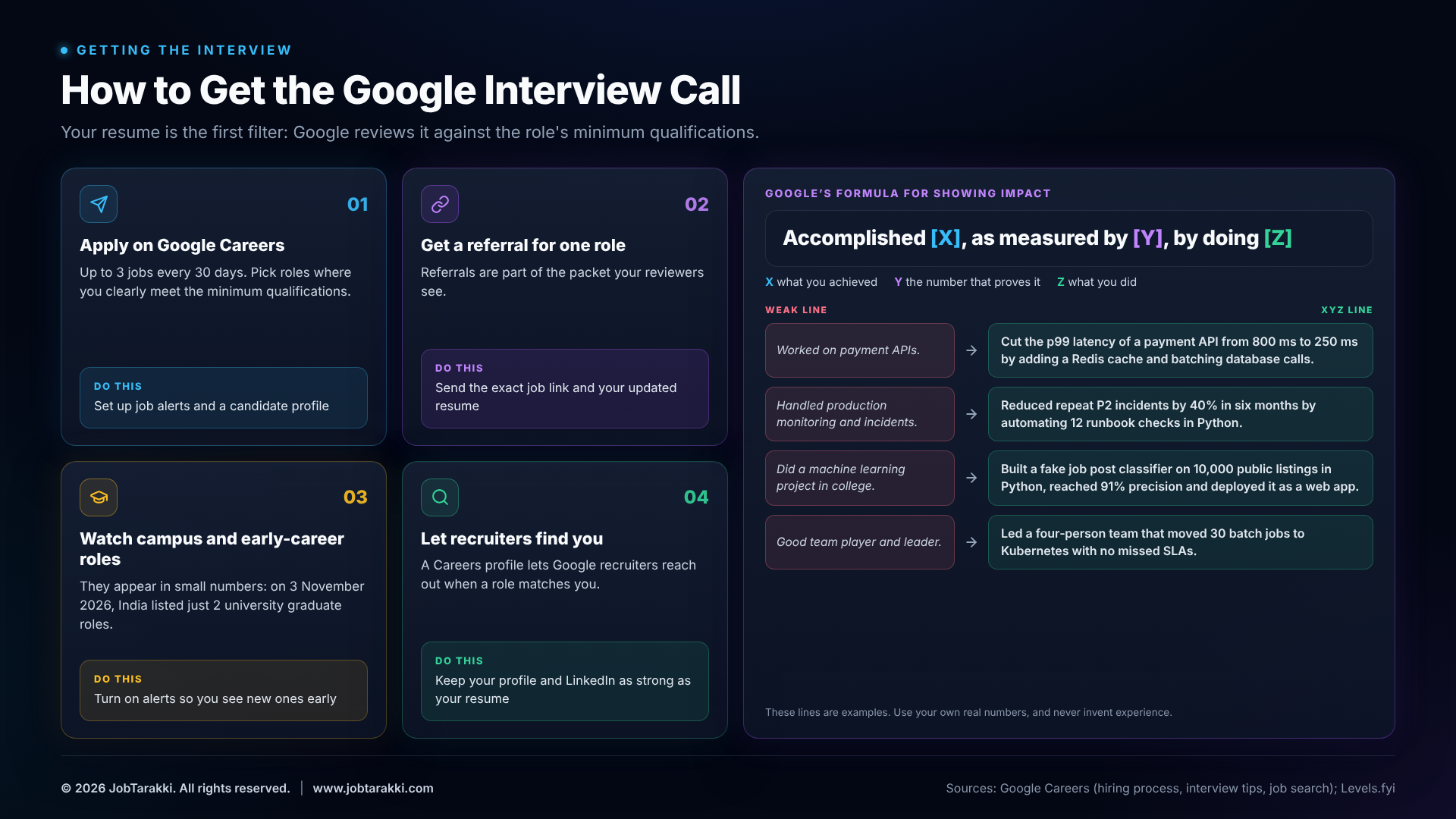
- Apply on Google Careers. You can apply for up to three jobs every 30 days, so pick roles where you clearly meet the minimum qualifications. Set up job alerts and a candidate profile so Google can match you to new roles (Google Careers).
- Ask for a referral for a specific role. Referrals are part of the packet your reviewers see (Levels.fyi). Send the person referring you the exact job link and your updated resume.
- Watch for campus and early-career roles. These appear in small numbers. On 3 November 2026, Google’s India listings had just two university graduate roles and a handful of PhD early-career roles (Google Careers), so job alerts matter.
- Let recruiters find you. Google says a candidate profile lets its recruiters reach out when a role matches you (Google Careers). Keep that profile and your LinkedIn up to date with the same proof that is on your resume.
Write resume lines Google can measure
Google’s resume advice is short: tailor your resume to each job, show clearly how you meet the minimum qualifications, be specific about projects and outcomes, include data and keep it short. Cover letters are not required (Google Careers). To show impact with data, Google suggests a simple formula: Accomplished [X], as measured by [Y], by doing [Z] (Google Careers).
| Weak line | XYZ line |
|---|---|
| Worked on payment APIs. | Cut the p99 latency of a payment API from 800 ms to 250 ms by adding a Redis cache and batching database calls. |
| Handled production monitoring and incidents. | Reduced repeat P2 incidents by 40% in six months by automating 12 runbook checks in Python. |
| Did a machine learning project in college. | Built a fake job post classifier on 10,000 public listings in Python, reached 91% precision and deployed it as a web app. |
| Good team player and leader. | Led a four-person team that moved 30 batch jobs to Kubernetes with no missed SLAs. |
The numbers above are examples. Use your own real numbers, and never invent experience.
What this means for you: apply to fewer, better-matched roles, and make every resume line prove one thing with a number.
Wondering how your resume reads for a Google role? Use the JobTarakki Resume Analyzer to check it against your target role before you apply.
Case Study: Two Candidates, Same Experience, Different Results
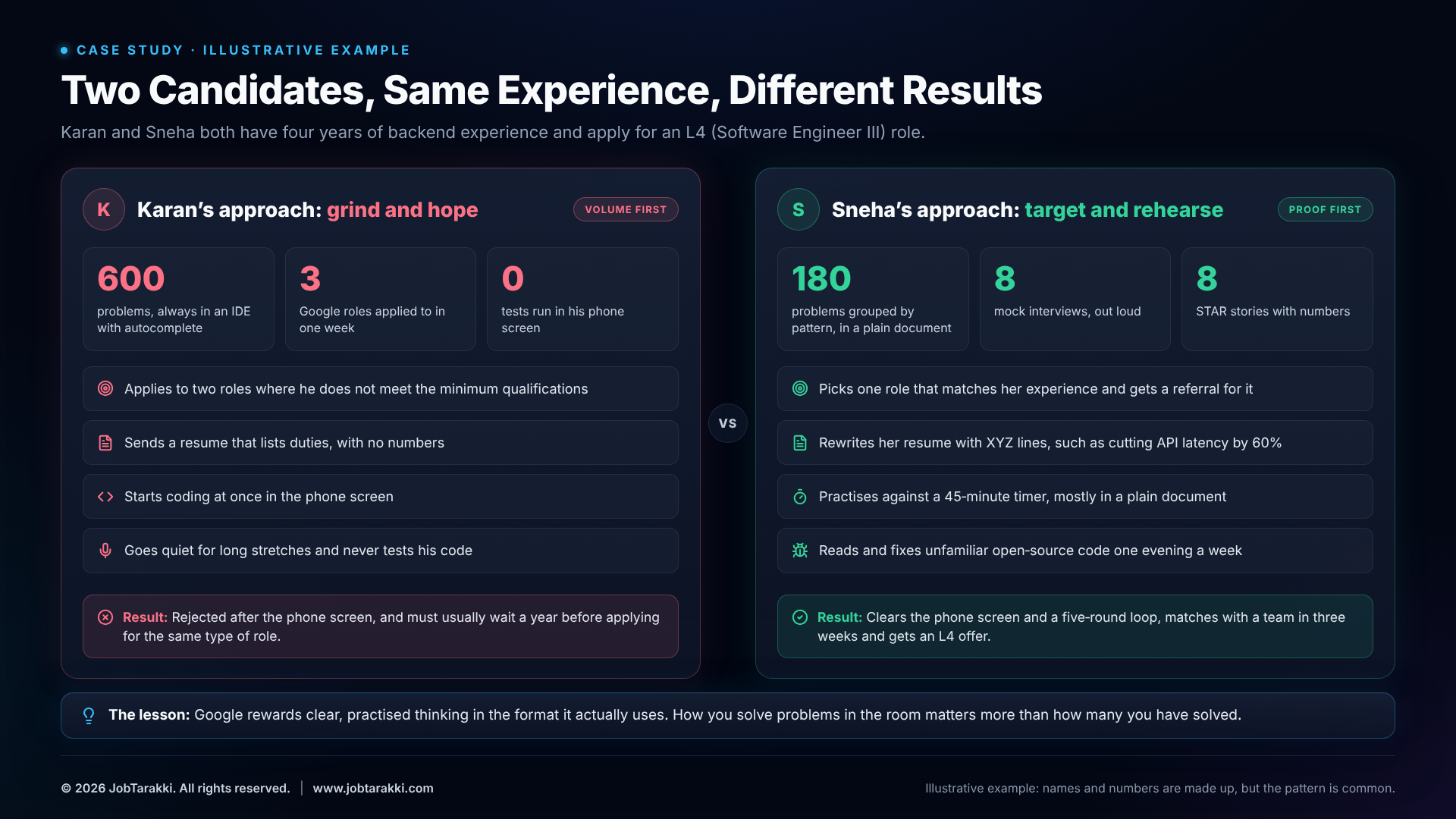
The gap between a rejection and an offer at Google is usually preparation, not talent. Here is an illustrative example. The names and numbers are made up, but the pattern is common.
Karan and Sneha both have four years of backend experience at Bengaluru companies, and both apply for an L4 (Software Engineer III) role.
Karan’s approach: grind and hope
- Solves 600 problems on a practice site, always in an IDE with autocomplete.
- Applies to three Google roles in one week, including two where he does not meet the minimum qualifications.
- Sends a resume that lists duties (“responsible for APIs and monitoring”) with no numbers.
- In the phone screen, starts coding at once, goes quiet for long stretches and never tests his code.
- Result: rejected after the phone screen, and he must usually wait a year before applying for the same type of role.
Sneha’s approach: target and rehearse
- Picks one role that matches her experience and gets a referral for that exact job.
- Rewrites her resume with XYZ lines, such as cutting an API’s latency by 60% with caching.
- Solves 180 problems grouped by pattern, mostly in a plain document with a 45-minute timer.
- Does eight mock interviews out loud and writes eight STAR stories with numbers.
- Spends one evening a week reading and fixing unfamiliar open-source code, in case her loop includes code comprehension.
- Result: clears the phone screen and a five-round loop, matches with a team in three weeks and gets an L4 offer.
The lesson: Google rewards clear, practised thinking in the format it actually uses. How you solve problems in the room matters more than how many you have solved.
The 12-Week Google Interview Prep Plan
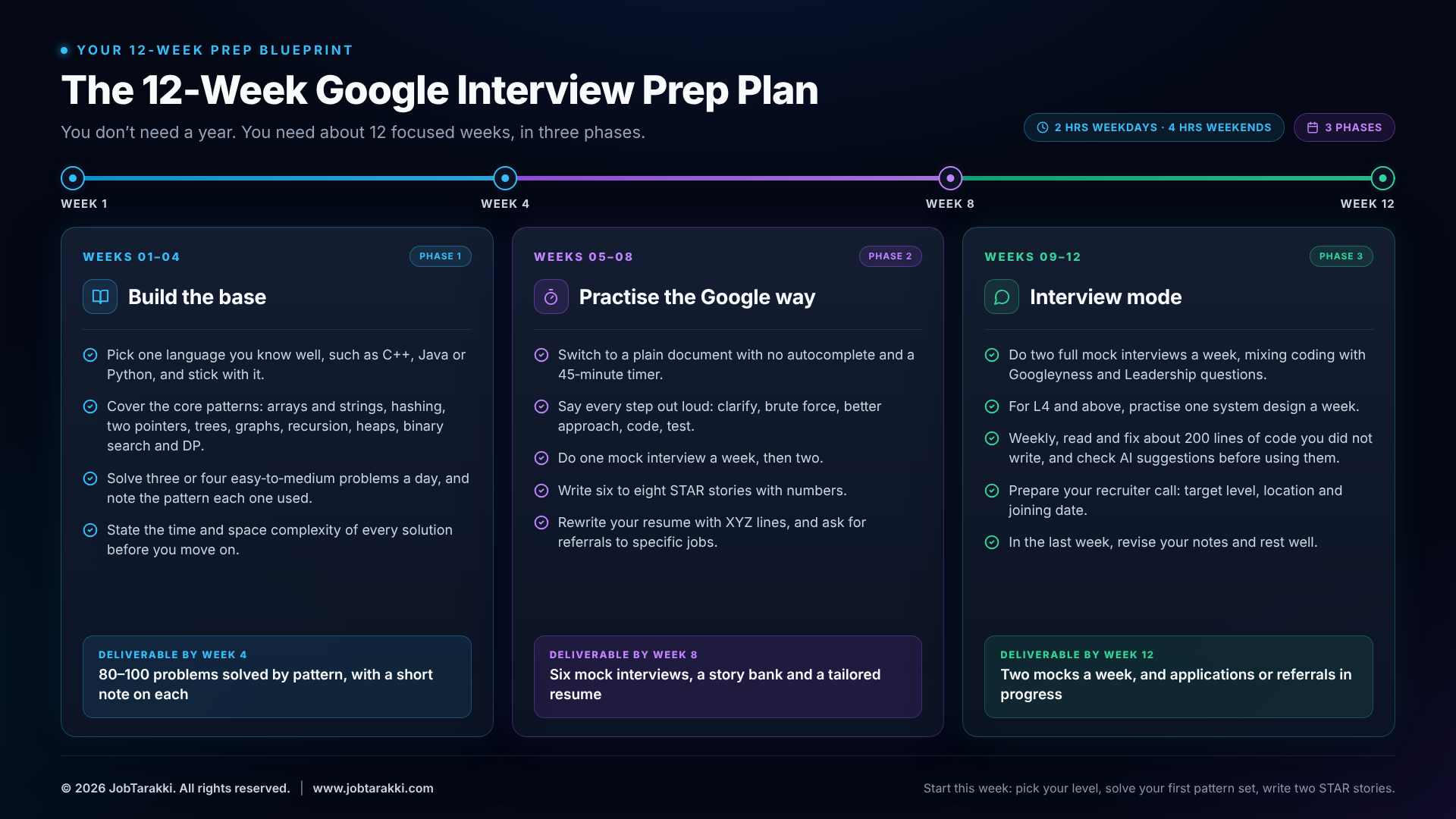
You don’t need a year. You need about 12 focused weeks, at roughly two hours on weekdays and four on weekends, in three phases.
| Phase | Focus | Deliverable by the end |
|---|---|---|
| Weeks 1–4 | Build the base: one language, core patterns and complexity | 80–100 problems solved by pattern, with a short note on each |
| Weeks 5–8 | Practise the Google way: timed, out loud, in a plain document | Six mock interviews, a story bank and a tailored resume |
| Weeks 9–12 | Interview mode: full mock loops, design and code reading | Two mocks a week, and applications or referrals in progress |
Weeks 1–4: Build the base
- Pick one language you know well, such as C++, Java or Python, and stick with it.
- Cover the core patterns: arrays and strings, hashing, two pointers and sliding window, stacks and queues, trees, graphs (BFS and DFS), recursion and backtracking, heaps, binary search and dynamic programming.
- Solve three or four easy-to-medium problems a day, and write one line on the pattern each problem used.
- For every solution, state the time and space complexity before you move on.
Weeks 5–8: Practise the Google way
- Switch to a plain document with no autocomplete, and solve medium problems against a 45-minute timer.
- Say every step out loud: clarify, brute force, better approach, code, test.
- Do one mock interview a week, then two, with a friend or on a peer practice platform.
- Write six to eight STAR stories with numbers: a conflict, a failure, a project with unclear requirements and a time you led without the title.
- Rewrite your resume with XYZ lines, and ask for referrals to specific job links.
Weeks 9–12: Interview mode
- Do two full mock interviews a week, mixing coding with Googleyness and Leadership questions.
- For L4 and above, practise one system design a week: requirements, scale, components and trade-offs.
- Once a week, read and fix about 200 lines of code you did not write, and practise checking AI suggestions instead of accepting them.
- Prepare for your recruiter call: your target level, preferred location and the joining date you can manage.
- In the last week, revise your pattern notes, and rest well before the interview day.
Common Mistakes That Sink Strong Candidates
These habits can sink an otherwise strong candidate. Each one has a simple fix.
| Mistake | Why it hurts | The fix |
|---|---|---|
| Coding before clarifying | You may solve the wrong problem, and you lose the chance to show how you think | Restate the problem and ask about input size and edge cases first |
| Going silent while coding | The interviewer can only score the thinking they can hear | Explain each step and decision as you go |
| Not testing your code | Bugs you leave behind count against you | Walk through one normal example and one edge case before you say “done” |
| Practising only in an IDE | Google’s coding rounds often give you no autocomplete or compiler | Do most of your practice in a plain document |
| Generic behavioral answers | Google wants specific examples, not “I always do X” | Prepare STAR stories with real numbers |
| Applying to every role you see | You can apply to only three jobs every 30 days | Pick roles where you clearly meet the minimum qualifications |
| Using AI or search in a normal round | Google does not permit AI tools during interviews | Use AI only if your recruiter says the round is AI-assisted |
Sources: Google’s hiring process and interview tips pages for its rules and advice, and Levels.fyi for the shared-document format.
Google Interview Readiness Scorecard
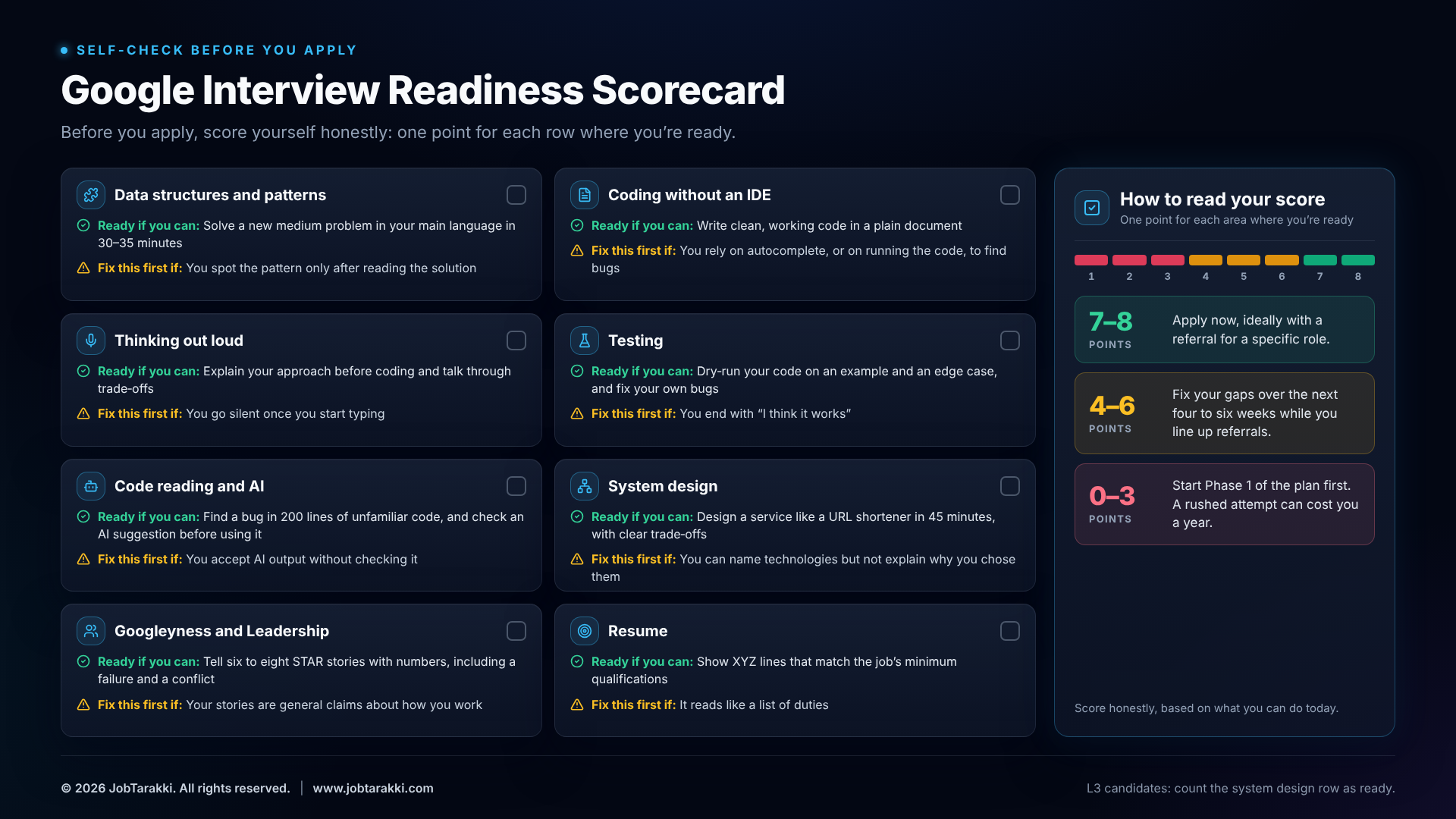
Before you apply, score yourself honestly. Give yourself one point for each row where you are ready.
| Area | You’re ready if you can… | Fix this first if… |
|---|---|---|
| Data structures and patterns | Solve a new medium problem in your main language in 30–35 minutes | You spot the pattern only after reading the solution |
| Coding without an IDE | Write clean, working code in a plain document | You rely on autocomplete, or on running the code, to find bugs |
| Thinking out loud | Explain your approach before coding and talk through trade-offs | You go silent once you start typing |
| Testing | Dry-run your code on an example and an edge case, and fix your own bugs | You end with “I think it works” |
| Code reading and AI | Find a bug in 200 lines of unfamiliar code, and check an AI suggestion before using it | You accept AI output without checking it |
| System design (L3 candidates: count this row as ready) | Design a service like a URL shortener in 45 minutes, with clear trade-offs | You can name technologies but not explain why you chose them |
| Googleyness and Leadership | Tell six to eight STAR stories with numbers, including a failure and a conflict | Your stories are general claims about how you work |
| Resume | Show XYZ lines that match the job’s minimum qualifications | It reads like a list of duties |
How to read your score:
- 7–8 points: apply now, ideally with a referral for a specific role.
- 4–6 points: fix your gaps over the next four to six weeks while you line up referrals.
- 0–3 points: start Phase 1 of the plan above before you apply. A rushed attempt can cost you a year, because Google usually asks you to wait that long before reapplying for the same type of role.
Conclusion: Prepare for the Interview Google Runs Today
Google’s interview in 2026 keeps its core: coding without shortcuts, structured rubrics and a behavioral round. What is new is in-person rounds for some roles, a design conversation inside the Googleyness and Leadership round, and an AI-assisted code comprehension round in pilot teams.
You can’t control how many roles are open or how many people apply. You can control three things:
- The role you target: one level, and a few roles where you clearly meet the minimum qualifications.
- How you practise: timed, out loud, in a plain document, with mock interviews and real STAR stories.
- The proof you show: XYZ resume lines with real numbers, and projects you can explain in depth.
Start this week. Pick your target level, solve your first pattern set and write your first two STAR stories.
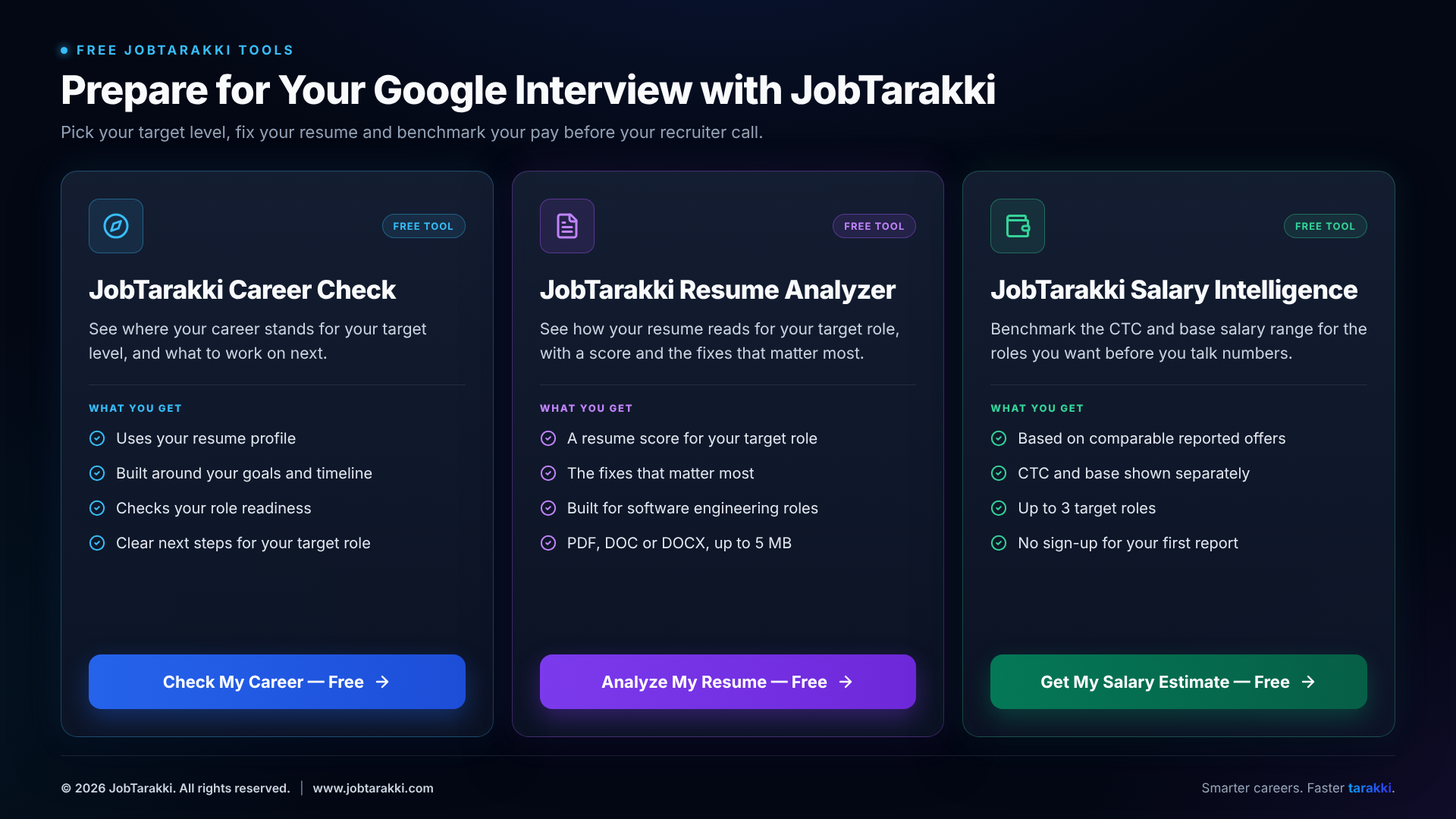
Ready to see where you stand? Use JobTarakki Career Check to see where your career stands, check your resume against your target role with the Resume Analyzer, and benchmark your pay with Salary Intelligence.
Sources
All links checked on 3 November 2026.
- Our hiring process — Google Careers
- Interviewing at Google: Best practices, advice, and tips — Google Careers
- Software engineer jobs in India — Google Careers job search, checked 3 November 2026
- Early-career jobs in India — Google Careers job search, checked 3 November 2026
- A guide to structured interviewing for better hiring practices — Google re:Work
- Google opens Ananta campus in Bengaluru, one of its largest globally — Business Standard, February 2025
- Google to reintroduce in-person interviews amid rising AI cheating concerns — Storyboard18, August 2025
- Google CEO says 75% of the company’s code is AI-generated — Fast Company, April 2026
- Google will let software engineers use AI during job interviews — NewsBytes, reporting Business Insider, May 2026
- ‘Like asking a kid to take a math test without a calculator’: Google will let candidates use AI in interviews — Moneywise on Yahoo Finance, reporting Business Insider, May 2026
- Internal docs reveal how Google is shaking up its interview process with AI — Business Insider, via DNYUZ, October 2026
- Google’s Interview Process for Software Engineers — Levels.fyi, by a former Google recruiter, December 2020
- Google Software Engineer salaries in India — Levels.fyi, updated 1 November 2026
- Google software engineer interview guide — IGotAnOffer
- Here’s exactly what Google grades interviewees on when it’s hiring — Business Insider India, quoting Eric Schmidt and Jonathan Rosenberg’s How Google Works