Introduction
If you are a fresher looking for your first IT job in India right now, you are hearing two stories at once.
One says hiring is back. The other says there are no jobs for freshers.
Both are true.
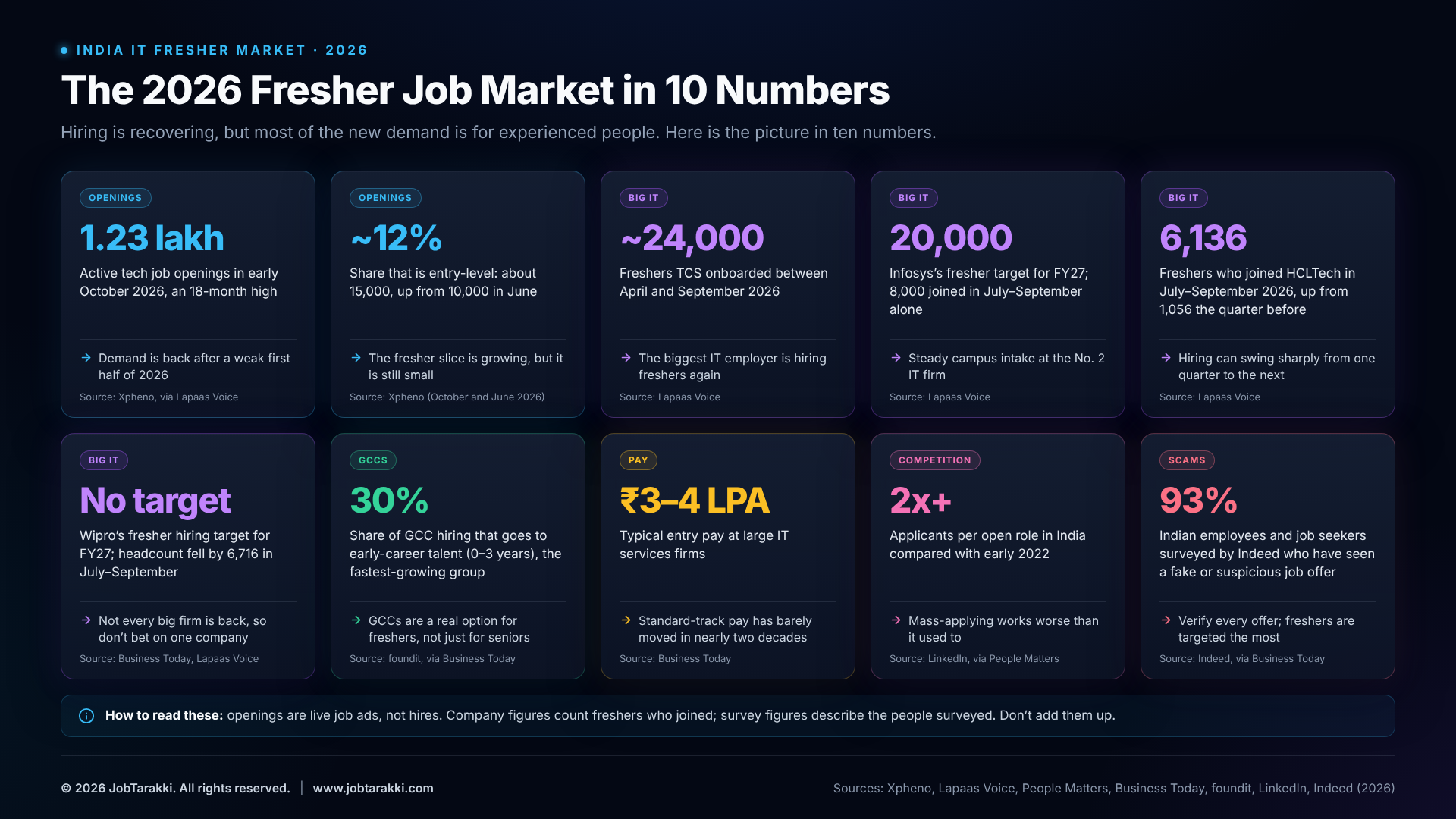
In early October 2026, India had about 1.23 lakh active tech job openings, the highest in 18 months, according to staffing firm Xpheno. TCS brought in about 24,000 freshers between April and September 2026, and Infosys is sticking to its target of 20,000 for the year.
But only about 15,000 of those 1.23 lakh openings, roughly 12%, were entry-level roles. Starting pay at large IT services firms is still around ₹3–4 lakh a year. And 93% of Indian employees and job seekers surveyed by Indeed said they had come across a fake or suspicious job offer.
So the market is not closed. It is choosier.
This guide gives you the real numbers, where the openings are, how to spot fake offers, and a 90-day plan to land your first IT job. Every number comes with its source, so you can check it yourself.
The 2026 Fresher Job Market in 10 Numbers
Hiring is recovering, but most of the new demand is for experienced people. Here is the picture in ten numbers.
| Number | What it measures | What it means for you |
|---|---|---|
| 1.23 lakh | Active tech job openings in early October 2026, an 18-month high (Xpheno, via Lapaas Voice) | Demand is back after a weak first half of 2026 |
| ~12% | Share of those openings that are entry-level: about 15,000, up from 10,000 in June (Xpheno, via Lapaas Voice and People Matters) | The fresher slice is growing, but it is still small |
| ~24,000 | Freshers TCS onboarded between April and September 2026 (Lapaas Voice) | The biggest IT employer is hiring freshers again |
| 20,000 | Infosys's fresher target for FY27; 8,000 joined in July–September alone (Lapaas Voice) | Steady campus intake at the No. 2 IT firm |
| 6,136 | Freshers who joined HCLTech in July–September 2026, up from 1,056 the quarter before (Lapaas Voice) | Hiring can swing sharply from one quarter to the next |
| No target | Wipro's fresher hiring target for FY27; its headcount fell by 6,716 in July–September (Business Today, Lapaas Voice) | Not every big firm is back, so don't bet on one company |
| 30% | Share of GCC hiring that goes to early-career talent (0–3 years), the fastest-growing group (foundit, via Business Today) | GCCs are a real option for freshers, not just for seniors |
| ₹3–4 LPA | Typical entry pay at large IT services firms (Business Today) | Standard-track pay has barely moved in nearly two decades |
| 2x+ | Applicants per open role in India compared with early 2022 (LinkedIn, via People Matters) | Mass-applying works worse than it used to |
| 93% | Indian employees and job seekers surveyed by Indeed who have come across a fake or suspicious job offer (Business Today) | Verify every offer; freshers are targeted the most |
A quick note on reading these: openings are a snapshot of live job ads, not people hired. Company figures count freshers who joined, and survey figures describe the people surveyed. They measure different things, so don't add them up.
Why Fresher Hiring Got Harder
Four shifts explain why the job hunt feels tougher than it did for your seniors.
1. Big IT now hires to demand, not by habit
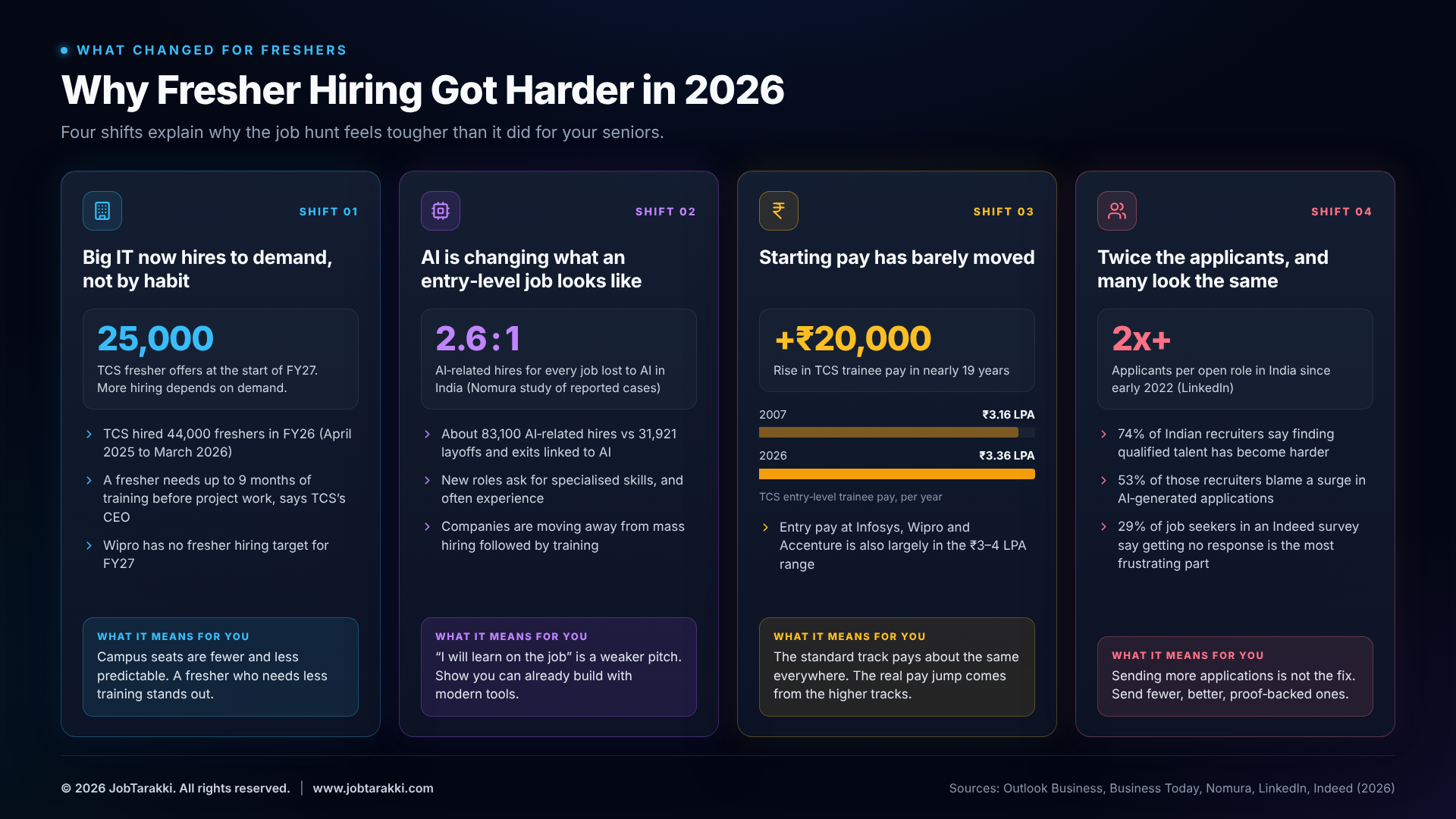
TCS hired 40,000 or more freshers every year for at least three years, including 44,000 in FY26 (April 2025 to March 2026), according to Outlook Business.
TCS started FY27 with 25,000 offers and said more hiring depends on demand. Its CEO explained why: a fresher needs up to nine months of training before working on a project, while an experienced hire can deliver right away.
Wipro went further. It said it has no fresher hiring target for FY27, and its headcount fell by 6,716 in July–September 2026.
What this means for you: campus seats are fewer and less predictable. A fresher who needs less training stands out.
2. AI is changing what an entry-level job looks like
AI is creating jobs in India, but not the same jobs it removes. A Nomura study of reported company cases counted about 83,100 AI-related hires in India against 31,921 layoffs and exits linked to AI. That is roughly 2.6 hires for every job lost.
The catch: the new roles ask for specialised skills, and often experience. The report notes that companies are moving away from mass hiring followed by training.
What this means for you: “I will learn on the job” is a weaker pitch than before. Show that you can already build things with modern tools.
3. Starting pay has barely moved
At TCS, the entry-level trainee role paid about ₹3.16 lakh a year in 2007. In 2026, it pays about ₹3.36 lakh, a rise of ₹20,000 in nearly 19 years, as Business Today reported. Entry pay at Infosys, Wipro and Accenture is also largely in the ₹3–4 LPA range.
What this means for you: the standard track pays about the same everywhere. The real pay jump comes from the higher tracks, covered below.
4. Twice the applicants, and many of them look the same
LinkedIn found that applicants per open role in India have more than doubled since early 2022. Yet 74% of Indian recruiters say finding qualified talent has become harder.
Why both at once? Among recruiters who say hiring got harder, 53% blame a surge in AI-generated applications.
The result is the silence many freshers know well. In an Indeed survey, 29% of job seekers said getting no response after applying is the most frustrating part of hiring.
What this means for you: sending more applications is not the fix. Sending fewer, better, proof-backed applications is.
Where the Openings Are in 2026
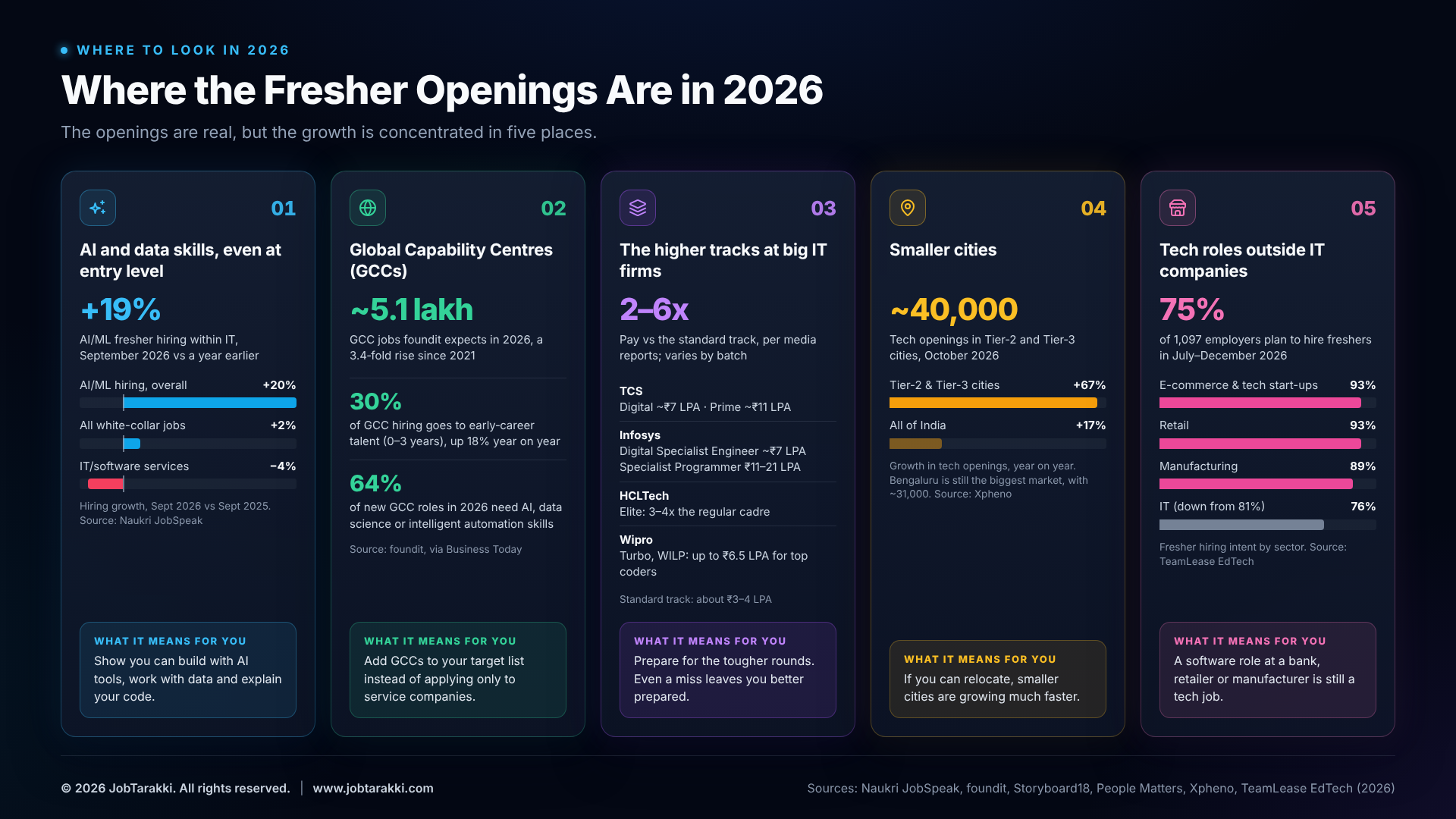
The openings are real, but the growth is concentrated in five places.
1. AI and data skills, even at entry level
In September 2026, AI/ML hiring grew 20% year on year while overall white-collar hiring grew just 2%, according to Naukri JobSpeak. IT/software services hiring fell 4%. But within IT, AI/ML hiring for freshers grew 19%.
What this means for you: you don't need to become an AI researcher. But knowing how to use AI APIs, work with Python, and handle data makes you stand out from the crowd of plain web-development resumes.
2. Global Capability Centres (GCCs)
GCCs are the offshore tech offices of multinational companies like JPMorgan, Walmart, Target and Wells Fargo. There are over 1,700 of them in India now, and they employ about 1.9 million people, according to an ANSR report covered by Business Today.
The big shift: GCCs used to hire only senior engineers. In 2024, early-career talent (0–3 years) made up 30% of their total hiring, up from 21% the year before. And GCCs typically pay ₹6–10 LPA for entry-level roles, well above the IT services standard.
What this means for you: put GCCs on your target list. They hire off-campus and on platforms like Unstop and LinkedIn.
3. The higher tracks at big IT firms
The ₹3.5 LPA salary gets the headlines, but the big firms have created higher tracks for strong coders. The gap between tracks is wider than it has ever been:
- Infosys: offers up to ₹21 LPA for specialised entry-level roles, against its standard ₹3–3.5 LPA offer. Its Specialist Programmer role pays around ₹9.5 LPA, and Digital Specialist Engineer pays around ₹6.5 LPA.
- TCS: runs three tracks: Ninja (₹3.36 LPA), Digital (around ₹7 LPA) and Prime (around ₹9 LPA), decided through its National Qualifier Test (NQT).
- Wipro: offers Turbo (around ₹6.5 LPA) alongside its standard Elite track.
- Accenture: offers Advanced Application Engineering Analyst (around ₹6.5 LPA) alongside its standard Associate Software Engineer role (₹4.5 LPA).
Sources: Storyboard18, citing Moneycontrol; company career pages.
What this means for you: preparing for the higher track at a service firm often takes just a few more weeks of data structures and problem-solving practice, but it can double your starting pay.
4. Mid-tier IT firms and product companies
Firms like Persistent Systems, Coforge, LTIMindtree and Zoho often offer clearer project placement and starting packages of ₹4.5–7 LPA. Product startups and scale-ups hire fewer people, but they evaluate projects and practical coding rather than college tiers.
5. Tech roles outside IT companies
In TeamLease EdTech's survey, fresher hiring intent across all industries rose to 75% for July–December 2026. The demand is strong in banking and financial services, retail, and manufacturing, all of which hire software developers, data analysts and cloud engineers directly.
What this means for you: a software role at a bank, retailer, manufacturer or e-commerce company often pays better than IT services and gives you direct ownership of real business features.
Fake Job Offers: How to Spot Them Before They Cost You
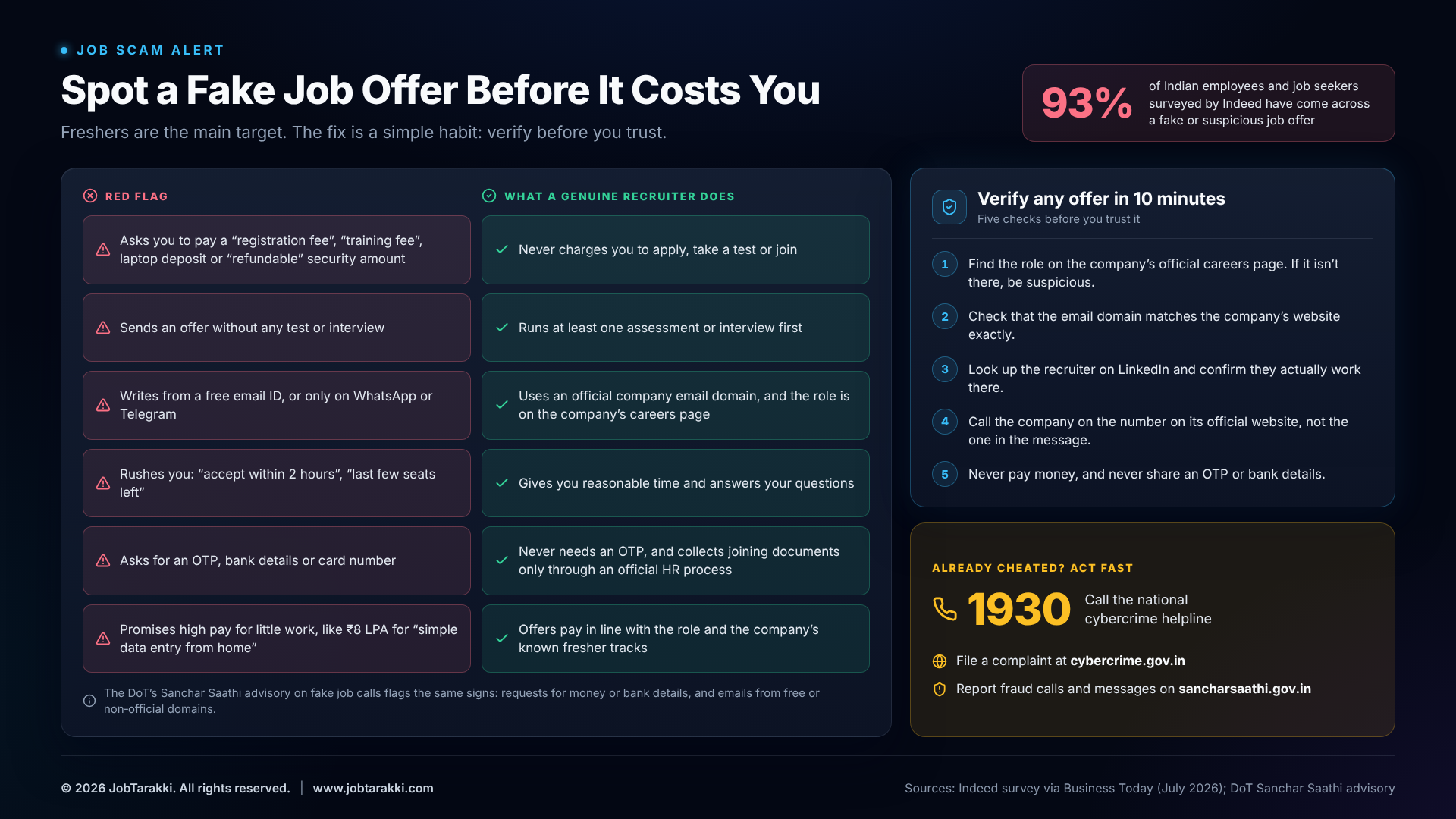
Freshers are the main target of job scams. In an Indeed survey reported in July 2026, 93% of Indian job seekers said they had encountered a fake or suspicious offer. Scammers know freshers are anxious, unfamiliar with corporate hiring, and eager for an offer letter.
The fix is a simple habit: verify before you trust.
| Red flag | What a genuine recruiter does |
|---|---|
| Asks you to pay a “registration fee”, “training fee”, laptop deposit or “refundable bond” | Never charges you to apply, take a test or join. Genuine employers pay you, not the other way around. |
| Sends an offer without any test or interview, or after only a two-minute chat | Runs at least one structured assessment or interview first. |
| Writes from a free email ID (like @gmail.com or @outlook.com), or contacts you only on WhatsApp or Telegram | Uses an official company email domain (@tcs.com, @infosys.com), and the role is listed on the company's careers portal. |
| Rushes you: “accept within 2 hours”, “last few seats left” | Gives you reasonable time (typically 3 to 7 days) and answers your questions. |
| Asks for an OTP, bank details or card number during the “verification” step | Never needs an OTP, and collects joining documents only through an official, secure HR onboarding portal. |
| Promises high pay for little work, like “₹8 LPA for simple part-time data entry from home” | Offers pay in line with the role, market benchmarks, and the company's published fresher tracks. |
The Department of Telecommunications' Sanchar Saathi advisory on fake job calls reminds job seekers that genuine employers never demand money for interviews, registration or onboarding.
How to verify any offer in 10 minutes
- Find the role on the company's official careers page. If it isn't listed there, be suspicious.
- Check that the email domain matches the company's website exactly (for example, @infosys.com, not @infosys-careers.co).
- Look up the recruiter on LinkedIn and confirm they actually work in HR or talent acquisition at that company.
- Call the company on the contact number listed on its official website, not the phone number in the email or WhatsApp message.
- Never pay money, and never share an OTP or bank details.
If you have already been cheated, call the national cybercrime helpline 1930 and file a report at cybercrime.gov.in immediately.
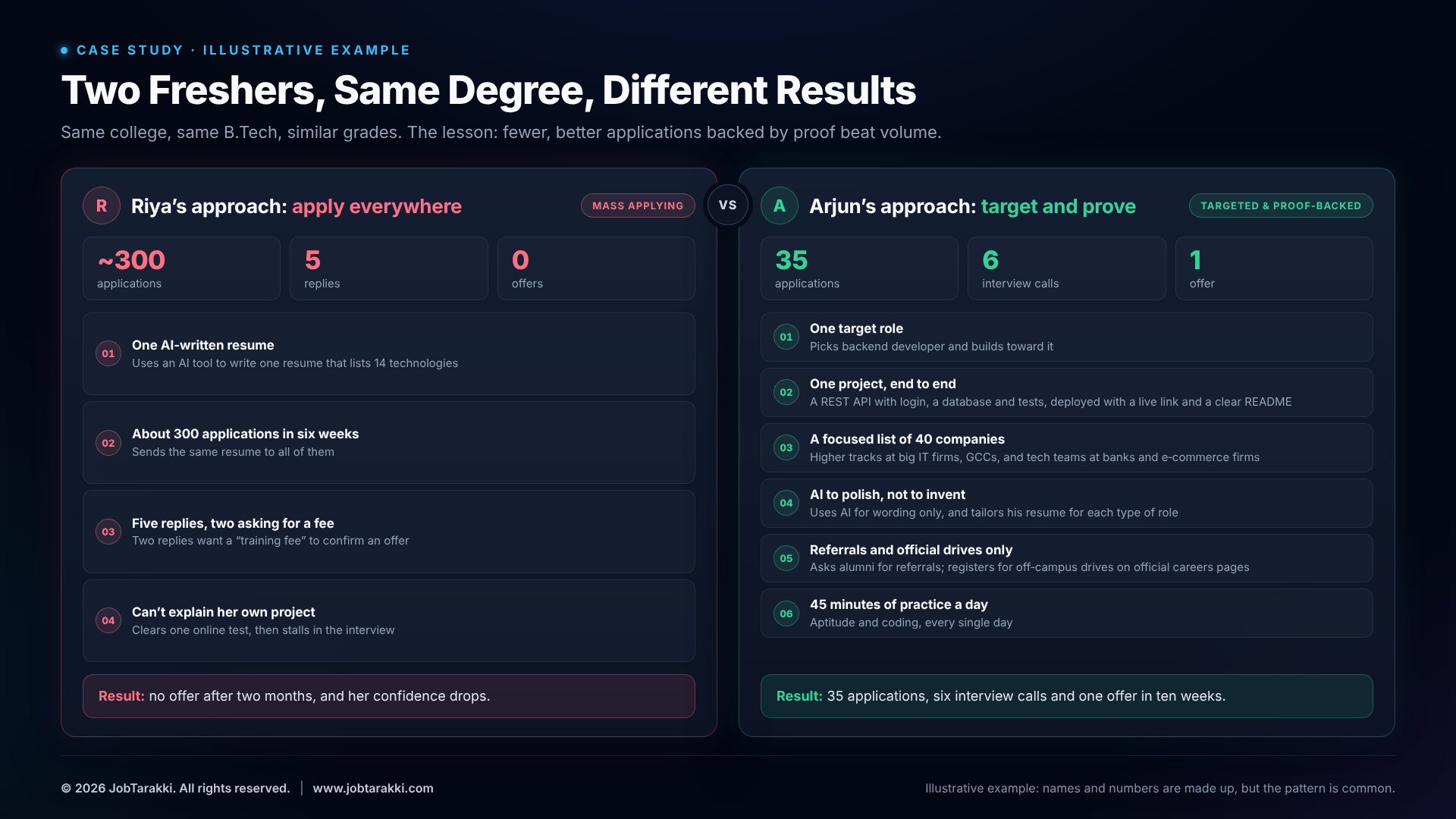
Case Study: Two Freshers, Same Degree, Different Results
The gap between getting stuck and getting hired is usually strategy, not talent.
Riya and Arjun graduate from the same college in 2026, with the same B.Tech in computer science and the same 7.8 CGPA.
Riya's approach: apply everywhere
- Uses an AI tool to write one generic resume listing 14 technologies.
- Sends the same resume to about 300 job postings in six weeks.
- Gets five replies; two ask for a “training fee” to confirm an offer.
- Clears one online test, but cannot explain her project in the interview.
- Result: zero offers after two months, high burnout and falling confidence.
Arjun's approach: target and prove
- Picks one clear target role: backend developer.
- Builds one project end-to-end: a REST API with JWT auth, PostgreSQL, tests, and deployed live on Render with full documentation.
- Lists 40 target companies: higher tracks at big IT, GCCs, and mid-tier tech teams.
- Tailors his resume to match specific backend requirements with measurable metrics.
- Reaches out to college alumni for referrals and solves aptitude/DSA 45 mins daily.
- Result: 35 applications, 6 interview calls, and a ₹7.2 LPA offer in ten weeks.
The lesson: fewer, better applications backed by tangible proof beat mass volume every single time.
Wondering how your resume reads for the role you want? Use the JobTarakki Resume Analyzer to check your keywords and proof points before applying.
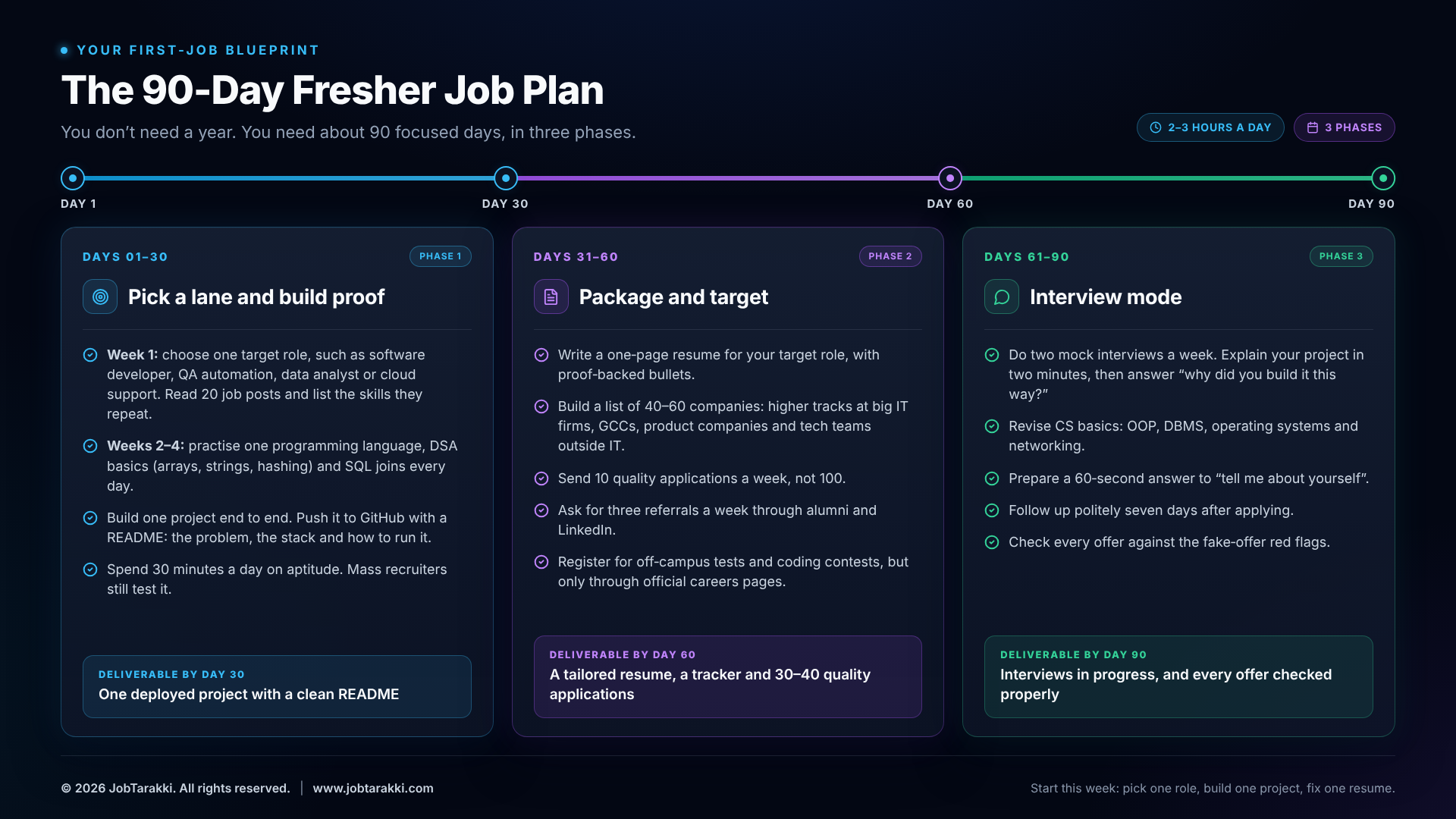
The 90-Day Fresher Job Plan
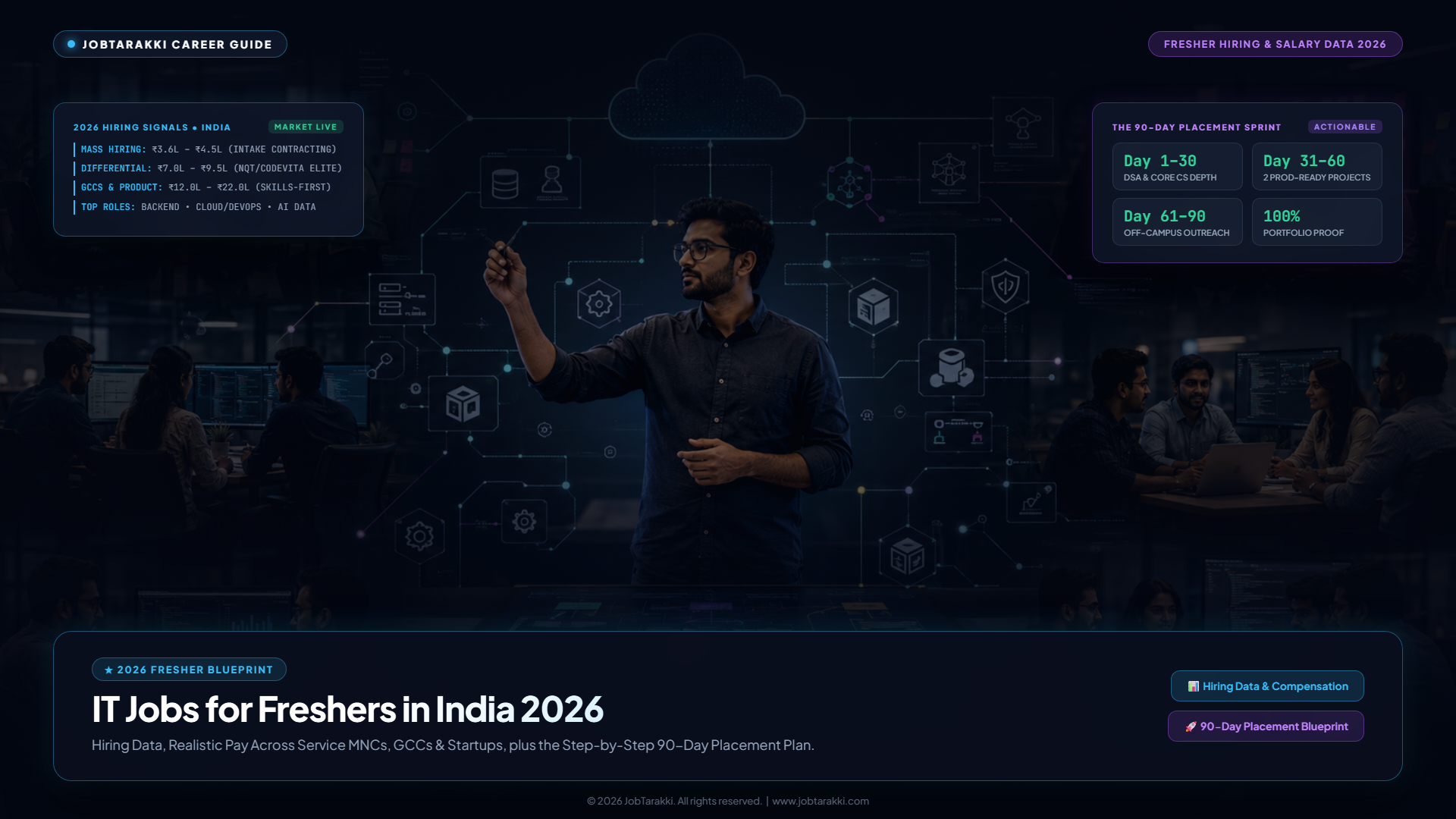
You don't need a year. You need about 90 focused days, at two to three hours a day.
| Phase | Focus | Deliverable by the end |
|---|---|---|
| Phase 1: Days 1–30 | Pick one track and build one real project | One working, deployed project on GitHub with a live link and a clean README |
| Phase 2: Days 31–60 | Prepare for tests and build your target company list | 40 target companies, a polished resume, and consistent scores on mock aptitude tests |
| Phase 3: Days 61–90 | Apply in a targeted way, get referrals and interview | 10 quality applications a week, tracked in a spreadsheet, with interview follow-ups |
Phase 1: Days 1–30 — Pick one track and build one real project
- Pick one track: Backend development (Java or Python), Frontend (React and TypeScript), Data/AI (Python, SQL and data libraries), or Cloud/DevOps (Linux, Docker, AWS basics). Do not try to learn all four at once.
- Build one project from scratch. Not a calculator, a to-do list or an e-commerce tutorial copy. Build something that solves a small, real problem:
- A job-tracker API with user login and status reminders
- A campus event booking tool with a database and email alerts
- A data dashboard that cleans a real public dataset and shows three useful charts
- Deploy it. Use Render, Vercel, Supabase or Railway. A live link in your resume sets you apart from 80% of applicants whose code lives only on their laptops.
- Write a clean README. Explain what the project does, the architecture decisions you made, how to run it locally, and what you learned.
Phase 2: Days 31–60 — Prepare for tests and build your company list
- Practise aptitude every day (45 minutes). TCS NQT, Infosys, Accenture and Cognizant all use timed aptitude tests as the first filter. Practise quantitative, logical and verbal questions on IndiaBIX or PrepInsta until you hit 75%+ accuracy within the time limit.
- Practise coding problems (45 minutes). Solve 50 easy and 30 medium problems on LeetCode or HackerRank. Focus on arrays, strings, hashmaps and basic recursion. These cover most entry-level coding tests.
- Build your target list of 40 companies:
- 10 big IT services firms (aim for their higher tracks)
- 10 GCCs that hire freshers (JPMorgan, Wells Fargo, Target, Lowe's, etc.)
- 10 mid-tier IT and product companies (Zoho, Persistent, Coforge, LTIMindtree)
- 10 tech teams at banks, retailers or non-IT companies
- Rewrite your resume. Keep it to one clean page. Lead with your live project, your target track, and specific skills. Drop generic hobby sections and high-school achievements.
Phase 3: Days 61–90 — Apply with intent, get referrals and interview
- Send 10 thoughtful applications a week, not 100 blind ones. For every job, spend 15 minutes tailoring your project bullet points to match the job post.
- Ask for alumni referrals. Find seniors from your college on LinkedIn who work at your target companies. Send a short, polite note:
“Hi [Name], I'm a 2026 grad from [College]. I saw the [Role] opening at [Company] (Job ID: 12345). I've built a deployed [Backend/React] project with [Stack] here: [link]. Would you be open to referring me if my profile looks like a fit? Happy to share my resume.”
- Prepare for standard interview questions:
- “Tell me about yourself”: 60 seconds on your degree, your target track, and the project you built.
- “Walk me through your project”: explain the problem, the database schema, an edge case you handled, and what you would improve next.
- “Why this company?”: mention one specific product, client domain or team initiative, not “it is a reputed MNC”.
- Track every application in a simple spreadsheet: company, role, date applied, referral source, status, and follow-up date.
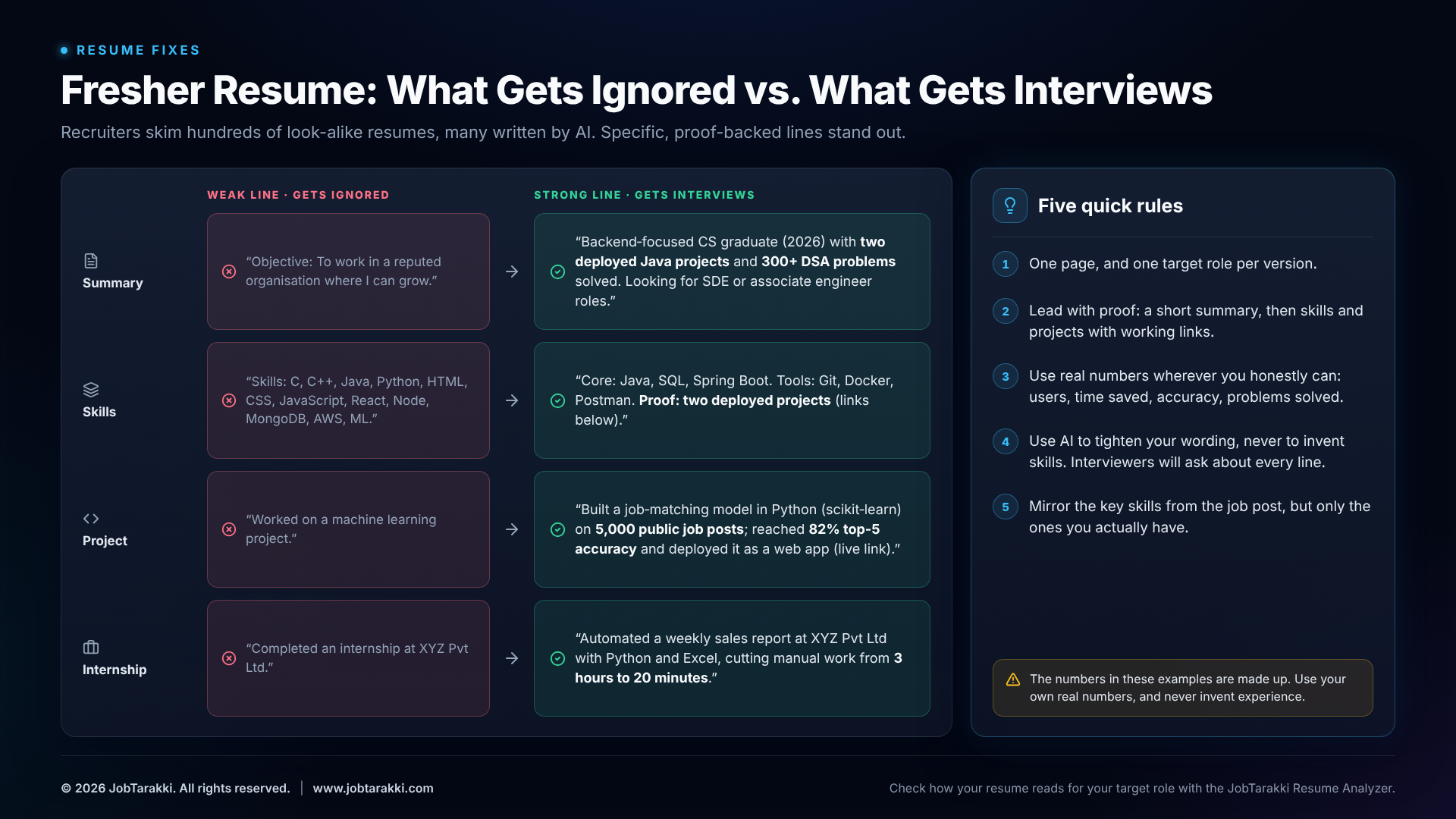
Resume Lines That Get Ignored vs Lines That Get Interviews
Most fresher resumes read like course syllabi. Here is how to turn passive knowledge into proof of capability.
| What gets ignored | What gets interviews | Why it works |
|---|---|---|
| “Knowledge of Python, Java, C++, HTML, CSS, JavaScript, SQL, React and AWS” | “Built a REST API in Python (FastAPI) with PostgreSQL, JWT authentication, and automated unit tests” | Shows you can assemble technologies into a working backend, not just name them |
| “Completed e-commerce website project as part of final-year curriculum” | “Developed an inventory management app deployed on Render with 25 mock products, handling order state transitions and stock validation” | Proves the system actually functions and handles business logic, not just static UI |
| “Hardworking student with good communication skills and a passion for technology” | “Solved 80+ LeetCode problems in Python; built a CLI tool used by 40 classmates to check campus bus timings” | Replaces self-praise with verifiable evidence of discipline and problem-solving |
| “Familiar with machine learning algorithms” | “Fine-tuned a scikit-learn classifier on 5,000 customer reviews, reaching 84% F1-score with cross-validation” | Shows you know how ML models are measured and validated, not just imported |
Three quick resume rules for 2026
- One page only. Freshers do not need two pages. Cut coursework listings and high-school marks.
- Put your GitHub and live project link in the top header, right below your contact details. Make them clickable links.
- Mirror the key skills from the job post, but only the ones you actually know well enough to defend in an interview.
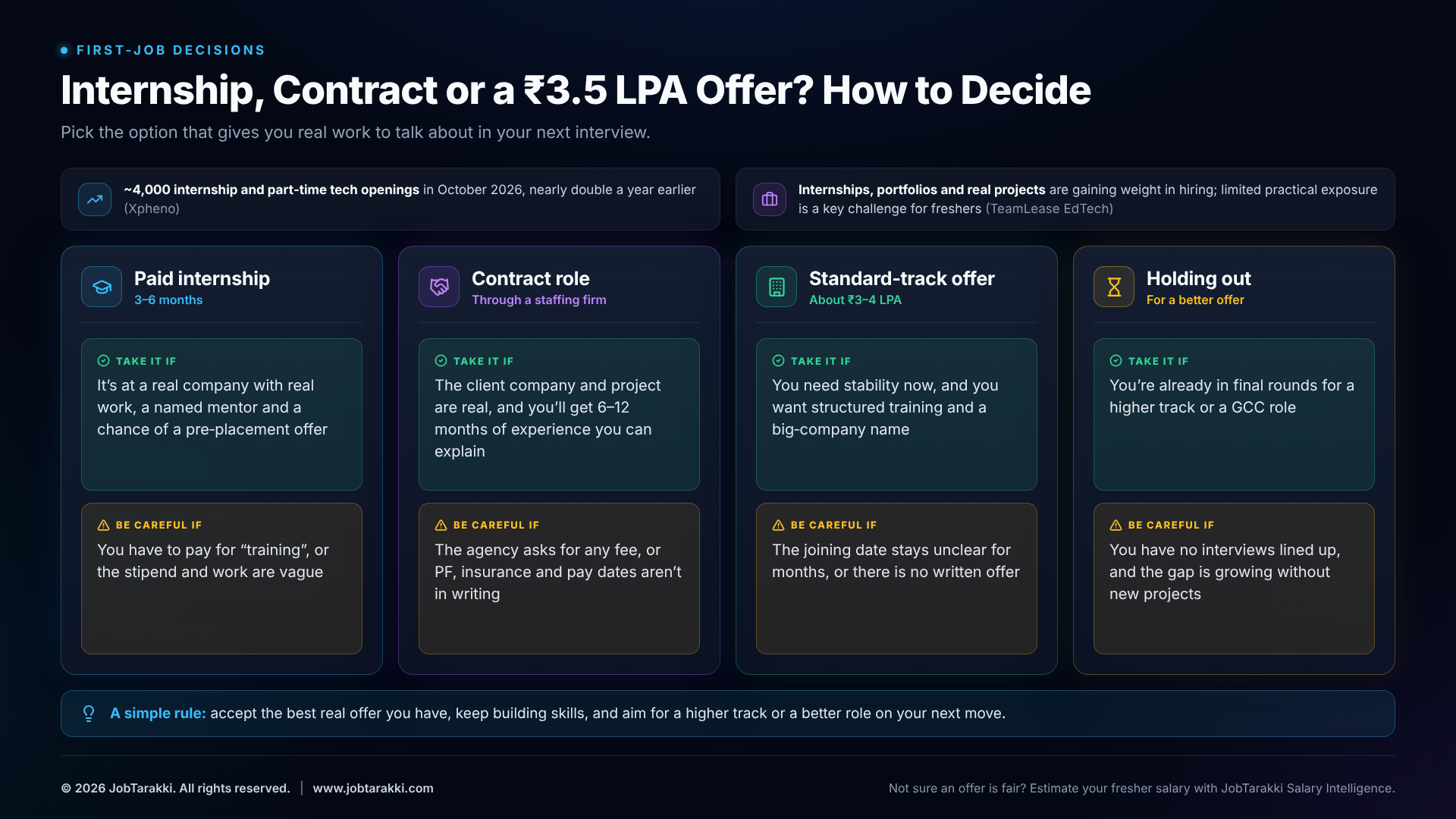
Internship, Contract or a ₹3.5 LPA Offer? How to Decide
The best first job is the one that gives you real work to talk about in your next interview, not necessarily the one with the biggest brand name.
Employers increasingly want proof of hands-on work. TeamLease EdTech found that 79% of employers see an internship as a key hiring criterion.
| Option | Take it if... | Be careful if... |
|---|---|---|
| Paid internship (3–6 months) | It's at a real company with real engineering work, a named mentor, and a clear path to a pre-placement offer (PPO). | You have to pay for “training”, or the stipend and day-to-day work are left vague in the offer letter. |
| Contract role through a staffing firm | The client company and project are real, and you'll get 6–12 months of hands-on production code experience to put on your resume. | The agency asks for any upfront fee, or PF, insurance and pay dates are not clearly committed in writing. |
| Standard-track offer (₹3–4 LPA) | You need financial stability now, and you value structured enterprise training alongside a recognised corporate brand name. | The onboarding and joining date stays delayed for months with zero communication, or there is no written formal offer. |
| Holding out for a better offer | You are already in final interview rounds for a higher track (Digital/Prime) or a GCC engineering role. | You have zero live interviews lined up, and your employment gap is growing without any active projects being built. |
A simple rule: accept the best real offer you have, keep building skills on evenings and weekends, and aim for a higher-track role or a GCC transition after 12 to 18 months.
Not sure if an offer is fair for your role and city? Use the JobTarakki Salary Intelligence tool to benchmark pay against real industry data.
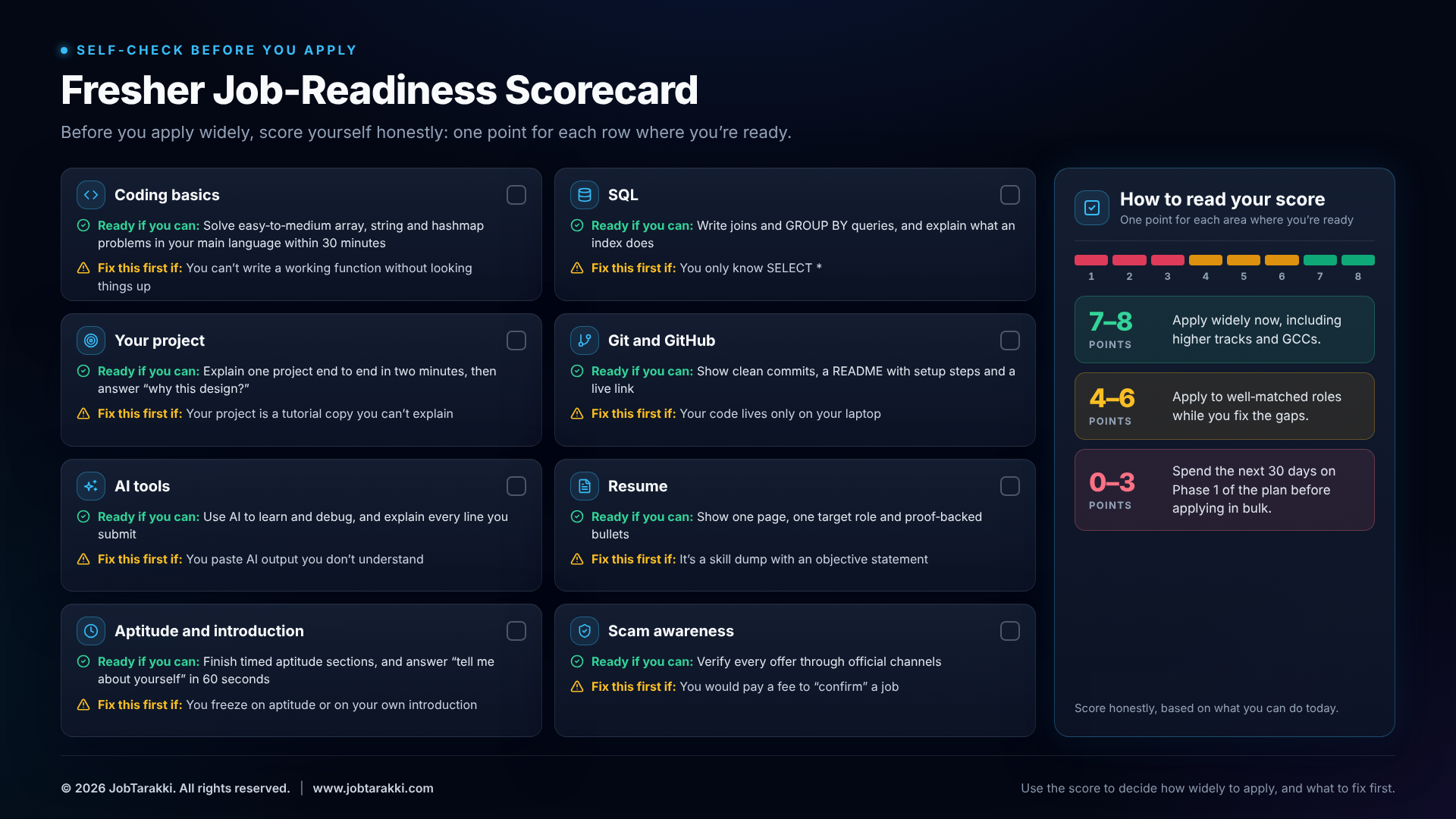
Fresher Job-Readiness Scorecard
Before you apply widely, score yourself honestly. Give yourself one point for each box you can check today.
| Area | You're ready if you can... | Fix this first if... |
|---|---|---|
| Coding basics | Solve easy-to-medium array, string and hashmap problems in your main language without hints | You can't write a working function without looking up basic syntax |
| SQL & Databases | Write multi-table joins, GROUP BY queries, and explain what an index does under the hood | You only know simple SELECT * queries from single tables |
| Your project | Explain one project end to end in two minutes, then answer “why did you choose this architecture?” | Your project is a tutorial copy from YouTube that you cannot modify on the spot |
| Git & GitHub | Show clean, meaningful commits, a comprehensive README with setup steps, and a live deployed link | Your code lives only on your local laptop hard drive |
| AI tools | Use AI tools (Cursor, Copilot, ChatGPT) to accelerate learning and debugging, and explain every line you submit | You blindly paste AI output into codebases without understanding the implementation |
| Resume | Show a one-page resume tailored to one target role with proof-backed, metric-driven bullet points | Your resume is a 2-page generic technology dump with an “objective statement” |
| Aptitude & Intro | Finish timed aptitude sections with 75%+ accuracy, and deliver a crisp 60-second self-introduction | You freeze on timed aptitude math sections or hesitate on your own introduction |
| Scam awareness | Verify every recruiter and offer letter through official company career pages and domains | You would consider paying a “refundable deposit” or training fee to secure a job |
How to read your score:
- 7–8 points: Apply widely now, including higher tracks (TCS Digital/Prime, Infosys Specialist) and GCCs. You are in the top quartile of applicants.
- 4–6 points: Apply to well-matched entry roles while spending 1 hour daily closing your specific gap areas.
- 0–3 points: Pause bulk applications. Spend the next 30 days strictly on Phase 1 of the 90-day plan before sending resumes out.
Conclusion: The Market Is Tough, Not Closed
Openings are back at an 18-month high. Big IT is hiring freshers again, but only as many as client demand justifies. Mass hiring and six-month bench training are no longer the default.
At the same time, specific high-value doors are opening: AI and data skills, Global Capability Centres (GCCs), higher salary tracks, and tech roles at non-IT companies.
You cannot control macroeconomic headwinds or quarterly hiring targets. You can control three things:
- What you target: one defined engineering role, and a focused list of 40 well-researched companies.
- The proof you show: one real, deployed project you can defend line by line, and a one-page resume built around it.
- How carefully you verify offers: official company channels only, zero upfront fees, and absolute security regarding your personal data.
Start this week. Pick your track, build your first deployed project, and build proof that makes you impossible to ignore.
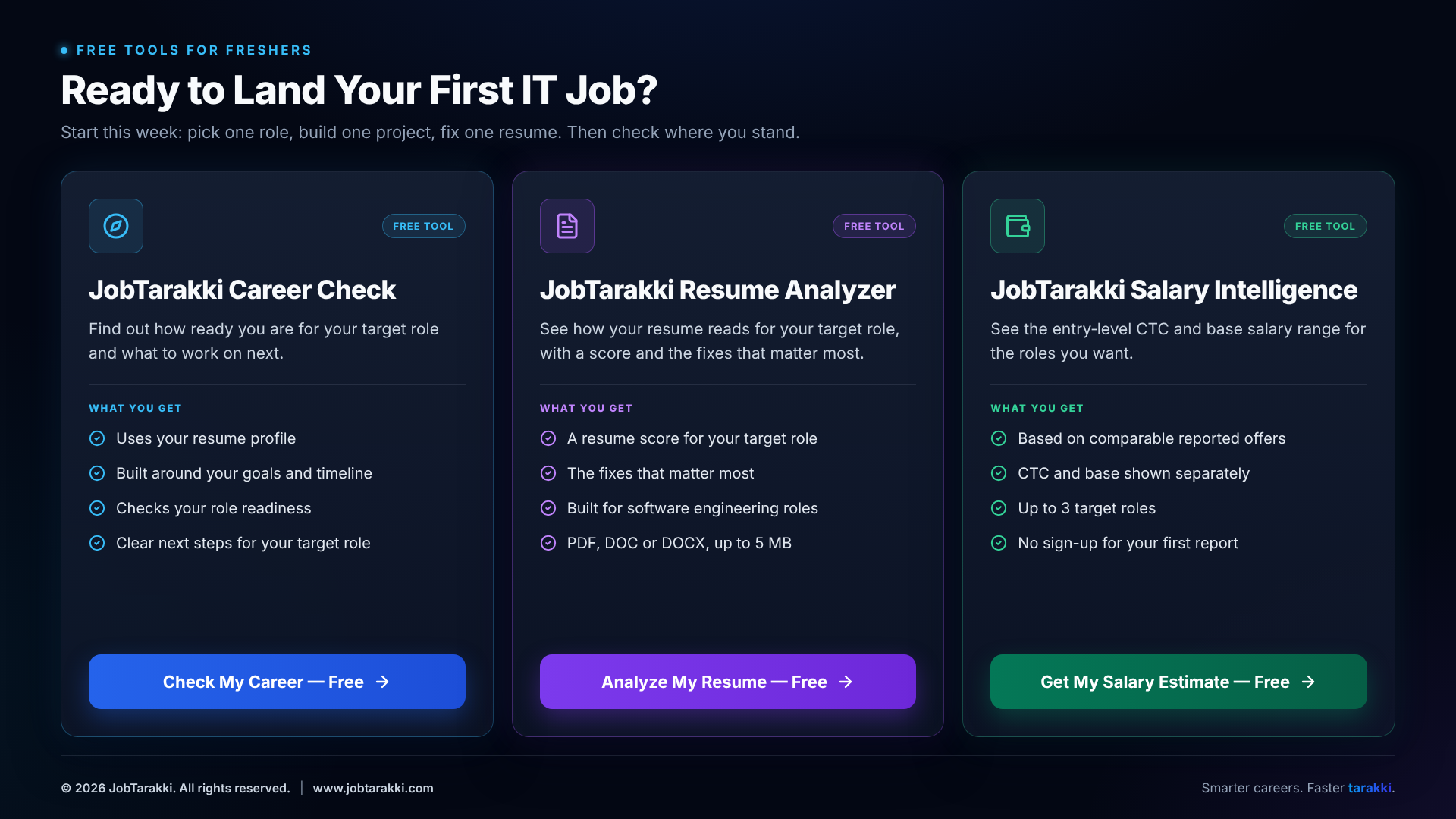
Ready to see where your skills and resume stand? Use the JobTarakki Career Readiness Check to get instant, data-backed feedback on your profile and benchmark your readiness today.
Sources & References
All data sources and reference links verified as of 29 October 2026:
- India Tech Job Openings: 1.23 Lakh in October Outlook — Lapaas Voice (Xpheno data), October 2026
- India's tech hiring drops to 28-month low as active openings fall to 93,000 — People Matters (Xpheno data), June 2026
- TCS, Infosys, HCLTech, Wipro and Tech Mahindra Add 13,918 Employees in Q2 FY27 — Lapaas Voice, October 2026
- HCLTech attrition rises to 12.8% as headcount grows by 6,450 in Q2 — The Hindu BusinessLine, October 2026
- TCS Makes Only 25k Fresher Offers This Fiscal, More Hires Dependent on Demand Scenario — Outlook Business, April 2026
- 'No target for fresher hiring': Wipro CHRO as IT giant adapts to AI — Business Today, April 2026
- Rs 3.16 LPA in 2007, Rs 3.36 LPA in 2026: India's IT fresher pay freezes — Business Today, February 2026
- Infosys raises fresher pay, offers up to Rs 21 lakh for specialised roles — Storyboard18 (Moneycontrol), September 2024 / 2026
- India adds 2.6 AI jobs for every role lost, but a widening skills gap threatens freshers — Business Today (Nomura report), August 2026
- Applicants per job double in India, intensifying job search pressure — People Matters (LinkedIn data), 2024
- Over 70 pc Indian recruiters turning to AI to find 'hidden talent' — IANS Live, February 2026
- 54% of Indian jobseekers say skills tests are fairer than resumes — Business Today (Indeed survey), September 2026
- More than 9 in 10 job seekers encounter fake job offers — Business Today (Indeed survey), July 2026
- Beware of Fake Job Calls (PDF) — Department of Telecommunications, Sanchar Saathi Advisory
- At 5.1 lakh jobs, India's Global Capability Centre hiring boom scales new peak — Business Today (ANSR / foundit data), July 2026
- Naukri JobSpeak: White-collar hiring holds steady in September; AI/ML surges 20% — Naukri, October 2026
- Fresher hiring intent rises to 75%, but IT demand loses ground — People Matters (TeamLease EdTech), August 2026