Introduction
Imagine two engineers.
Both have eight years of experience.
Both write clean code.
Both consistently deliver projects.
Yet only one gets promoted to Staff Engineer.
Why?
Because promotion committees rarely ask:
"Who writes the best code?"
Instead, they ask:
-
Who makes multiple teams more effective?
-
Who influences technical direction?
-
Who reduces engineering risk?
-
Who solves problems before they become incidents?
-
Who mentors future leaders?
This shift surprises many Senior Engineers.
The skills that helped you reach Senior level are no longer enough. Staff Engineers succeed by increasing the impact of everyone around them.
This guide explains how to make that transition in Indian product companies, startups, and global engineering organizations.
Why Staff Engineer Is a Different Job
Many engineers think Staff Engineer is simply the "next promotion."
It isn't.
The scope changes dramatically.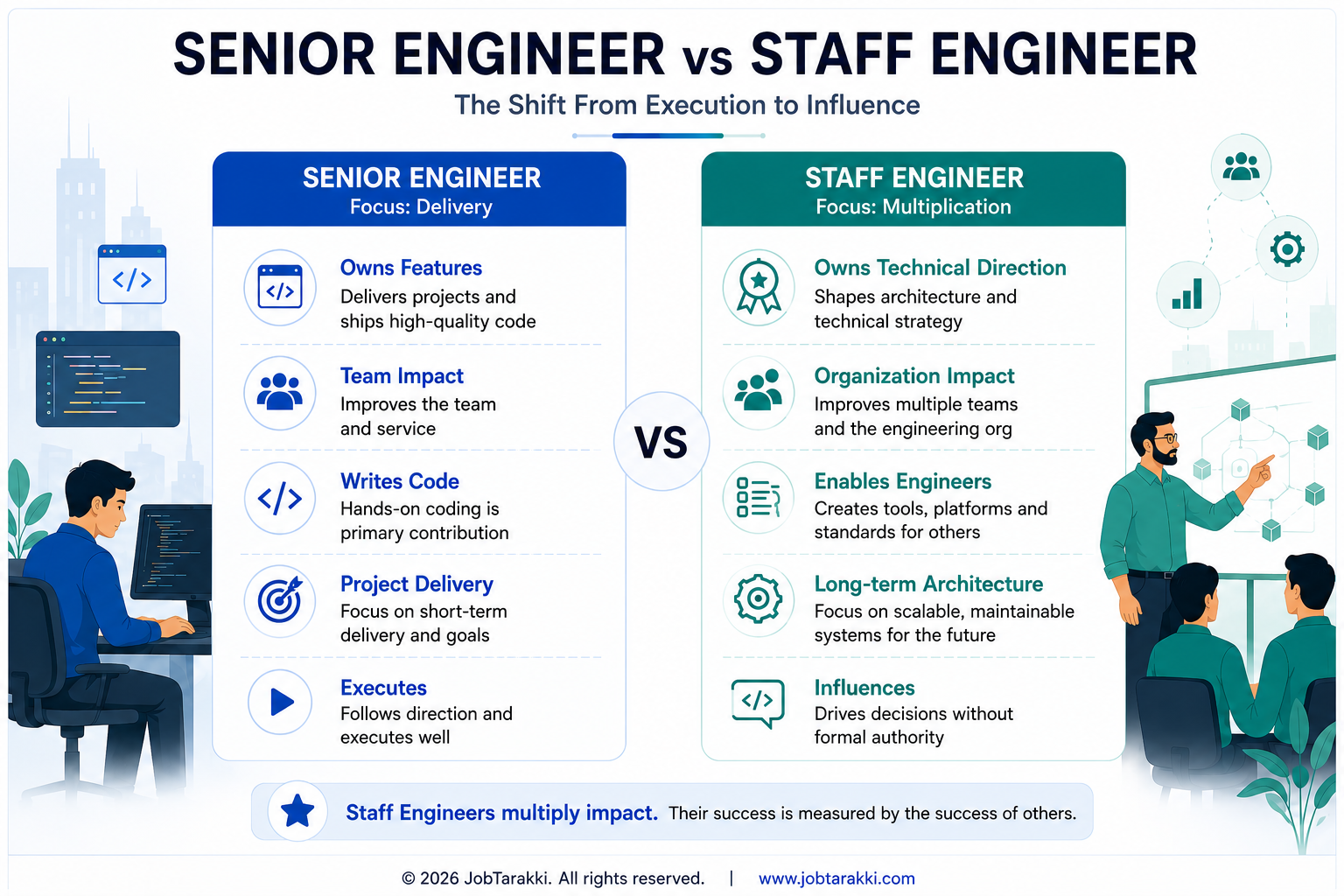
Notice something important.
Coding is still essential.
But coding is no longer the primary measure of success.
Your influence becomes your biggest contribution.
Understanding the Engineering Career Ladder
A simplified engineering ladder often looks like this:
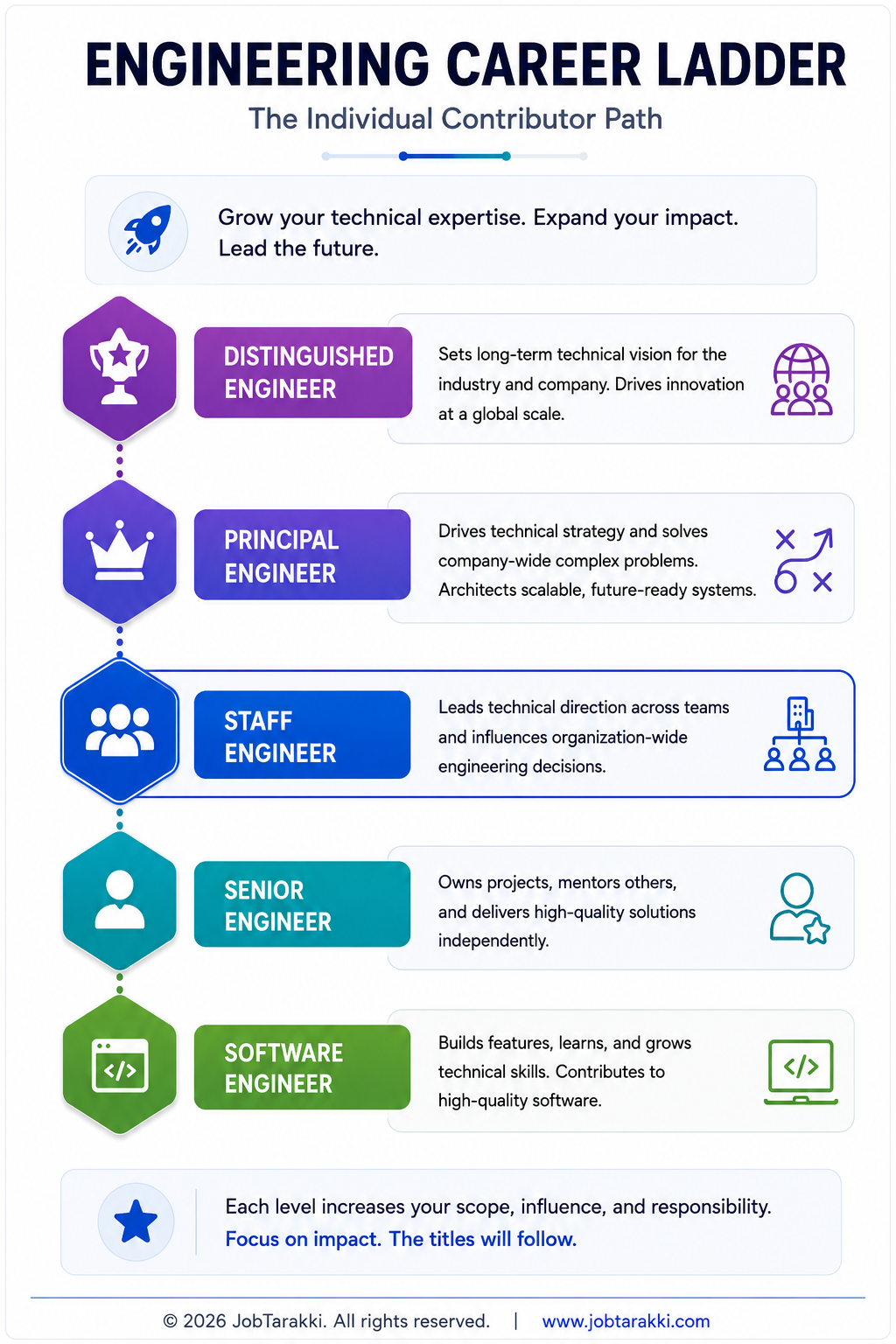
Each level increases your scope rather than just your technical complexity.
A Senior Engineer may optimize a service.
A Staff Engineer may redesign an organization's platform strategy.
Why Promotions Become Much Harder
Early promotions are mostly based on execution.
Later promotions depend on influence.
Consider this example.
A Senior Backend Engineer migrates one service to Kubernetes.
Great achievement.
A Staff Engineer creates migration standards, tooling, documentation, monitoring, and rollout practices that enable fifty services to migrate successfully.
The difference is multiplication.
Staff Engineers create systems that help other engineers succeed.
The Five Characteristics of Successful Staff Engineers
They Think Beyond Their Team
Senior Engineers often optimize local problems.
Staff Engineers optimize global problems.
Instead of asking:
"How do I improve my service?"
They ask:
"How do we improve reliability across the company?"
Examples include:
-
Common authentication platforms
-
Shared observability standards
-
Developer tooling
-
Internal SDKs
-
CI/CD improvements
They Make Architecture Simpler
Complex systems are expensive.
Staff Engineers reduce unnecessary complexity.
Example:
Instead of introducing another microservice, they might consolidate services after analyzing operational costs.
Good architecture balances:
-
Scalability
-
Reliability
-
Developer productivity
-
Maintainability
-
Operational overhead
Trade-offs matter as much as technical correctness.
They Mentor Without Micromanaging
Mentorship isn't about reviewing every pull request.
It's about helping engineers make better decisions independently.
Examples include:
-
Architecture review sessions
-
Design document feedback
-
Pair programming for complex problems
-
Career coaching
-
Knowledge sharing sessions
Strong Staff Engineers create more strong engineers.
They Communicate Clearly
Technical expertise alone rarely earns promotion.
You also need to explain ideas effectively.
Examples:
Instead of saying:
"Redis is faster."
Explain:
"Using Redis for session caching reduces repeated database reads, improving latency while lowering database load. The trade-off is eventual consistency, which is acceptable for session data."
Decision-making becomes transparent.
They Influence Without Authority
One of the biggest surprises at Staff level is that many engineers don't report to you.
You influence through:
-
Credibility
-
Technical reasoning
-
Collaboration
-
Documentation
-
Trust
You cannot rely on job titles.
People follow good technical judgment.
Real Engineering Scenario
Situation
A product company has six backend teams.
Each team uses different logging formats.
Different deployment pipelines.
Different monitoring dashboards.
Incident response becomes chaotic.
A Senior Engineer might improve logging for their own service.
A Staff Engineer creates:
-
Common logging libraries
-
Shared observability dashboards
-
Alerting standards
-
Deployment templates
-
Incident playbooks
Result:
Every team becomes more productive.
That is Staff-level impact.
Building Technical Leadership
Technical leadership is often misunderstood.
It doesn't mean making every decision.
Instead, it means helping teams consistently make better technical decisions.
Strong technical leaders:
-
Ask thoughtful questions before proposing solutions.
-
Encourage design reviews that surface trade-offs early.
-
Document architectural decisions so future teams understand the reasoning.
-
Create reusable patterns instead of one-off fixes.
-
Balance short-term delivery with long-term maintainability.
A useful habit is to replace "How can I solve this?" with "How can we solve similar problems more effectively in the future?"
From Problem Solver to Problem Finder
Senior Engineers are excellent at solving assigned problems.
Staff Engineers often identify important problems before anyone else notices them.
For example:
-
Recognizing that deployment frequency is slowing because of inconsistent pipelines.
-
Spotting recurring production incidents caused by missing observability.
-
Identifying duplicated infrastructure work across multiple teams.
Finding the right problem to solve can create more value than solving ten smaller ones.
Architecture Thinking at Staff Level
Architecture is more than selecting technologies.
It is about making decisions that remain effective as the organization grows.
Before recommending a new technology, ask:
-
Will this still work when traffic doubles?
-
How difficult will it be for new engineers to understand?
-
What operational burden does it introduce?
-
Can other teams adopt it easily?
-
Does it reduce or increase cognitive load?
Staff Engineers earn trust by considering technical and organizational trade-offs rather than chasing the newest tools.
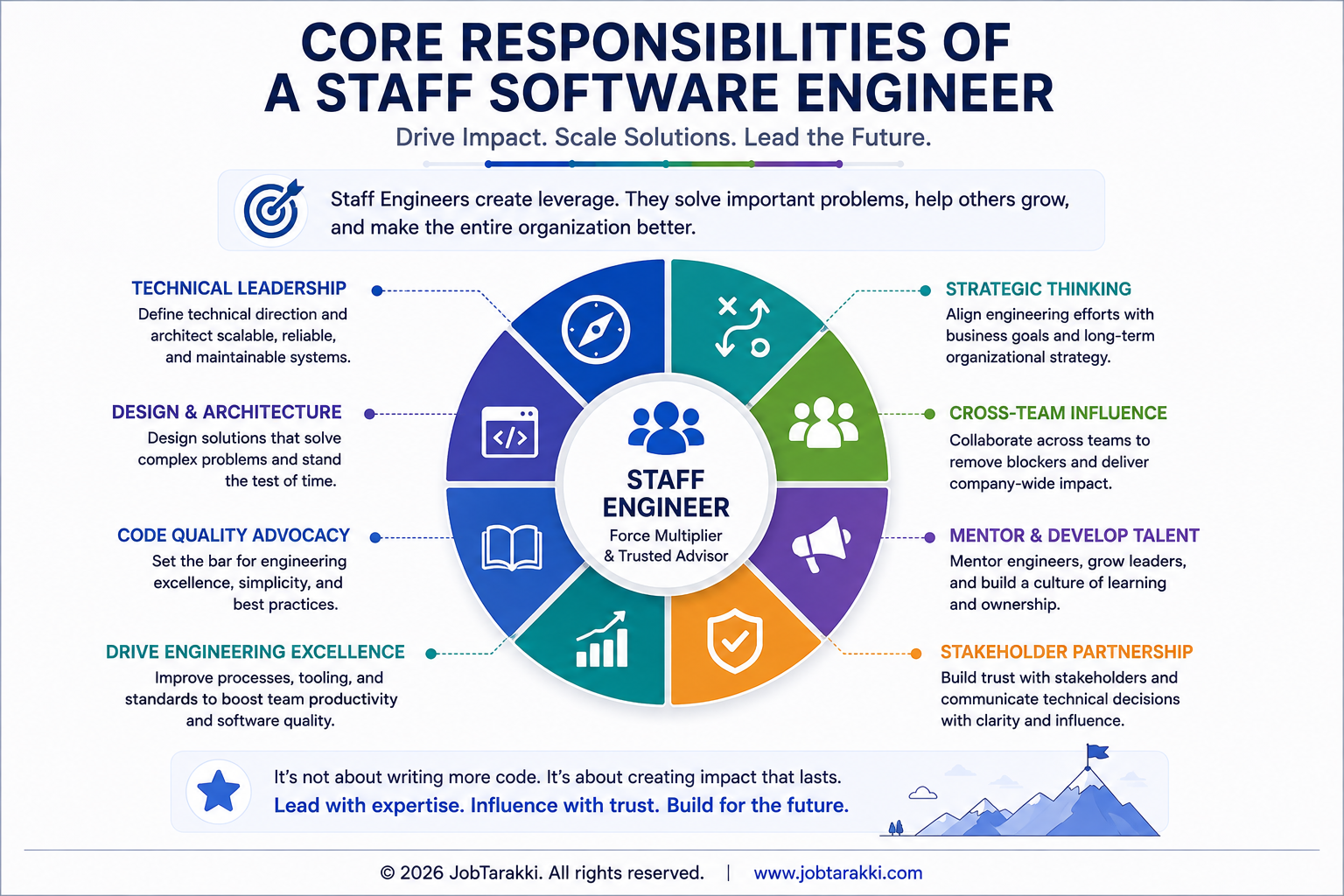
Common Architectural Trade-offs
|
Decision |
Benefit |
Trade-off |
|
Microservices |
Independent scaling |
Operational complexity |
|
Monolith |
Simpler development |
Scaling challenges over time |
|
Event-driven systems |
Loose coupling |
Higher debugging complexity |
|
Shared libraries |
Consistency |
Version management |
|
Internal platforms |
Developer productivity |
Initial investment |
Cross-Team Influence: Where Staff Engineers Create the Most Value
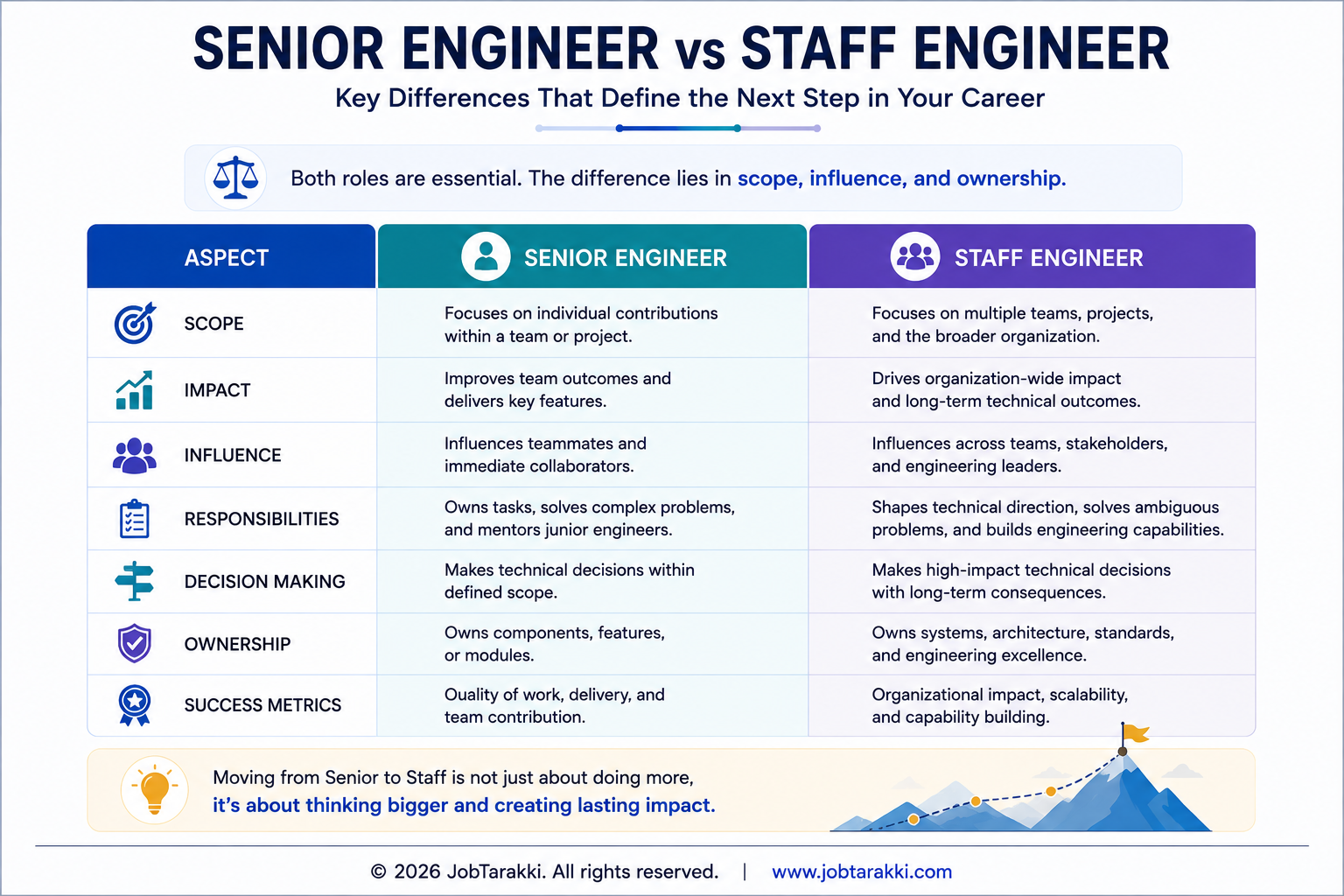
The biggest difference between a Senior Engineer and a Staff Engineer is the size of the problems they solve.
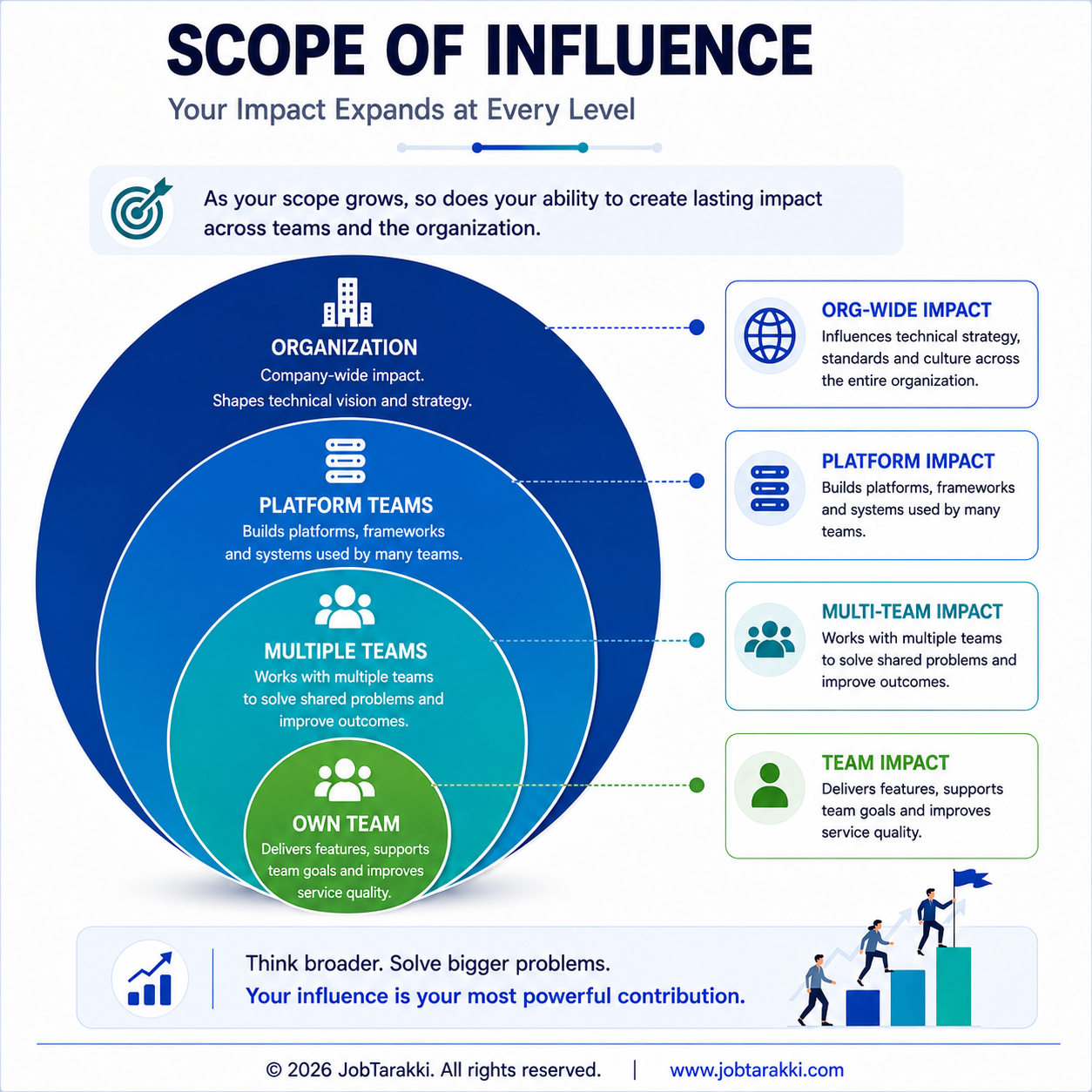
A Senior Engineer might own one service.
A Staff Engineer improves how multiple teams build, deploy, observe, and operate software.
Areas of Cross-Team Impact
|
Area |
Example Impact |
|
Architecture |
Define API standards across multiple services |
|
Developer Experience |
Improve build times and local development workflows |
|
Platform Engineering |
Build reusable deployment templates |
|
Reliability |
Standardize monitoring, alerting, and incident response |
|
Security |
Introduce secure coding standards and automated security checks |
|
Performance |
Create organization-wide performance budgets and profiling practices |
A useful question to ask yourself is:
If I stopped working for two weeks, would only my team notice—or would several teams feel the impact?
Staff-level work usually has organization-wide visibility.
Real Examples
Backend Engineer
Instead of optimizing a single API:
-
Design a common authentication platform.
-
Standardize API versioning.
-
Build reusable middleware.
-
Improve database migration practices.
The result is that dozens of services benefit.
DevOps Engineer
Rather than fixing deployment issues for one application:
-
Build reusable CI/CD templates.
-
Standardize Infrastructure as Code.
-
Automate compliance checks.
-
Improve rollback strategies.
Every engineering team ships software more safely.
Startup Example
In a fast-growing startup, engineers often create duplicate solutions because teams move quickly.
A Staff Engineer notices this pattern and introduces:
-
Shared design documents
-
Technical RFC process
-
Coding standards
-
Platform libraries
Instead of slowing innovation, these changes reduce repeated work.
Product Company Example
Imagine five teams independently implementing feature flags.
A Staff Engineer creates:
-
One feature flag platform
-
Shared SDKs
-
Governance guidelines
-
Rollout dashboards
The company saves engineering time while improving reliability.
Promotion Readiness Checklist
You don't need every item before being promoted, but consistently demonstrating these behaviors is a strong indicator of Staff-level readiness.
Technical Leadership
-
Designed systems used by multiple teams
-
Led architecture reviews
-
Influenced major technical decisions
-
Improved engineering standards
-
Reduced operational complexity
Business Impact
-
Delivered measurable engineering improvements
-
Reduced incidents or downtime
-
Improved deployment speed
-
Increased developer productivity
-
Balanced technical quality with delivery timelines
Communication
-
Write clear design documents
-
Present technical proposals
-
Explain trade-offs effectively
-
Build alignment across teams
-
Handle technical disagreements constructively
Mentorship
-
Mentor Senior Engineers
-
Help engineers grow independently
-
Conduct effective design reviews
-
Share knowledge through documentation and talks
Common Mistakes That Delay Promotion
1. Measuring Success by Lines of Code
More code rarely means more impact.
The highest-impact solution may actually involve deleting unnecessary code or simplifying a system.
2. Solving Only Assigned Problems
Staff Engineers proactively identify important problems instead of waiting for assignments.
3. Avoiding Documentation
Many promotion committees evaluate engineering influence through design documents, architecture proposals, and technical RFCs.
If your best work only exists in source code, much of your impact remains invisible.
4. Becoming the Bottleneck
Being the "only person who understands the system" is not a promotion strategy.
Staff Engineers create leverage by enabling others.
5. Chasing New Technologies Without Clear Value
Introducing new tools should solve real business or engineering problems.
Technology choices should always be justified by trade-offs, maintenance costs, and long-term sustainability.
A Practical 12-Month Roadmap
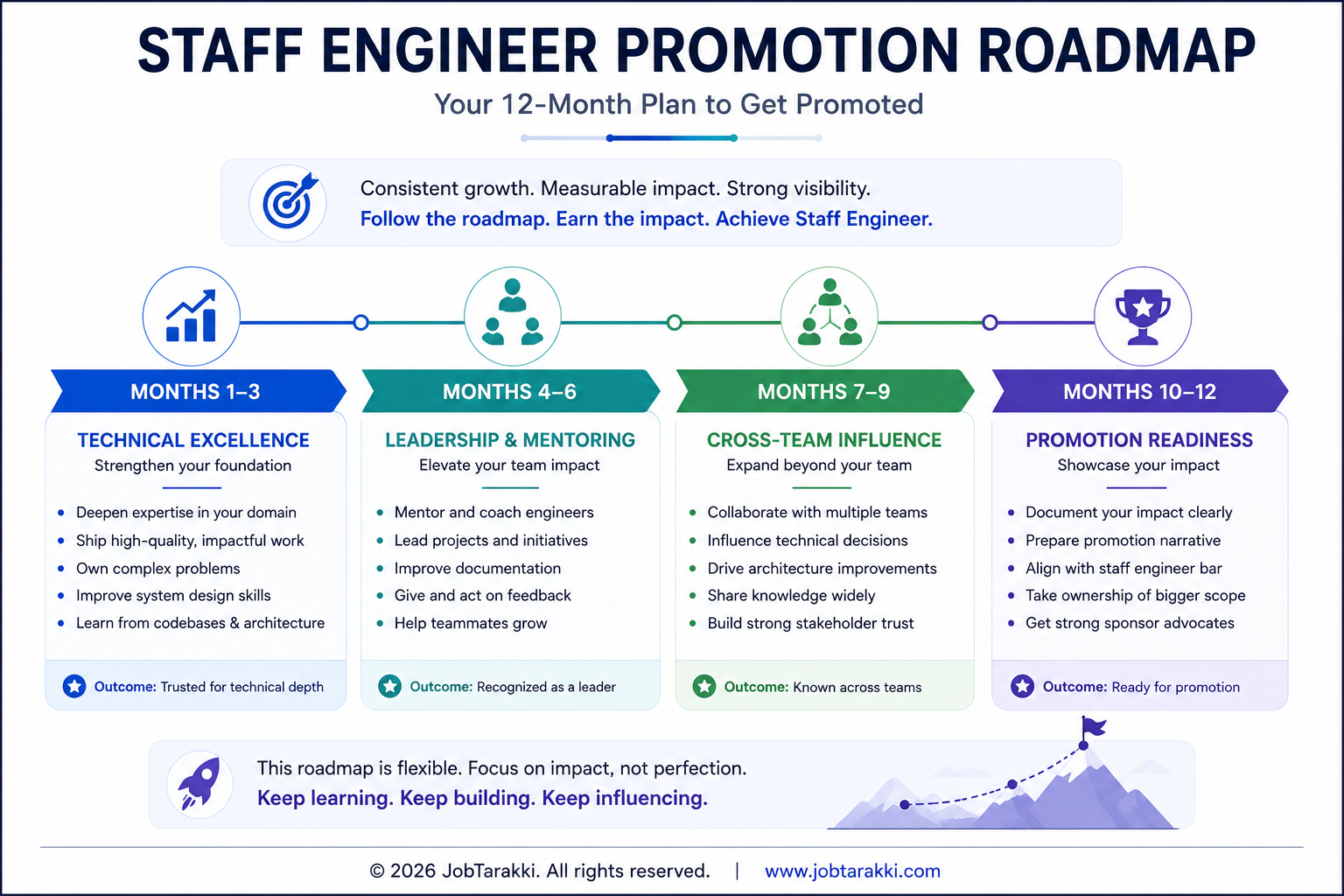
Months 1–3
Focus on technical depth.
-
Master your primary systems.
-
Improve design documentation.
-
Participate actively in architecture discussions.
Months 4–6
Expand your influence.
-
Mentor engineers.
-
Lead technical initiatives.
-
Improve developer tooling.
-
Drive reliability improvements.
Months 7–9
Increase organizational impact.
-
Lead cross-team projects.
-
Standardize engineering practices.
-
Present architectural proposals.
-
Collaborate with product and infrastructure teams.
Months 10–12
Prepare for promotion.
-
Document your impact.
-
Collect feedback.
-
Review promotion expectations with your manager.
-
Identify remaining gaps.
-
Create measurable evidence of Staff-level contributions.
How Promotion Committees Evaluate
Ready to Take the Next Step in Your Engineering Career?
Smarter careers. Faster tarakki.
Your next promotion isn't just about writing better code. It's about building the right skills, demonstrating the right impact, and growing with confidence.
With JobTarakki, you can:
-
Assess your current engineering level
-
Find the skills you need next
-
Build a personalized career roadmap
-
Prepare for interviews and promotions
-
Track your progress over time
Frequently Asked Questions
1. Is Staff Engineer higher than Senior Software Engineer?
Yes. Staff Engineer is typically the next individual contributor (IC) level after Senior Engineer and carries broader technical and organizational responsibilities.
2. Do Staff Engineers still write code?
Absolutely. Most Staff Engineers continue writing code, but they spend more time on architecture, design reviews, mentoring, and technical strategy than feature implementation alone.
3. How many years does it usually take to become a Staff Engineer in India?
There is no fixed timeline. Many engineers reach Staff level after 7–12 years, though promotions depend more on demonstrated impact than years of experience.
4. Is Staff Engineer equivalent to Engineering Manager?
No. A Staff Engineer is an individual contributor focused on technical leadership, while an Engineering Manager focuses on people management, delivery, and team operations.
5. Should I become a Staff Engineer or an Engineering Manager?
Choose the path that aligns with your strengths. If you enjoy solving complex technical problems and influencing architecture, the Staff Engineer path may be a better fit. If you prefer coaching people, planning work, and managing teams, Engineering Management may be more suitable.
6. What skills matter most for promotion?
Strong system design, architectural thinking, communication, mentorship, technical decision-making, and cross-team influence are among the most important skills.
7. Are certifications required?
Generally, no. Practical experience and measurable impact usually outweigh certifications for Staff-level promotions.
8. How can I demonstrate Staff-level impact?
Lead initiatives that benefit multiple teams, improve engineering practices, mentor others, document decisions, and deliver measurable improvements in reliability, productivity, or scalability.
9. Do startups have Staff Engineer roles?
Some startups do, while others use different titles. Regardless of title, the expectations often involve organization-wide technical leadership.
10. What is the biggest mindset shift?
Moving from "How can I deliver this feature?" to "How can I help the entire engineering organization build better software?"