
Introduction
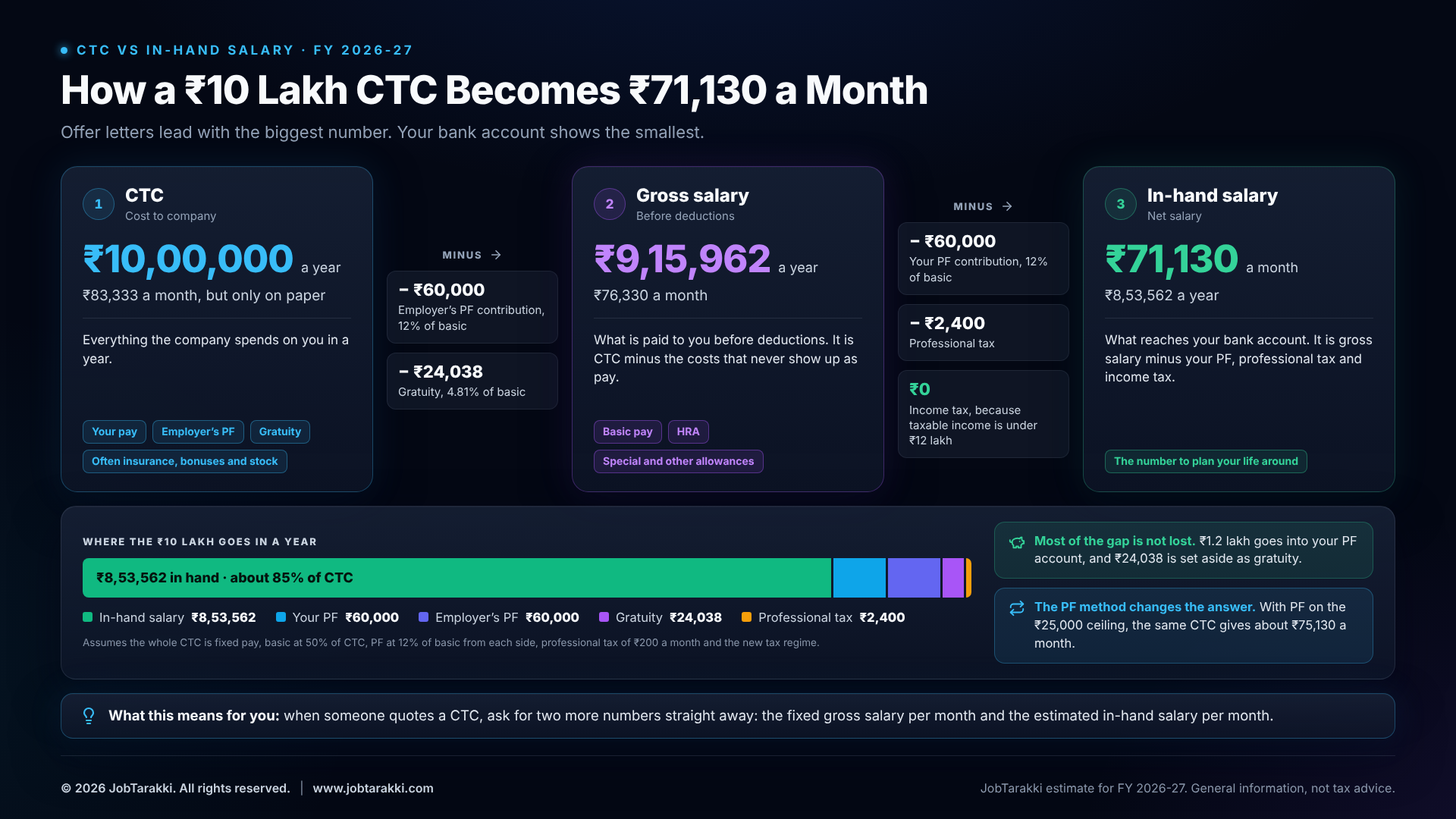
A ₹10 lakh CTC does not put ₹83,333 in your bank account every month. With a typical 2026 salary structure, it puts about ₹71,000 to ₹75,000 there.
The gap is not a mistake. CTC (cost to company) counts everything your employer spends on you in a year. Part of it goes into your PF, part is set aside as gratuity, part may be a bonus you get only if targets are met, and part goes as tax.
In 2026 that gap changed for most salaried employees in India:
- Salary structures were redrawn. The four labour codes came into force on 21 November 2025 (SCC Online), and the final central rules were notified on 8 May 2026 (KPMG). Under the codes, the wages used to work out your PF and gratuity must be at least half of your total pay. Many companies began realigning their pay structures in April 2026, usually with a higher basic pay and smaller allowances (Business Standard).
- Take-home pay fell for many people, even when CTC did not. Experts quoted by Business Standard estimated a drop of ₹1,000 to ₹3,000 a month, and ₹5,000 to ₹8,000 in some cases for people in the ₹8–15 lakh range.
- The PF wage ceiling went up. From 17 September 2026 it is ₹25,000 a month instead of ₹15,000, the first revision since 2014 (PIB). If your PF was capped at ₹1,800 a month, it is usually ₹3,000 now.
- Income tax slabs stayed the same. Budget 2026 did not change them, so a salary of up to ₹12.75 lakh still pays no income tax under the new regime (Business Today).
So the number to plan your life around is your in-hand salary, not your CTC.
The salary figures here are estimates worked out from the published rules. They are general information, not personal tax advice. Your own payslip depends on your company, your state and your tax choices.
CTC, Gross and In-Hand: The Three Numbers You Need to Know
Every salary conversation uses three numbers. Offer letters lead with the biggest one. Your bank account shows the smallest.
| Number | What it means | Example |
|---|---|---|
| CTC (cost to company) | Everything the company spends on you in a year: your pay, its PF contribution, gratuity, and often insurance, bonuses and stock | ₹10,00,000 a year |
| Gross salary | What is paid to you before deductions. It is CTC minus the costs that never show up as pay, such as the employer’s PF share and gratuity | ₹9,15,962 a year, or ₹76,330 a month |
| In-hand (net) salary | What reaches your bank account. It is gross salary minus your PF, professional tax and income tax | ₹71,130 a month |
The example assumes that the whole ₹10 lakh is fixed pay, basic pay is 50% of CTC, PF is 12% of basic from each side, gratuity is 4.81% of basic, professional tax is ₹200 a month and you are on the new tax regime.
Here is how the ₹10 lakh shrinks, step by step:
| Step | Amount per year |
|---|---|
| CTC | ₹10,00,000 |
| Minus the employer’s PF contribution (12% of basic) | − ₹60,000 |
| Minus gratuity (4.81% of basic) | − ₹24,038 |
| Gross salary | ₹9,15,962 |
| Minus your PF contribution (12% of basic) | − ₹60,000 |
| Minus professional tax | − ₹2,400 |
| Minus income tax | ₹0, because taxable income is under ₹12 lakh |
| In-hand salary | ₹8,53,562 a year, or ₹71,130 a month |
Two things to notice:
- Most of the gap is not lost. ₹1.2 lakh goes into your PF account, and ₹24,038 is set aside as gratuity.
- The PF method changes the answer. If the company works out PF on the ₹25,000 ceiling instead of your full basic, the same CTC gives about ₹75,130 a month.
What this means for you: when someone quotes a CTC, ask for two more numbers straight away: the fixed gross salary per month and the estimated in-hand salary per month.
What Is Inside Your CTC
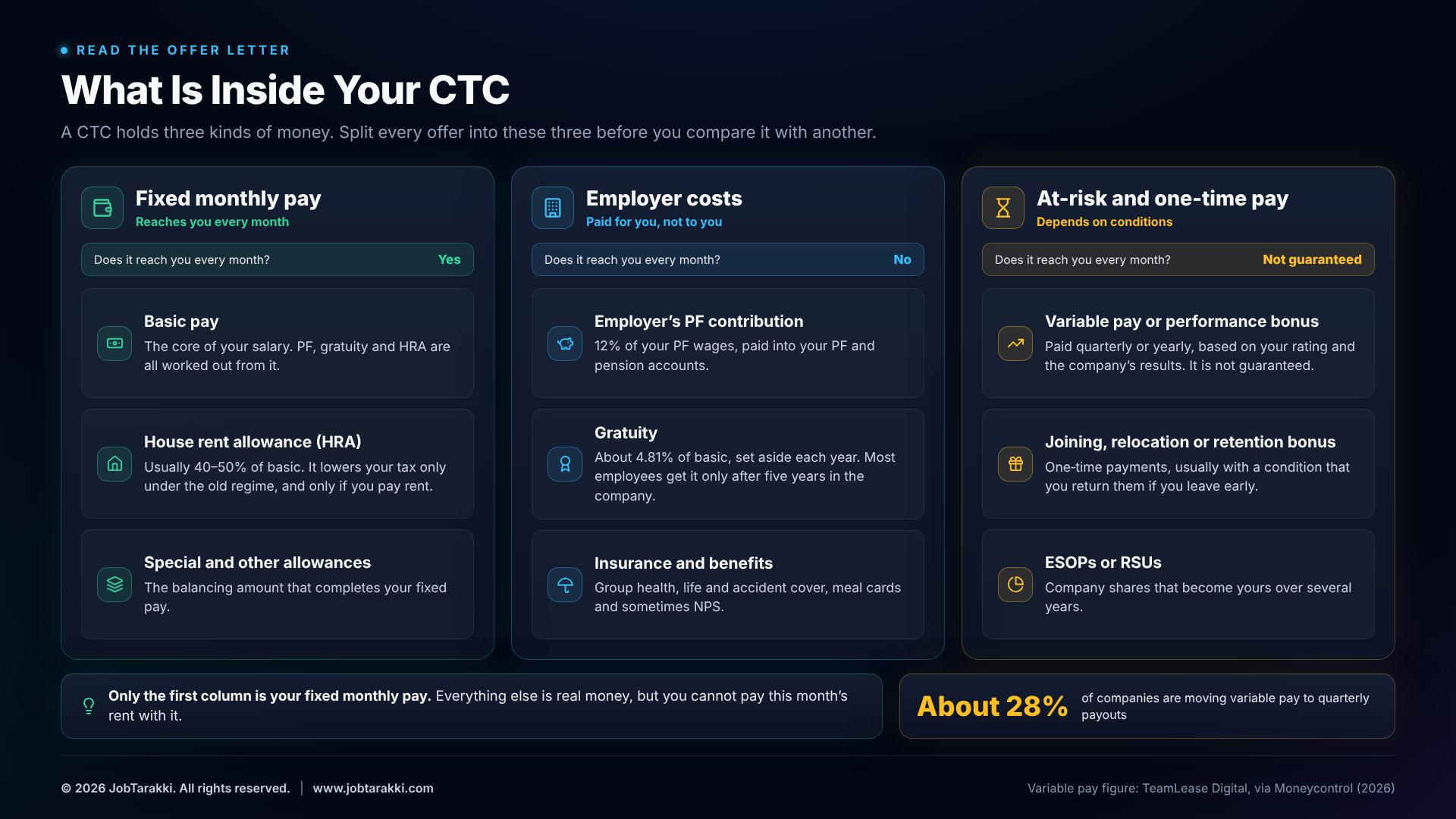
A CTC holds three kinds of money: pay you get every month, money the company spends on your behalf, and pay that depends on conditions.
| Part of CTC | What it is | Does it reach you every month? |
|---|---|---|
| Basic pay | The core of your salary. PF, gratuity and HRA are all worked out from it | Yes |
| House rent allowance (HRA) | Usually 40–50% of basic. It lowers your tax only under the old regime, and only if you pay rent | Yes |
| Special and other allowances | The balancing amount that completes your fixed pay | Yes |
| Employer’s PF contribution | 12% of your PF wages, paid into your PF and pension accounts | No. It goes into your PF |
| Gratuity | About 4.81% of basic, set aside each year. Most employees get it only after five years in the company | No |
| Insurance and benefits | Group health, life and accident cover, meal cards and sometimes NPS | No |
| Variable pay or performance bonus | Paid quarterly or yearly, based on your rating and the company’s results | No, and it is not guaranteed |
| Joining, relocation or retention bonus | One-time payments, usually with a condition that you return them if you leave early | One time only |
| ESOPs or RSUs | Company shares that become yours over several years | No |
The first three rows are your fixed monthly pay. Everything below them is real money, but you cannot pay this month’s rent with it.
Variable pay needs the closest look. A 2026 Moneycontrol report, citing TeamLease Digital, said about 28% of companies were moving variable pay to quarterly payouts (Moneycontrol, shared by Trilegal).
What this means for you: before you compare two offers, split each one into fixed pay, employer costs and at-risk pay.
What Changed in 2026: The Labour Codes and the PF Ceiling
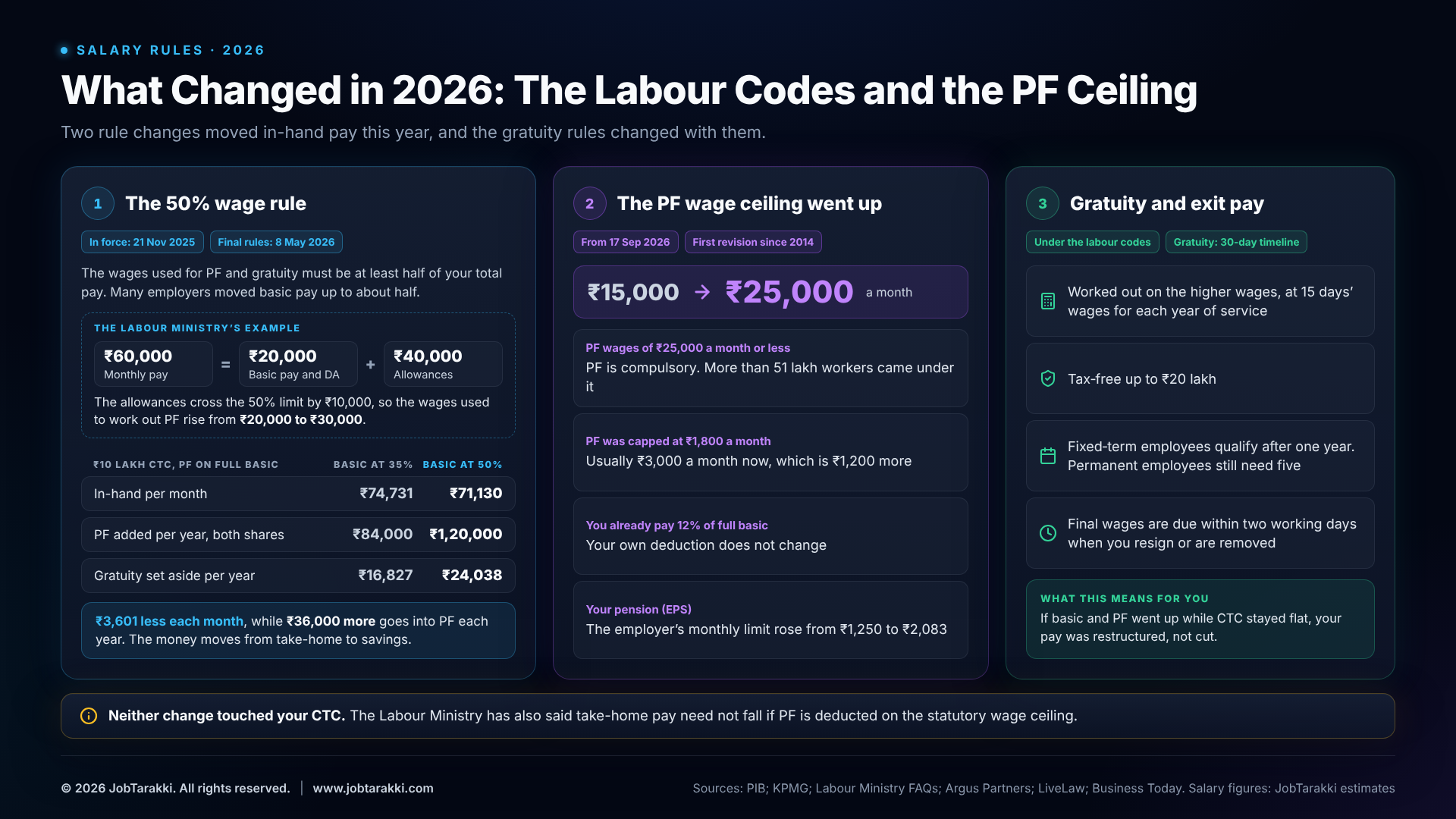
Two rule changes moved in-hand pay in 2026. Neither of them changed your CTC.
1. The 50% wage rule
The Code on Wages defines wages as basic pay, dearness allowance and retaining allowance. Items such as HRA, conveyance allowance and the employer’s PF contribution are left out (King Stubb & Kasiva). But if the left-out items add up to more than half of your total pay, the extra is added back to wages (Labour Ministry FAQs, via SCC Online).
The Labour Ministry’s own example: on a monthly pay of ₹60,000 with ₹20,000 of basic pay and DA and ₹40,000 of allowances, the allowances cross the 50% limit by ₹10,000. So the wages used to work out PF rise from ₹20,000 to ₹30,000 (Business Today).
The rule does not necessarily mean that every company must redesign its salary structure, and lawyers call the idea that basic must be exactly 50% of CTC a common misconception (King Stubb & Kasiva). In practice, many employers moved basic pay up to about half of the package. Before this, basic was often 30–35% of CTC (Business Standard).
A higher basic changes three things:
- PF goes up if your company works it out on full basic, because both shares are 12% of a bigger number.
- Gratuity goes up, because it is based on your last drawn wages.
- Take-home goes down, because more of the same CTC moves into PF and gratuity.
For a ₹10 lakh CTC with PF on full basic, moving basic from 35% to 50% looks like this:
| What you get | Basic at 35% of CTC (older structure) | Basic at 50% of CTC (2026 structure) |
|---|---|---|
| In-hand per month | ₹74,731 | ₹71,130 |
| PF added per year, both shares | ₹84,000 | ₹1,20,000 |
| Gratuity set aside per year | ₹16,827 | ₹24,038 |
This employee gets ₹3,601 less each month, while ₹36,000 more goes into PF each year. The money moves from take-home to savings.
There is one important exception. The ministry has said take-home pay need not fall if PF is deducted on the statutory wage ceiling, and that contributing on wages above the ceiling is voluntary (Business Today).
Employers felt it too. Six big IT companies together booked about ₹5,400 crore of one-time costs for the codes in the October–December 2025 quarter (PTI, via The Week).
2. The PF wage ceiling is now ₹25,000
From 17 September 2026, the PF wage ceiling is ₹25,000 a month, up from ₹15,000 (PIB). October 2026 was the first full salary month under it (Business Today).
| Your situation | What changed |
|---|---|
| Your PF wages are ₹25,000 a month or less | PF is compulsory. More than 51 lakh workers earning ₹15,000–25,000 came under it |
| Your PF was capped at ₹1,800 a month and your PF wages are ₹25,000 or more | Your deduction is usually ₹3,000 a month now, which is ₹1,200 more |
| You already pay 12% of your full basic | Your own deduction does not change |
| Your pension (EPS) | The most your employer can put into your pension each month rose from ₹1,250 to ₹2,083 |
The rows for existing members follow Argus Partners’ reading of the notification (Argus Partners).
EPFO has also said the employer’s share is legally separate from yours. An employer cannot treat it as your deduction just because the offer letter shows it inside CTC (Business Today). If your take-home changed in October, ask HR how the higher PF was handled in your pay.
3. Gratuity and exit pay
- Gratuity is worked out on the higher wages, at 15 days’ wages for each year of service. It is tax-free up to ₹20 lakh (IndianPayCalculator).
- Fixed-term employees qualify after one year (KPMG). Permanent employees still need five years.
- Final wages are due within two working days when you resign or are removed. Gratuity has its own 30-day timeline (LiveLaw).
What this means for you: put this year’s payslips next to last year’s. If basic and PF went up while CTC stayed flat, your pay was restructured, not cut.
What Gets Deducted From Your Salary Every Month
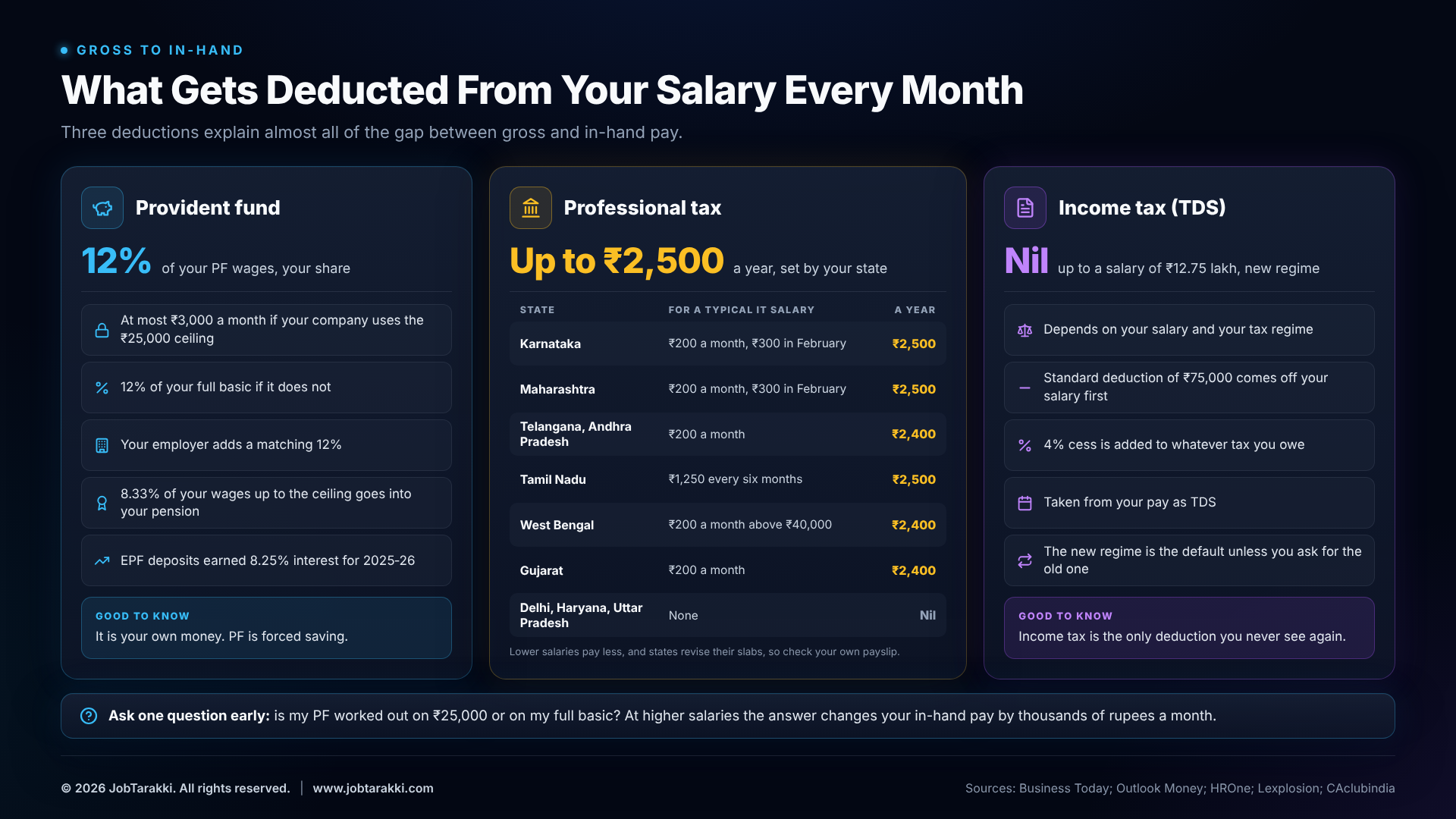
Three deductions explain almost all of the gap between gross and in-hand pay.
| Deduction | How much | Good to know |
|---|---|---|
| Provident fund (your share) | 12% of your PF wages. That is at most ₹3,000 a month if your company uses the ₹25,000 ceiling, or 12% of your full basic if it does not | It is your own money, and it earns interest |
| Professional tax | Up to ₹2,500 a year, set by your state | Some states charge nothing |
| Income tax (TDS) | Depends on your salary and your tax regime | Nil up to a salary of ₹12.75 lakh under the new regime |
Provident fund
Your employer adds a matching 12%. Out of the employer’s share, 8.33% of your wages up to the ceiling goes into your pension account, and the rest goes into your EPF (Business Today). EPF deposits earned 8.25% interest for 2025-26 (Outlook Money).
PF is compulsory if your PF wages are ₹25,000 a month or less. If your wages are higher and you have never been a PF member, you are not required to join. If you are already a member, you continue (Argus Partners).
Professional tax
Professional tax is a small state tax on salaried people. For a typical IT salary it looks like this:
| State | Professional tax |
|---|---|
| Karnataka | ₹200 a month and ₹300 in February, so ₹2,500 a year |
| Maharashtra | ₹200 a month and ₹300 in February, so ₹2,500 a year |
| Telangana and Andhra Pradesh | ₹200 a month, so ₹2,400 a year |
| Tamil Nadu | ₹1,250 every six months, so ₹2,500 a year |
| West Bengal | ₹200 a month for salaries above ₹40,000, so ₹2,400 a year |
| Gujarat | ₹200 a month, so ₹2,400 a year |
| Delhi, Haryana and Uttar Pradesh | None |
Sources: HROne for the state slabs and Lexplosion for Karnataka’s 2025 revision. Lower salaries pay less, and states revise their slabs, so check your own payslip.
You may also see ESI if your monthly wages are ₹21,000 or less (Labour Ministry FAQs, via SCC Online), a small labour welfare fund amount in some states, and anything you choose yourself, such as extra PF (VPF) or NPS.
What this means for you: income tax is the only deduction you never see again. PF is forced saving. So ask one question early: is my PF worked out on ₹25,000 or on my full basic? At higher salaries the answer changes your in-hand pay by thousands of rupees a month.
Income Tax in FY 2026-27: New Regime vs Old Regime
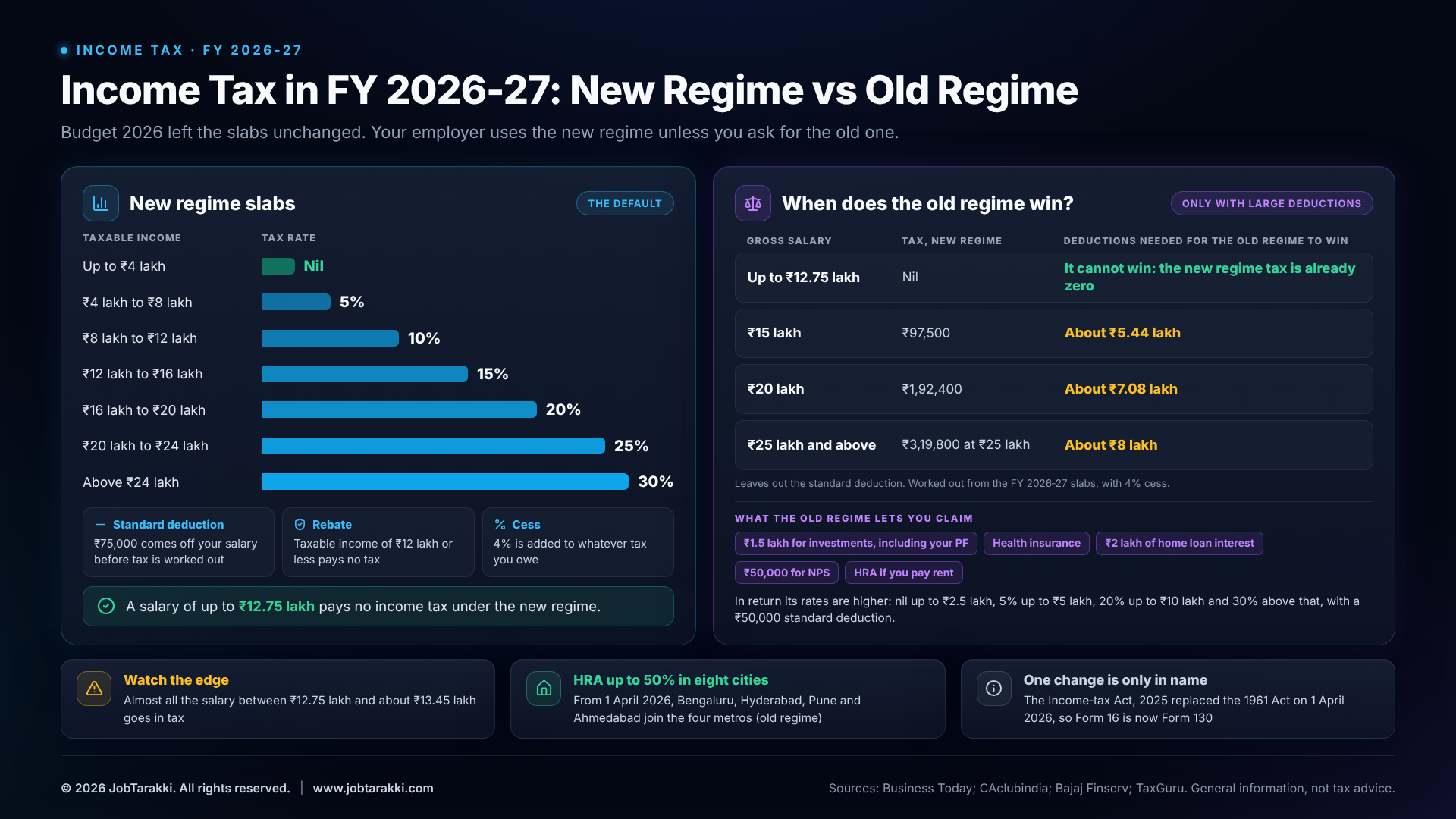
Budget 2026 left the tax slabs unchanged, and the new regime is still the default (Business Today). Your employer will use the new regime unless you ask for the old one.
New regime
| Taxable income | Tax rate |
|---|---|
| Up to ₹4 lakh | Nil |
| ₹4 lakh to ₹8 lakh | 5% |
| ₹8 lakh to ₹12 lakh | 10% |
| ₹12 lakh to ₹16 lakh | 15% |
| ₹16 lakh to ₹20 lakh | 20% |
| ₹20 lakh to ₹24 lakh | 25% |
| Above ₹24 lakh | 30% |
Three rules sit on top of the slabs (CAclubindia):
- Standard deduction: ₹75,000 comes off your salary before tax is worked out.
- Rebate: if your taxable income is ₹12 lakh or less, the rebate wipes out your tax. With the standard deduction, a salary of up to ₹12.75 lakh pays nothing.
- Cess: 4% is added to whatever tax you owe.
Watch the edge. Just above ₹12 lakh of taxable income, your tax is limited to the amount by which you cross ₹12 lakh, plus cess. In effect, almost all the salary between ₹12.75 lakh and about ₹13.45 lakh goes in tax.
One deduction that still works in the new regime is your employer’s contribution to NPS, up to 14% of basic pay. If your company offers NPS inside the CTC, it can lower your tax.
Old regime
The old regime has higher rates: nil up to ₹2.5 lakh, 5% up to ₹5 lakh, 20% up to ₹10 lakh and 30% above that. Its standard deduction is ₹50,000.
In return, it lets you claim deductions: up to ₹1.5 lakh for investments including your own PF, health insurance premiums, up to ₹2 lakh of home loan interest, ₹50,000 for NPS, and HRA if you pay rent (Bajaj Finserv).
One 2026 change helps renters in IT cities. From 1 April 2026, Bengaluru, Hyderabad, Pune and Ahmedabad join Delhi, Mumbai, Kolkata and Chennai on the list where HRA can be exempt up to 50% of salary instead of 40% (TaxGuru).
Which one pays less?
The old regime wins only when your deductions are large. Leaving out the standard deduction, this is roughly how much you need in deductions and exemptions before the old regime beats the new one:
| Gross salary | Tax under the new regime | Deductions needed for the old regime to win |
|---|---|---|
| Up to ₹12.75 lakh | Nil | It cannot win, because the new regime tax is already zero |
| ₹15 lakh | ₹97,500 | About ₹5.44 lakh |
| ₹20 lakh | ₹1,92,400 | About ₹7.08 lakh |
| ₹25 lakh and above | ₹3,19,800 at ₹25 lakh | About ₹8 lakh |
These figures are worked out from the FY 2026-27 slabs, with 4% cess.
So if you do not have both a home loan and high rent, the new regime is usually lower. If you have both, run the numbers and tell your payroll team which regime you want.
One change is only in name. The Income-tax Act, 2025 replaced the 1961 Act on 1 April 2026, so Form 16 is now Form 130. The slabs are the same.
What this means for you: for most people earning up to about ₹15 lakh, the new regime is the simple choice. Above that, check your deductions against the table before you decide.
In-Hand Salary by CTC: ₹3 Lakh to ₹50 Lakh
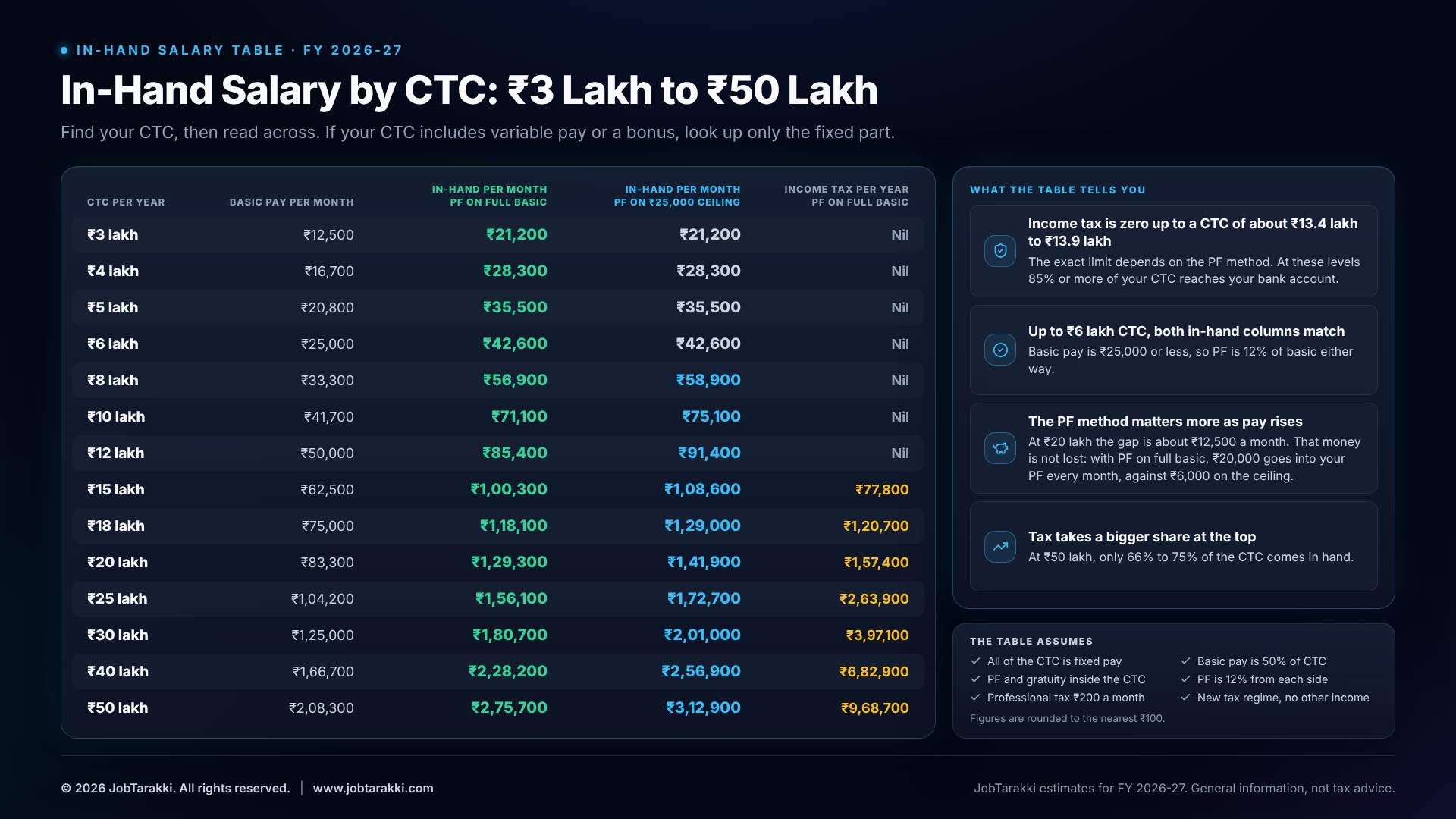
This table shows the monthly in-hand salary for common CTC levels in FY 2026-27. Find your CTC, then read across.
| CTC per year | Basic pay per month | In-hand per month, PF on full basic | In-hand per month, PF on the ₹25,000 ceiling | Income tax per year, PF on full basic |
|---|---|---|---|---|
| ₹3 lakh | ₹12,500 | ₹21,200 | ₹21,200 | Nil |
| ₹4 lakh | ₹16,700 | ₹28,300 | ₹28,300 | Nil |
| ₹5 lakh | ₹20,800 | ₹35,500 | ₹35,500 | Nil |
| ₹6 lakh | ₹25,000 | ₹42,600 | ₹42,600 | Nil |
| ₹8 lakh | ₹33,300 | ₹56,900 | ₹58,900 | Nil |
| ₹10 lakh | ₹41,700 | ₹71,100 | ₹75,100 | Nil |
| ₹12 lakh | ₹50,000 | ₹85,400 | ₹91,400 | Nil |
| ₹15 lakh | ₹62,500 | ₹1,00,300 | ₹1,08,600 | ₹77,800 |
| ₹18 lakh | ₹75,000 | ₹1,18,100 | ₹1,29,000 | ₹1,20,700 |
| ₹20 lakh | ₹83,300 | ₹1,29,300 | ₹1,41,900 | ₹1,57,400 |
| ₹25 lakh | ₹1,04,200 | ₹1,56,100 | ₹1,72,700 | ₹2,63,900 |
| ₹30 lakh | ₹1,25,000 | ₹1,80,700 | ₹2,01,000 | ₹3,97,100 |
| ₹40 lakh | ₹1,66,700 | ₹2,28,200 | ₹2,56,900 | ₹6,82,900 |
| ₹50 lakh | ₹2,08,300 | ₹2,75,700 | ₹3,12,900 | ₹9,68,700 |
The table assumes:
- The whole CTC is fixed pay, with no variable pay, bonus or insurance counted in it.
- Basic pay is 50% of CTC.
- The employer’s PF share and gratuity (4.81% of basic) are inside the CTC.
- PF is 12% from each side, either on full basic or on the ₹25,000 ceiling.
- Professional tax is ₹200 a month.
- You are on the new tax regime, with no other income and no employer NPS.
- Figures are rounded to the nearest ₹100.
What the table tells you:
- Up to a CTC of about ₹13.4 lakh to ₹13.9 lakh, income tax is zero. The exact limit depends on the PF method. At these levels 85% or more of your CTC reaches your bank account.
- Up to ₹6 lakh CTC, both in-hand columns match. Basic pay is ₹25,000 or less, so PF is 12% of basic either way.
- The PF method matters more as pay rises. At ₹20 lakh the gap is about ₹12,500 a month. That money is not lost: with PF on full basic, ₹20,000 goes into your PF every month, against ₹6,000 on the ceiling.
- Tax takes a bigger share at the top. At ₹50 lakh, only 66% to 75% of the CTC comes in hand.
If your CTC includes variable pay or a bonus, look up only the fixed part. A ₹15 lakh CTC with ₹3 lakh of variable pay starts from the ₹12 lakh row. Variable pay comes on top when it is actually paid, and it is taxed too.
Work out your own in-hand salary in five steps
Your structure may not match the table, so here is the method.
- Find your fixed pay. Take your CTC and remove variable pay, one-time bonuses and benefits such as insurance.
- Remove the employer’s costs. Subtract the employer’s PF contribution and gratuity, which is about 4.81% of basic. What is left is your gross salary.
- Subtract your PF. This is 12% of your PF wages.
- Subtract professional tax. This is usually ₹200 a month.
- Subtract income tax. Take ₹75,000 off your gross salary, apply the slabs, add 4% cess and divide by 12.
Here is the working for a ₹15 lakh CTC that is all fixed pay, with PF on full basic:
| Step | Working | Amount per year |
|---|---|---|
| Fixed pay | The whole CTC | ₹15,00,000 |
| Basic pay | 50% of ₹15,00,000 | ₹7,50,000 |
| Employer’s PF and gratuity | ₹90,000 + ₹36,058 | − ₹1,26,058 |
| Gross salary | ₹15,00,000 − ₹1,26,058 | ₹13,73,942 |
| Your PF | 12% of ₹7,50,000 | − ₹90,000 |
| Professional tax | ₹200 × 12 | − ₹2,400 |
| Income tax | Taxable income is ₹12,98,942. Tax is ₹74,841, plus 4% cess | − ₹77,835 |
| In-hand salary | ₹12,03,707 a year | ₹1,00,309 a month |
Case Study: The Bigger CTC That Pays Less Every Month
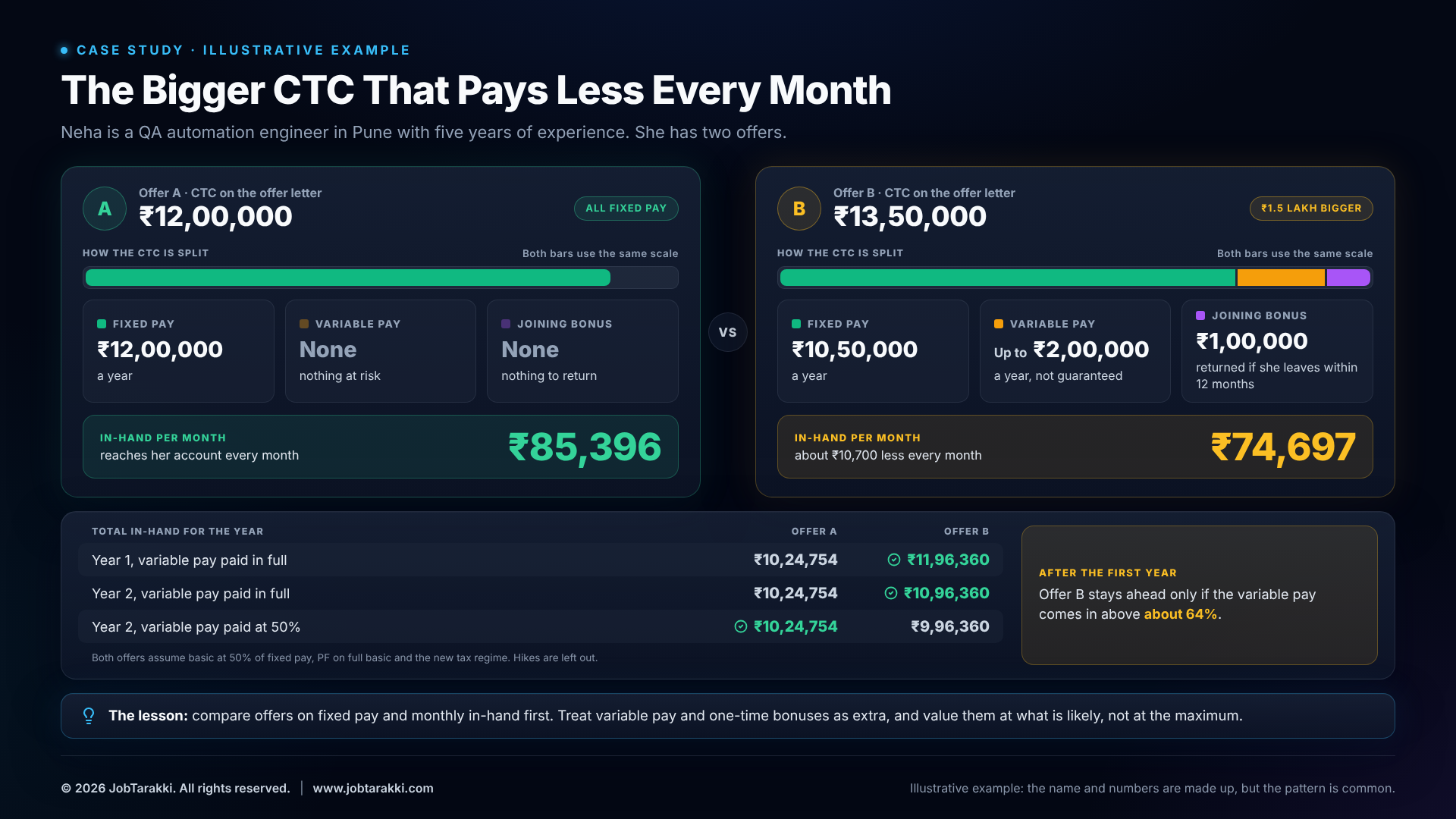
A higher CTC does not always mean more money in your account. Here is an illustrative example. The name and numbers are made up, but the pattern is common.
Neha is a QA automation engineer in Pune with five years of experience. She has two offers.
| What the offer says | Offer A | Offer B |
|---|---|---|
| CTC on the offer letter | ₹12,00,000 | ₹13,50,000 |
| Fixed pay | ₹12,00,000 | ₹10,50,000 |
| Variable pay | None | Up to ₹2,00,000 a year |
| Joining bonus | None | ₹1,00,000, to be returned if she leaves within 12 months |
| In-hand per month | ₹85,396 | ₹74,697 |
Offer B looks ₹1.5 lakh bigger. But it puts about ₹10,700 less in her account every month.
What about the whole year? That depends on how much of the variable pay is actually paid.
| Total in-hand for the year | Offer A | Offer B |
|---|---|---|
| Year 1, variable pay paid in full | ₹10,24,754 | ₹11,96,360 |
| Year 2, variable pay paid in full | ₹10,24,754 | ₹10,96,360 |
| Year 2, variable pay paid at 50% | ₹10,24,754 | ₹9,96,360 |
After the first year, Offer B stays ahead only if the variable pay comes in above about 64%. Both offers assume basic at 50% of fixed pay, PF on full basic and the new tax regime. Hikes are left out.
Before deciding, Neha asks the Offer B recruiter two things: the usual variable payout at her level over the last two years, and whether the joining bonus has to be returned in full if she leaves early.
The lesson: compare offers on fixed pay and monthly in-hand first. Treat variable pay and one-time bonuses as extra, and value them at what is likely, not at the maximum.
How to Compare Offers and Negotiate on In-Hand Pay
A CTC hike is not the same as an in-hand hike
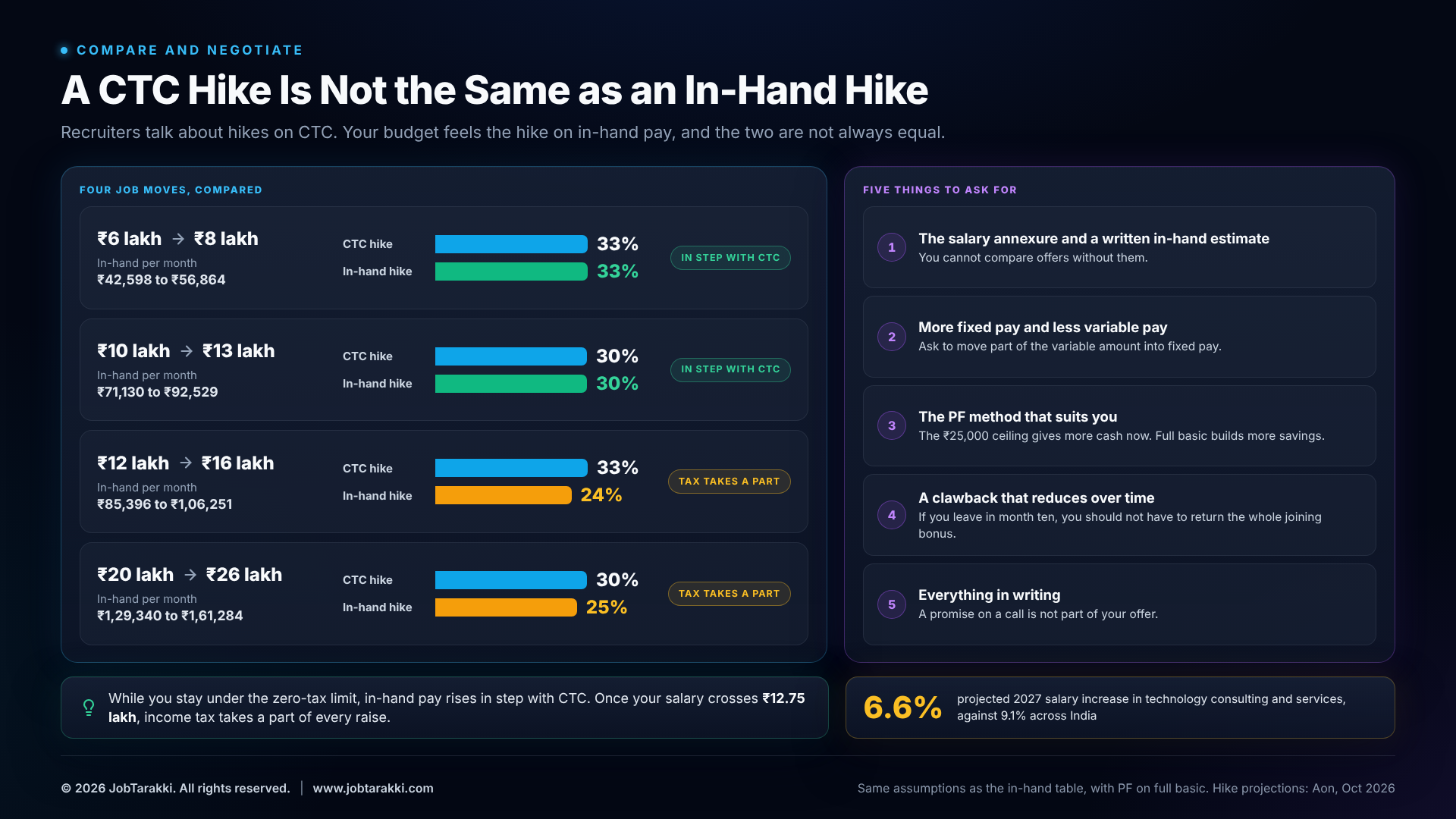
Recruiters talk about hikes on CTC. Your budget feels the hike on in-hand pay, and the two are not always equal.
| Move | CTC hike | In-hand per month | In-hand hike |
|---|---|---|---|
| ₹6 lakh to ₹8 lakh | 33% | ₹42,598 to ₹56,864 | 33% |
| ₹10 lakh to ₹13 lakh | 30% | ₹71,130 to ₹92,529 | 30% |
| ₹12 lakh to ₹16 lakh | 33% | ₹85,396 to ₹1,06,251 | 24% |
| ₹20 lakh to ₹26 lakh | 30% | ₹1,29,340 to ₹1,61,284 | 25% |
These use the same assumptions as the table above, with PF on full basic.
While you stay under the zero-tax limit, in-hand pay rises in step with CTC. Once your salary crosses ₹12.75 lakh, income tax takes a part of every raise.
This matters more when raises are small. Aon projects salary increases of 6.6% in 2027 for technology consulting and services, the lowest of any sector in its survey, against 9.1% across India (Aon).
Five things to ask for
- The salary annexure and a written in-hand estimate. You cannot compare offers without them.
- More fixed pay and less variable pay. Ask to move part of the variable amount into fixed pay.
- The PF method that suits you. PF on the ₹25,000 ceiling gives more cash now. PF on full basic builds more savings. Ask if the company lets you choose.
- A clawback that reduces over time. If you leave in month ten, you should not have to return the whole joining bonus.
- Everything in writing. A promise on a call is not part of your offer.
A simple way to ask: “Could you share the fixed monthly gross and the expected in-hand salary under the new tax regime? I would like to compare my offers on fixed pay.”
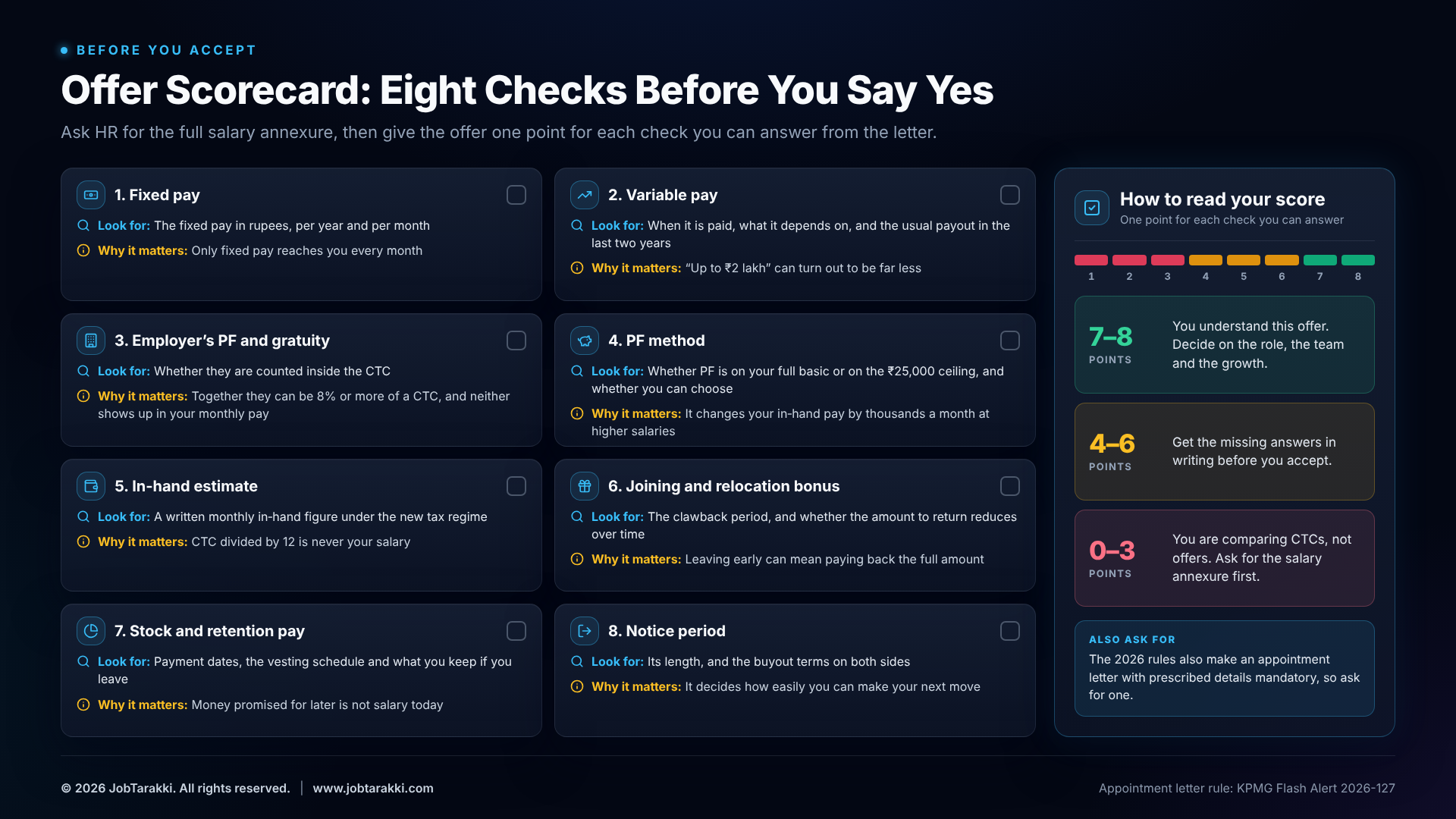
Offer Scorecard: Eight Checks Before You Say Yes
Ask HR for the full salary annexure, not just the CTC figure. Then score the offer: give it one point for each check you can answer from the letter.
| Check | What to look for | Why it matters |
|---|---|---|
| 1. Fixed pay | The fixed pay in rupees, per year and per month | Only fixed pay reaches you every month |
| 2. Variable pay | When it is paid, what it depends on, and the usual payout in the last two years | “Up to ₹2 lakh” can turn out to be far less |
| 3. Employer’s PF and gratuity | Whether they are counted inside the CTC | Together they can be 8% or more of a CTC, and neither shows up in your monthly pay |
| 4. PF method | Whether PF is on your full basic or on the ₹25,000 ceiling, and whether you can choose | It changes your in-hand pay by thousands a month at higher salaries |
| 5. In-hand estimate | A written monthly in-hand figure under the new tax regime | CTC divided by 12 is never your salary |
| 6. Joining and relocation bonus | The clawback period, and whether the amount to return reduces over time | Leaving early can mean paying back the full amount |
| 7. Stock and retention pay | Payment dates, the vesting schedule and what you keep if you leave | Money promised for later is not salary today |
| 8. Notice period | Its length, and the buyout terms on both sides | It decides how easily you can make your next move |
How to read your score:
- 7–8 points: you understand this offer. Decide on the role, the team and the growth.
- 4–6 points: get the missing answers in writing before you accept.
- 0–3 points: you are comparing CTCs, not offers. Ask for the salary annexure first.
The 2026 rules also make an appointment letter with prescribed details mandatory, so ask for one (KPMG).
Conclusion: Plan on In-Hand Pay, Not CTC
Your CTC is what you cost the company. Your in-hand salary is what you live on. In 2026 the distance between the two grew for many people, because the labour codes pushed basic pay up and the PF ceiling rose to ₹25,000, while the tax slabs stayed the same.
Before you accept an offer or plan a budget, do three things:
- Split the CTC into fixed pay, employer costs and at-risk pay.
- Work out the monthly in-hand salary with the five steps above, or ask HR for it in writing.
- Negotiate the structure, not just the total: more fixed pay, clear bonus terms and the PF method that suits you.
And remember that PF is still your money, and so is gratuity once you complete five years. They are just paid later.
Ready to see where you stand? If you are a fresher, estimate offers for your target roles with Salary Intelligence. Check your resume against your target role with the Resume Analyzer, and see where your career stands with JobTarakki Career Check.
Sources
All links checked on 10 November 2026.
- EPFO Raises Wage Ceiling from Rs. 15,000 to Rs. 25,000; Over 51 Lakh Workers to Benefit — Press Information Bureau, Ministry of Labour & Employment, September 2026
- GMS Flash Alert 2026-127: final central rules under the four labour codes — KPMG, May 2026
- Labour Ministry FAQs on the four labour codes — SCC Online, April 2026
- 50% Wage Rule Under India’s New Labour Codes: Impact on Salary, PF and Gratuity — King Stubb & Kasiva, August 2026
- Impact of new Labour Codes: What changes for salary, PF, gratuity — Business Standard, April 2026
- Govt ends confusion: new labour codes won’t cut your take-home pay if PF stays on Rs 15,000 ceiling — Business Today, December 2025
- Q3 earnings: Major IT cos take cumulative hit of Rs 5,400 cr from new labour code implementation — PTI, via The Week, January 2026
- IT employees feel the squeeze as firms redraw salary structures under labour code shift — Moneycontrol, shared by Trilegal, 2026
- EPFO Rs 25,000 ceiling: How much PF will be deducted from your salary from October 2026? — Business Today, September 2026
- Revision to EPF Wage Ceiling: Coverage, Contributions and the September Transition — Argus Partners, September 2026
- Govt ratifies 8.25 per cent EPF interest rate for 2025-26 — Outlook Money, June 2026
- Tax slabs FY 2026–27: What Budget 2026 changed for individual taxpayers and which regime works best — Business Today, February 2026
- New Tax Regime 2026-27: Slabs, Rebate & Relief Explained — CAclubindia, October 2026
- Income tax changes for FY 2026-27 — Bajaj Finserv, October 2026
- New Income Tax Rules 2026 Notified: Every Taxpayer Must Know — TaxGuru, March 2026
- Professional Tax Slab Rates 2026-27: Complete State-Wise Guide for HR & Payroll Teams — HROne, June 2026
- Karnataka notifies revised professional tax rate under the 2025 Amendment Act — Lexplosion, May 2025
- Gratuity calculation formula (15/26) — IndianPayCalculator, June 2026
- Two Working Days: Code On Wages And Employee’s Final Settlement — LiveLaw, October 2026
- Aon Study Finds Salaries in India Projected to Rise 9.1% in 2027 as Employers Balance Growth and Cost Pressures — Aon, October 2026
- Salary Intelligence — JobTarakki, checked 10 November 2026