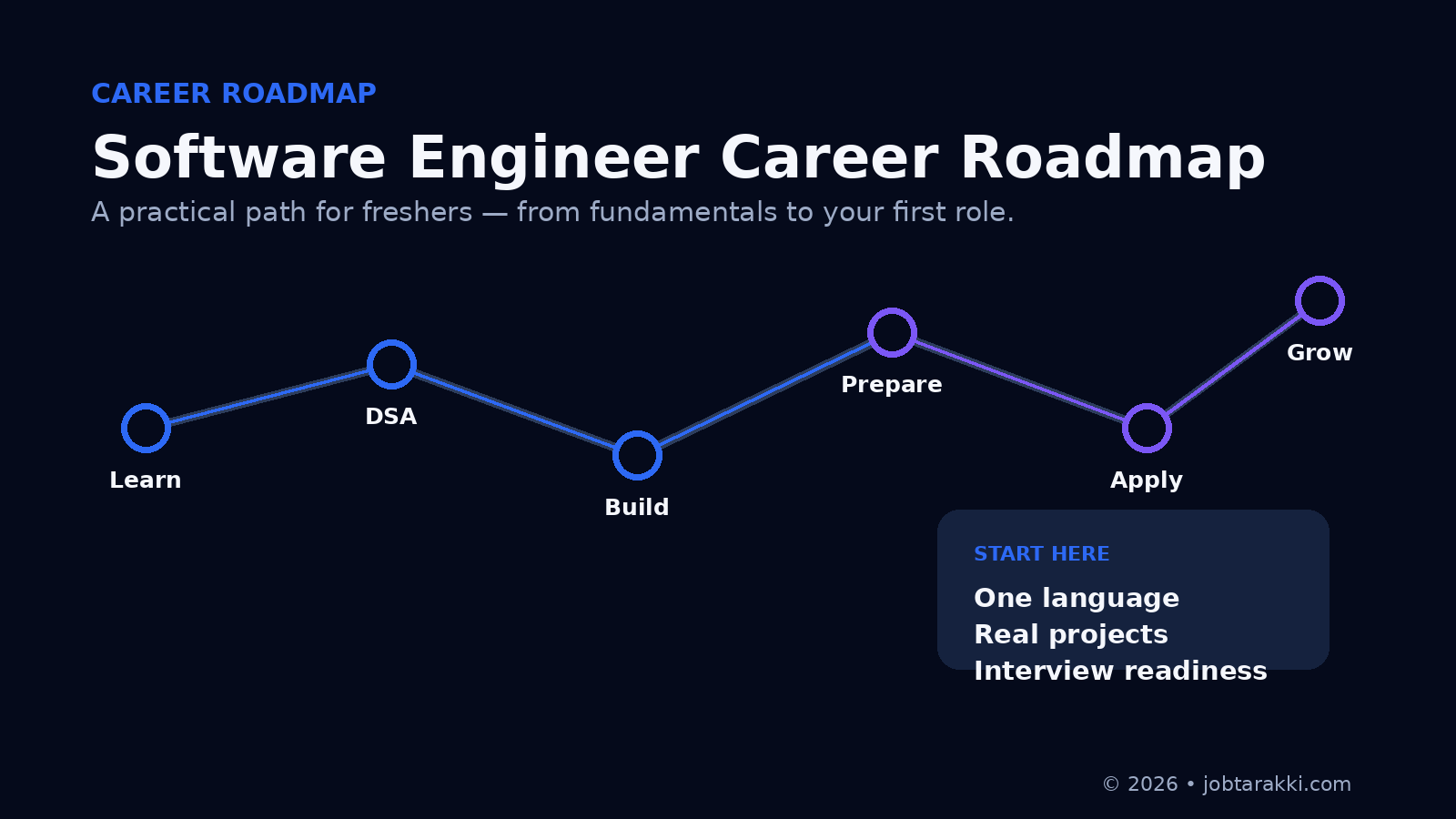
Starting a career in software engineering can feel confusing when you're a fresher.
You might know some programming, have completed a few college projects, or be learning data structures and algorithms. But when you look at software engineering job descriptions, you may see programming languages, databases, frameworks, cloud platforms, system design, and many other requirements.
The obvious question is:
What should you actually learn to get your first software engineering job?
The good news is that you don't need to master every technology before starting your career.
You need a solid foundation, practical projects, problem-solving ability, interview preparation, and a clear understanding of the type of role you want to pursue.
This guide provides a practical software engineer career roadmap for freshers in India, from learning programming fundamentals to preparing for interviews and evaluating your first opportunities.
Quick Summary
If you're starting your software engineering journey, here's a practical path:
- Learn one programming language well.
- Build strong programming fundamentals.
- Learn data structures and algorithms.
- Learn Git, databases, APIs, and basic developer tools.
- Choose a software engineering direction.
- Build practical projects.
- Prepare your resume and portfolio.
- Prepare for technical interviews.
- Start applying for internships and entry-level roles.
- Research career and salary information when evaluating opportunities.
You don't have to complete every step perfectly before moving forward.
The goal is to keep building useful skills while gradually becoming more prepared for real software engineering work.
1. What Does a Software Engineer Do?
A software engineer designs, develops, tests, maintains, and improves software systems.
Depending on the role, a software engineer might work on websites, backend services, mobile applications, databases, APIs, cloud infrastructure, automation, or other software systems.
For someone starting their career, the work may involve:
- Understanding existing code.
- Building new features.
- Fixing bugs.
- Writing tests.
- Working with databases and APIs.
- Using version control.
- Debugging problems.
- Collaborating with other engineers.
- Learning the team's development process.
Software engineering isn't only about writing code.
You also need to understand problems, make reasonable technical decisions, communicate clearly, and work with other people.
That's why your preparation should include both technical knowledge and practical development experience.
2. What Skills Do Freshers Need?
You can think about your preparation in five broad areas.
| Skill Area | What to Learn |
|---|---|
| Programming | One programming language, syntax, functions, data types, OOP |
| Problem Solving | DSA, algorithms, debugging, complexity |
| Development | Git, databases, APIs, testing, chosen tech stack |
| Practical Skills | Projects, documentation, deployment basics |
| Career Preparation | Resume, interviews, communication, job applications |
You don't need to become an expert in everything before applying.
Instead, build a strong foundation and gradually develop the ability to demonstrate what you know.
3. Step One: Choose Your First Programming Language
One of the first decisions you'll make is choosing a programming language.
You may see people comparing Java, Python, C++, JavaScript, and many other languages.
There isn't one programming language that every fresher must learn.
The better approach is to choose a language that matches your learning goals and then spend enough time with it to become comfortable solving problems and building applications.
Java
Java is widely used in backend and enterprise software development.
If you choose Java, focus on:
- Java fundamentals
- Object-oriented programming
- Collections
- Exception handling
- Generics
- Basic concurrency concepts
Python
Python is commonly used for backend development, automation, data-related work, and AI applications.
Start with:
- Python syntax
- Data types
- Functions
- Lists and dictionaries
- Modules
- Object-oriented programming
- Error handling
JavaScript
JavaScript is an important language for web development.
If you're interested in frontend or full-stack development, learn:
- JavaScript fundamentals
- DOM and browser concepts
- Asynchronous programming
- APIs
- Modern JavaScript syntax
Then you can move into a framework such as React.
C++
C++ is useful for learning programming fundamentals and practicing DSA.
You can focus on:
- Syntax
- Functions
- Classes
- Pointers and references
- STL
- Data structures
- Problem solving
Which programming language should a fresher choose?
A simple approach is:
- Interested in backend development? Consider Java or Python.
- Interested in web development? Consider JavaScript.
- Already comfortable with C++ from college? You can continue using it.
- Unsure? Pick one language and stick with it instead of constantly switching.
Depth is more useful than collecting programming languages.
4. Step Two: Build Strong Programming Fundamentals
Before jumping into advanced frameworks, make sure you understand basic programming.
You should be comfortable with:
- Variables and data types
- Conditional statements
- Loops
- Functions
- Arrays
- Strings
- Collections
- Object-oriented programming
- Exception handling
- Basic recursion
- Debugging
You should also learn how to break a problem into smaller steps.
For example, instead of immediately trying to solve a large application problem, ask:
What is the input?
What should the output look like?
What smaller problems make up the main problem?
What data do I need to store?
What could go wrong?
This way of thinking becomes increasingly important as you move from learning programming to building real software.
5. Step Three: Learn Data Structures and Algorithms
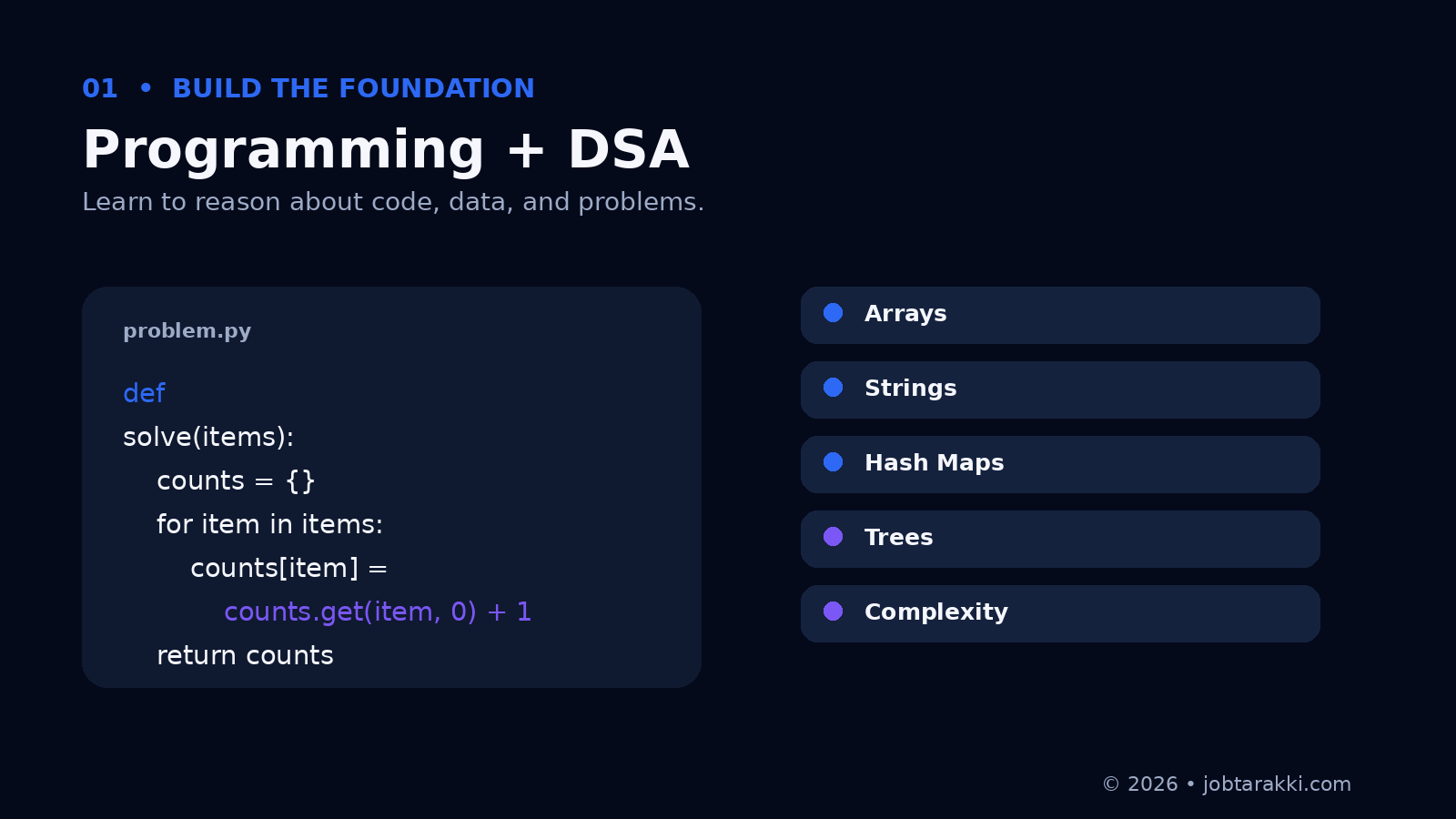
Data structures and algorithms, commonly called DSA, are an important part of technical interview preparation.
They also help you understand how to organize information and solve computational problems efficiently.
Start with:
- Arrays
- Strings
- Hash maps
- Linked lists
- Stacks
- Queues
- Trees
- Graphs
- Sorting
- Searching
- Recursion
- Basic dynamic programming
- Time and space complexity
Don't make DSA your entire preparation
One common mistake is spending months solving coding problems while never building an actual application.
DSA and practical development serve different purposes.
DSA helps with problem solving and many technical interviews.
Projects help demonstrate that you can build software.
You should develop both.
A better way to practice DSA
Instead of randomly solving hundreds of problems:
- Learn one concept.
- Understand how it works.
- Solve several problems using it.
- Review different approaches.
- Understand time and space complexity.
- Revisit problems you couldn't solve.
- Practice explaining your solution.
The goal isn't simply to increase your problem count.
The goal is to improve your ability to reason through unfamiliar problems.
6. Step Four: Learn Git, Databases, APIs, and Developer Tools
Programming is only one part of software development.
You also need to become comfortable with the tools developers use to build and maintain applications.
Git and GitHub
Learn how to:
- Create repositories.
- Make commits.
- Create branches.
- Merge changes.
- Resolve basic conflicts.
- Push code to a remote repository.
- Write useful README files.
You can use the official Git documentation as a reference.
Databases and SQL
Learn the fundamentals of relational databases.
Start with:
- Tables
- Rows and columns
- Primary keys
- Foreign keys
- Relationships
- SELECT
- INSERT
- UPDATE
- DELETE
- WHERE
- GROUP BY
- JOIN
- Basic indexing
PostgreSQL is one option you can use while learning SQL and relational database concepts.
The PostgreSQL documentation is a useful reference.
APIs and HTTP
You should also understand how applications communicate.
Learn:
- What an API is
- HTTP
- GET
- POST
- PUT
- PATCH
- DELETE
- JSON
- HTTP status codes
- Authentication basics
- API testing
You don't need to master every networking concept at this stage.
Start by understanding how a client sends a request and how a server processes and returns a response.
7. Step Five: Choose Your Software Engineering Career Path
Once you understand programming fundamentals, start exploring the type of software engineering work you enjoy.
You don't need to decide your entire career at this stage.
Your first direction can simply give you something specific to focus on.
Frontend Development
Frontend engineers build the parts of applications users interact with.
Learn:
- HTML
- CSS
- JavaScript
- Responsive design
- Accessibility
- A frontend framework such as React
- API integration
A beginner project could be a job application tracker with search, filtering, and application status.
Backend Development
Backend engineers build server-side systems, APIs, and application logic.
Learn:
- A backend language and framework
- REST APIs
- HTTP
- SQL
- Database design
- Authentication
- Testing
- Error handling
A good beginner project could be a task management API with authentication and database storage.
Full-Stack Development
Full-stack development combines frontend and backend development.
You can learn:
- Frontend development
- Backend development
- APIs
- Databases
- Authentication
- Testing
- Deployment basics
For example, you could build a complete expense tracker with accounts, transactions, categories, and a dashboard.
Cloud and Infrastructure
If you're interested in infrastructure and deployment, explore:
- Linux
- Command line
- Networking fundamentals
- Git
- Scripting
- Docker
- Cloud concepts
- Deployment
- Monitoring
You could start by containerizing a small application and documenting how it can be deployed.
8. Step Six: Build Projects That Demonstrate Your Skills
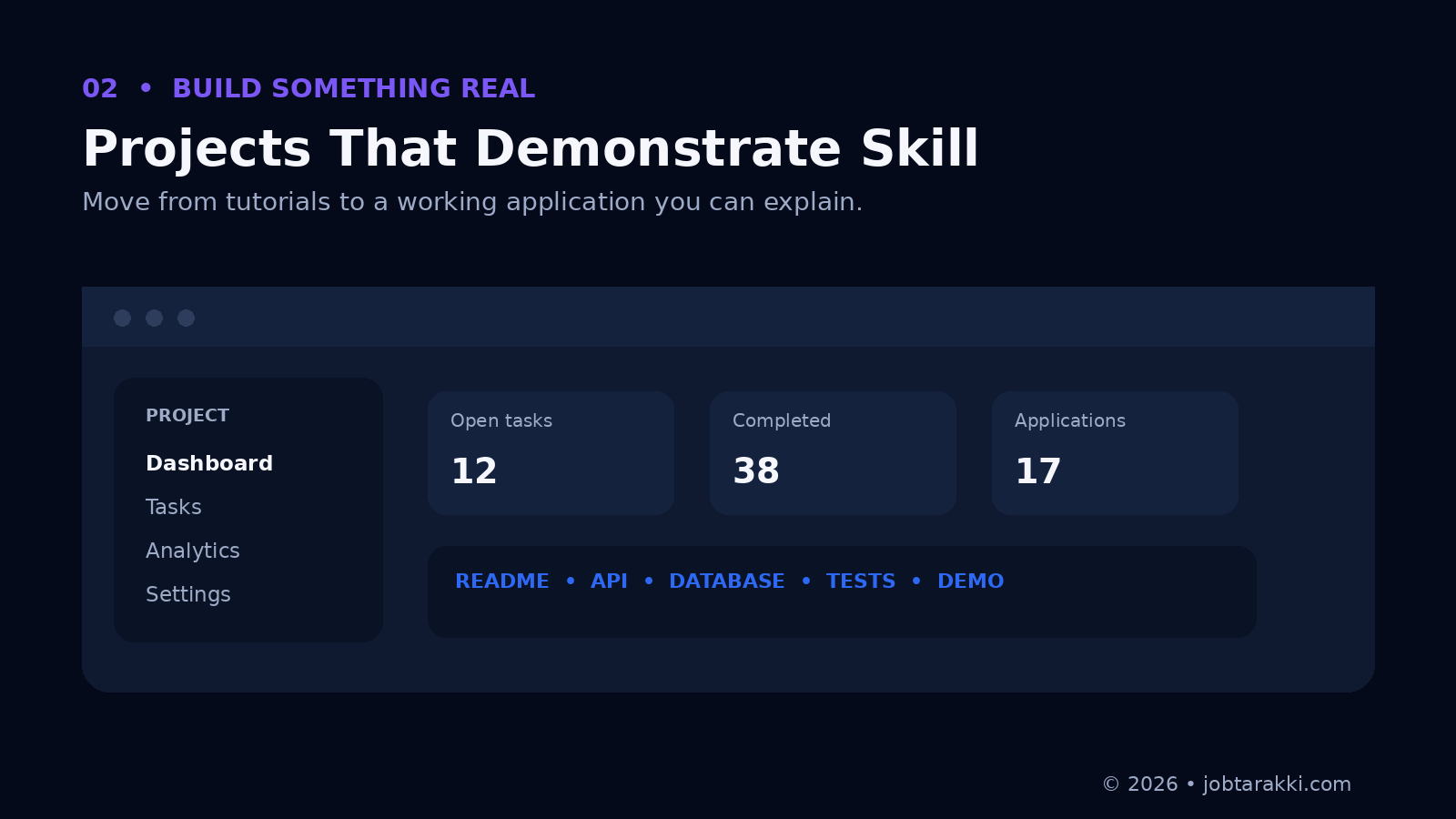
Projects are one of the best ways to turn theoretical knowledge into something you can demonstrate.
You don't need to build the most complicated application on the internet.
A good project should show that you can:
- Understand a problem.
- Design a solution.
- Write code.
- Work with data.
- Handle errors.
- Test your application.
- Document your decisions.
- Explain what you built.
Project ideas for freshers
| Project | Skills Demonstrated |
|---|---|
| Portfolio website | HTML, CSS, responsive design |
| Job application tracker | CRUD, database, UI |
| Expense tracker | APIs, database, charts |
| Task management application | Authentication, APIs, database |
| URL shortener | Backend, database, API design |
| Issue tracker | Roles, workflow, filtering |
| AI document assistant | API integration, data handling |
One complete project can be better than many unfinished projects
It's easy to build five tutorial projects and move on.
Instead, try taking one project further.
For example:
Version 1
Basic application.
Version 2
Add database storage.
Version 3
Add authentication.
Version 4
Add validation and error handling.
Version 5
Add tests.
Version 6
Deploy it.
Version 7
Document the architecture and technical decisions.
Now you have something much easier to discuss in an interview.
9. Step Seven: Prepare Your Resume and Portfolio
Your resume should make it easy for a recruiter to understand what you can do.
For a fresher, useful sections can include:
- Contact information
- Education
- Technical skills
- Projects
- Internships or experience
- Relevant achievements
- Professional links
How to write project descriptions
Instead of:
Built a task management application using React.
You could write:
Built a task management application using React and a backend API with task creation, status updates, filtering, and persistent storage.
Only mention technologies and features you actually implemented.
Build a simple portfolio
Your portfolio can include:
- Short introduction
- Technical skills
- Projects
- GitHub links
- Live demos
- Resume
- Contact information
Your GitHub profile should also make your projects easy to understand.
A good README can explain:
- What the project does
- Why you built it
- Technologies used
- How to run it
- Important technical decisions
- Screenshots or demo links
You can also use the JobTarakki Resume Analyzer as part of your resume preparation.
10. Step Eight: Prepare for Software Engineering Interviews
Interview processes vary between companies and roles.
However, fresher interviews may include some combination of:
- Resume screening
- Online coding assessments
- Technical interviews
- Project discussions
- Behavioral interviews
Programming fundamentals
Be ready to explain the language you use.
For example:
- Data types
- Functions
- OOP
- Error handling
- Collections
- Basic language-specific concepts
DSA
Practice common problem-solving patterns involving:
- Arrays
- Strings
- Hash maps
- Linked lists
- Trees
- Searching
- Sorting
- Recursion
SQL
Understand basic queries and relational database concepts.
Your projects
You should be able to answer:
What problem does your project solve?
Why did you choose this technology?
How is the application structured?
What was the hardest part?
What would you change if you built it again?
How does the database work?
How did you handle errors?
These questions are difficult to answer if you copied the project without understanding it.
Communication
Practice explaining your thought process.
If you don't know something, it's better to explain what you do know and how you would approach finding the answer than to pretend you know it.
11. Step Nine: Find and Apply for Fresher Jobs
Once you have a reasonable foundation, start applying.
You don't have to wait until you feel completely ready.
Look for opportunities such as:
- Software Engineer Intern
- Graduate Software Engineer
- Associate Software Engineer
- Junior Software Developer
- Graduate Engineer Trainee
- Frontend Developer Intern
- Backend Developer Intern
Where can you find opportunities?
Consider:
- Company career pages
- Campus placements
- Internship programs
- Job portals
- Professional networking platforms
- Referrals
- Engineering communities
Don't apply randomly
Before applying, check:
- Required skills
- Eligibility criteria
- Location
- Experience requirements
- Technology requirements
- Application instructions
Then make sure your resume highlights the skills and projects most relevant to that role.
Track your applications so you can understand which types of roles you're applying to and where you are getting responses.
12. Understand Salary and Market Information
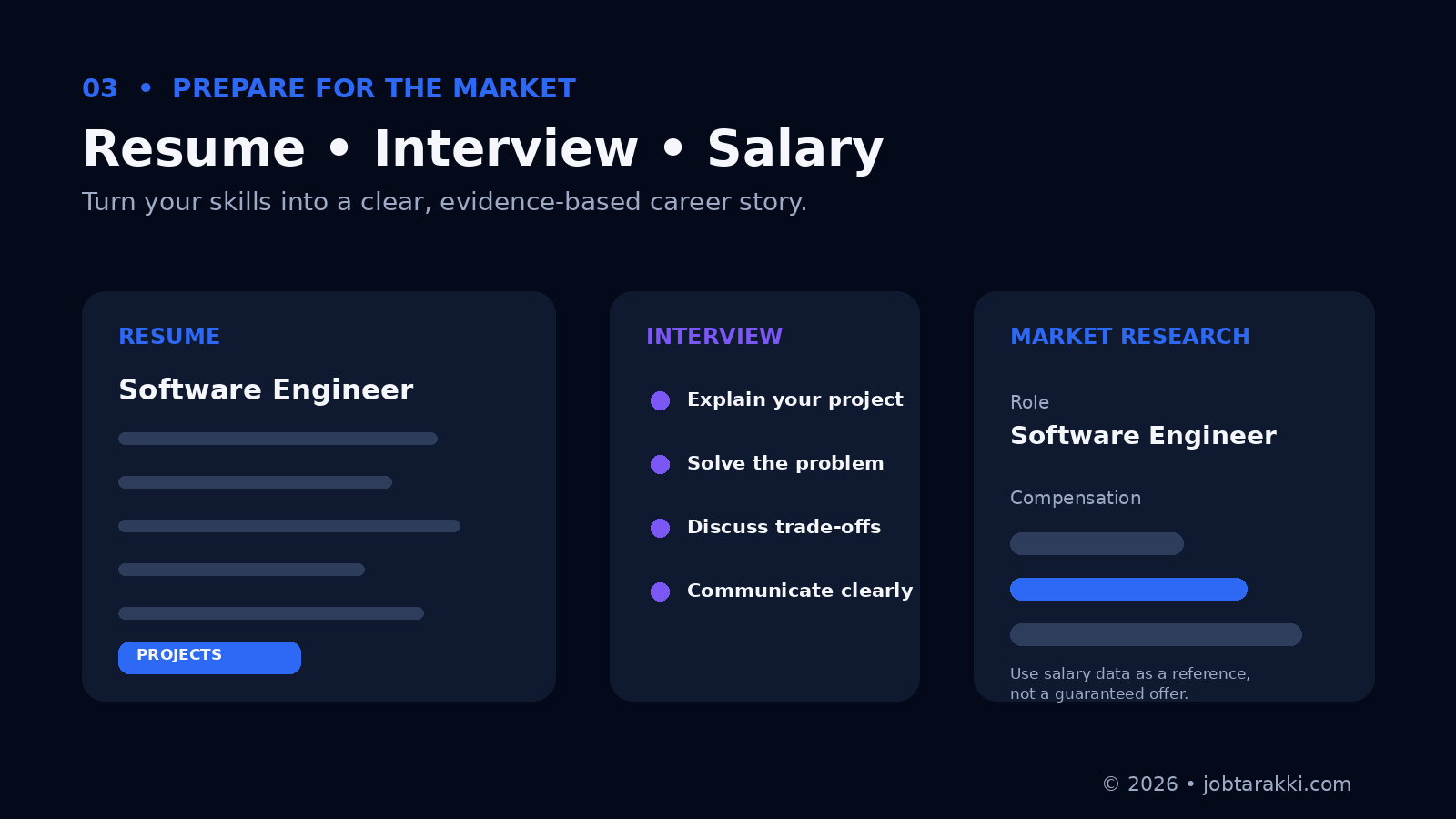
Getting your first job is important, but evaluating an opportunity is also part of your career journey.
When comparing opportunities, salary is one factor to consider alongside:
- Role responsibilities
- Learning opportunities
- Technology stack
- Location
- Work environment
- Growth opportunities
- Benefits
- Total compensation
Salary information can be useful as a reference point when researching opportunities.
The actual compensation offered to an individual can vary based on the role, company, location, skills, experience, and hiring process.
You can explore JobTarakki Salary Intelligence to research salary information as part of your career planning.
Don't treat salary data as a guaranteed offer. Use it together with the rest of the information available about a role.
13. A Practical 6-Month Career Roadmap
If you're looking for a structured starting point, the roadmap below provides a practical six-month path from programming fundamentals to job applications.
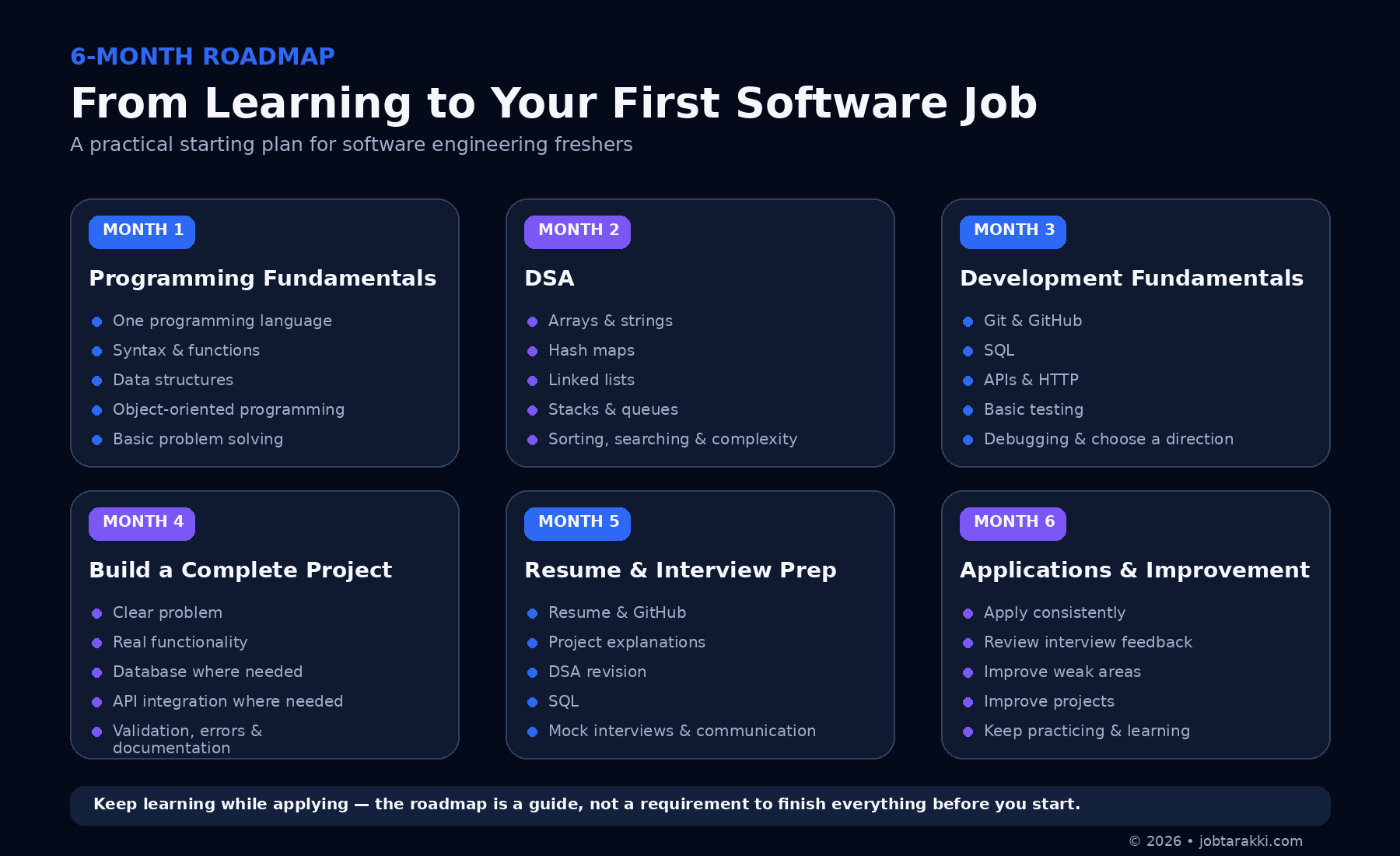 This is a starting framework, not a fixed timeline. Your pace may vary depending on your current skills, available time, and target role.
The important part is to keep building practical skills while gradually preparing for the job market. You don't have to stop learning while applying for opportunities.
This is a starting framework, not a fixed timeline. Your pace may vary depending on your current skills, available time, and target role.
The important part is to keep building practical skills while gradually preparing for the job market. You don't have to stop learning while applying for opportunities.14. Common Mistakes Freshers Should Avoid
Learning too many technologies
Jumping between Java, Python, React, Node.js, AWS, Docker, Kubernetes, and other technologies can leave you with shallow knowledge.
Start with a focused path.
Only watching tutorials
Tutorials are useful for learning concepts.
But eventually, close the tutorial and build something yourself.
Ignoring DSA
Many software engineering interviews include coding assessments.
Build your DSA foundation while also developing practical engineering skills.
Focusing only on DSA
The opposite problem is also common.
Solving coding problems doesn't automatically teach you how to build an application.
You need practical development experience too.
Building copied projects
If you cannot explain how your project works, it won't help much during an interview.
Build projects you understand.
Waiting until you're perfect
You will probably never feel completely ready.
Once you have a reasonable foundation, start applying while continuing to improve.
Ignoring communication
Engineers need to explain technical decisions, ask questions, collaborate, and communicate problems.
Technical ability and communication should develop together.
15. How to Know If You're Ready to Apply
You don't need to check every box before applying.
Use this as a self-assessment.
Fresher Job-Readiness Checklist
- I can write programs comfortably in at least one language.
- I understand core programming concepts.
- I can solve basic and intermediate DSA problems.
- I understand basic SQL.
- I can use Git and GitHub.
- I understand how APIs work.
- I have at least one project I can explain properly.
- I have a resume focused on relevant skills.
- I can explain my project architecture.
- I have practiced technical interview questions.
- I understand the type of role I'm applying for.
- I have researched relevant career and salary information.
If some boxes are unchecked, that doesn't automatically mean you should wait.
Use the checklist to identify what you should improve.
You can also use JobTarakki Career Check to get another perspective on your career direction and next steps.
16. Frequently Asked Questions
How can a fresher become a software engineer in India?
Start with one programming language and build strong programming fundamentals. Learn DSA, Git, databases, and APIs, then choose a development direction and build practical projects. Prepare your resume and technical interview skills while applying for internships and entry-level opportunities.
Which programming language is best for freshers?
There is no universal best language. Java, Python, JavaScript, and C++ can all be useful depending on your goals and the type of roles you want to pursue.
Is DSA necessary for getting a software engineering job?
DSA is important for many technical interviews, particularly those involving coding assessments. However, requirements vary by company and role. Practical development skills are also important.
Can I become a software engineer without a computer science degree?
Some employers hire candidates from non-CS backgrounds, while others have specific degree or eligibility requirements. Hiring criteria vary by company and role.
How many projects should a fresher have?
There is no fixed number. A few relevant projects that you genuinely understand can be more useful than a long list of unfinished or copied projects.
How long does it take to become job-ready?
It depends on your current knowledge, available study time, target role, and employer expectations. There is no fixed timeline that guarantees a job.
Should freshers learn frontend or backend first?
Choose based on your interests. Frontend focuses more on user interfaces, while backend focuses on application logic, APIs, and data. Both can lead to software engineering careers.
Do freshers need system design?
Start with basic application architecture, APIs, databases, and how different components communicate. More advanced system design can be learned as you gain experience.
Should I learn cloud technologies as a fresher?
Basic cloud and deployment knowledge can be useful, but don't let cloud services distract you from programming fundamentals and building applications. Learn them after establishing your core development skills.
What should I do if I am not getting interview calls?
Review your resume, projects, target roles, and application strategy. Check whether your skills match the positions you're applying for. Continue improving your technical skills and seek genuine feedback where possible.
17. What Should You Do Next?
Your software engineering career doesn't need to be planned perfectly from day one.
Start with the fundamentals.
Learn one language.
Practice problem solving.
Build something real.
Learn how software is actually developed.
Prepare your resume.
Start applying.
Then use the feedback you receive to improve.
Your first software engineering job is an important milestone, but it is only the beginning of your career.
The goal isn't to know everything before you start.
The goal is to become good enough to take the next step — and keep learning from there.