Introduction
In Indian IT, few roles are as misunderstood—and as exhausting—as Production Support.
You work rotating night shifts.
You carry the PagerDuty phone on weekends.
You know every server failure mode, every recurring database lock, and every fragile batch dependency that developers forgot to document.
Yet when appraisal discussions arrive, you are often treated as a “cost center.” Your effort is measured by how many repetitive tickets you closed, how quickly you restarted a hung JVM, and how rigidly you adhered to SLAs.
Meanwhile, on the other side of the engineering floor, Site Reliability Engineers (SREs) in Bengaluru, Hyderabad, and Pune are commanding 2x to 3x higher salaries, working standard business hours, and enjoying deep respect from engineering leadership.
Here is the truth that many service companies won't tell you: as a production support engineer, you already possess the hardest half of the SRE mindset.
You understand production chaos. You have triage muscle memory under fire. You know what happens when code hits real-world load.
What you lack is not intelligence or work ethic—it is simply the software engineering bridge: Infrastructure as Code (Terraform), container orchestration (Kubernetes), programmatic automation (Python), and data-driven reliability metrics (SLOs and Error Budgets).
This comprehensive guide provides the complete blueprint to build that bridge over the next 9 months, reframe your experience, build standout GitHub homelab projects, and successfully transition into SRE.
The Fundamental Mindset Shift: Solving Tickets vs. Engineering Out Toil
Many support engineers assume SRE is just “DevOps with on-call duty” or “L3 support with a modern title.”
It isn't.
The distinction comes down to how each discipline treats operational toil.
According to Google's foundational SRE framework, toil is work that is manual, repetitive, automatable, tactical, devoid of enduring value, and scales linearly as a service grows. Every time you log in to restart a Tomcat service, execute a manual SQL cleanup patch, or clear a clogged MQ queue, you are performing toil.
In Production Support, toil is accepted as routine employment. Success means resolving toil faster to keep the SLA green.
In Site Reliability Engineering, toil is considered a bug. SREs enforce a strict 50% toil cap: at least half of an SRE's engineering hours must be spent writing code, building self-healing infrastructure, and designing automation so the human never has to touch that incident again.
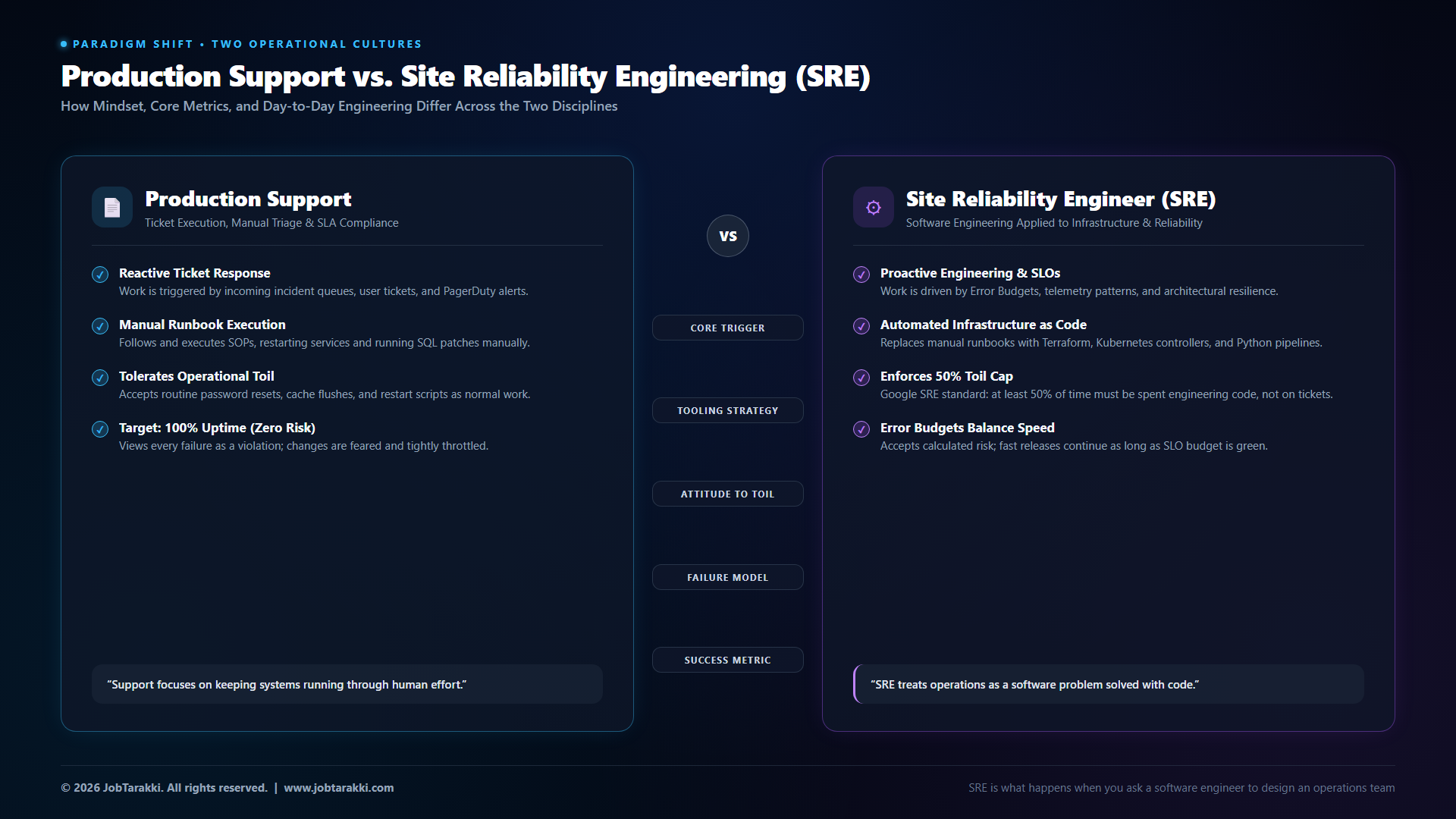
SRE is what happens when you treat operational reliability as a software problem rather than a manual staffing problem.
The Support-to-SRE Skill Gap Matrix
Before buying random Udemy courses or cramming for cloud certifications, you need an honest diagnostic of where you stand today.
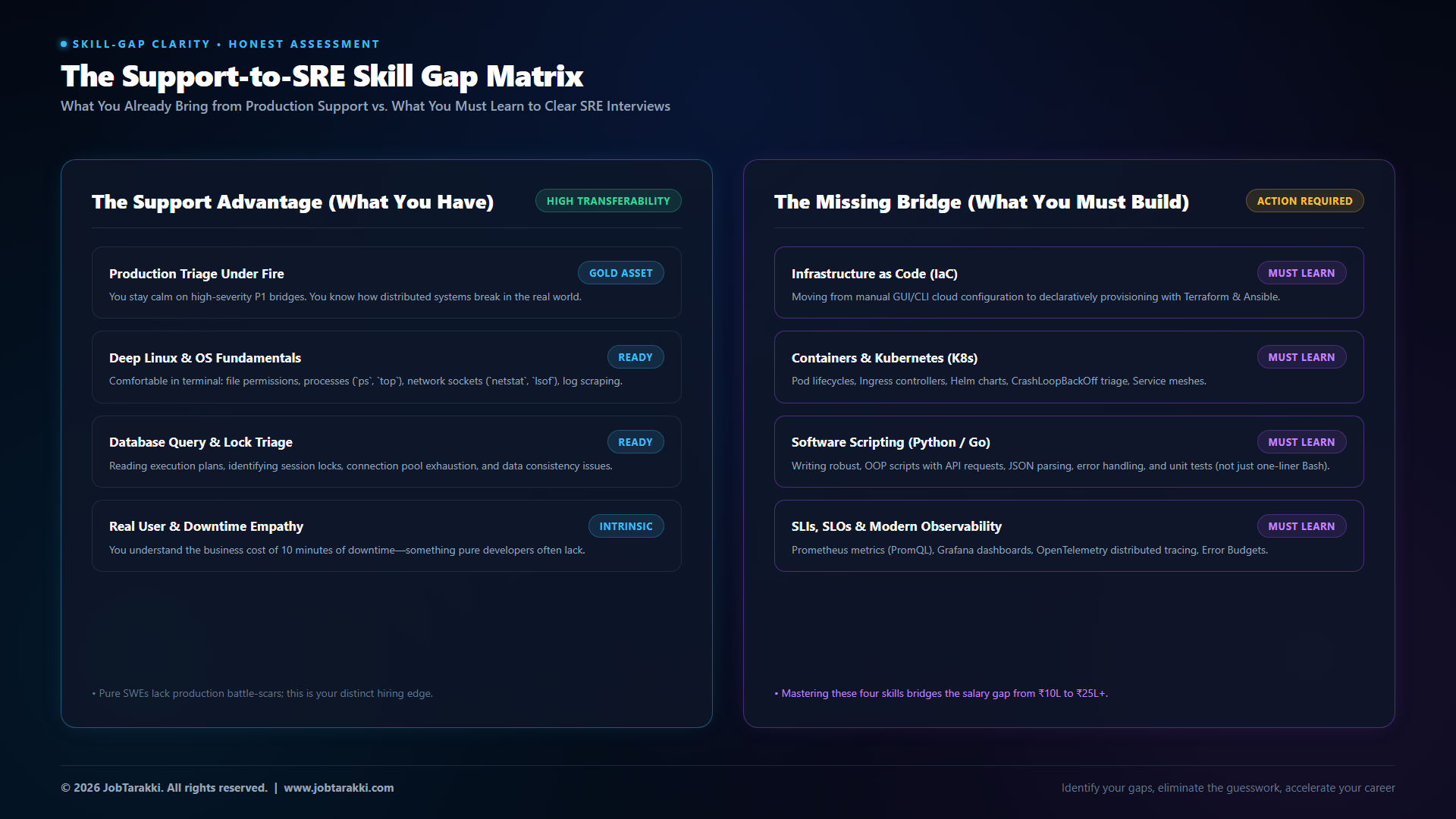
| Engineering Domain | What You Bring from Support (Your Edge) | What You Must Build (The SRE Bridge) |
|---|---|---|
| Operating Systems & Compute | Comfortable in bash shell, reading system logs, basic process commands (`top`, `ps -ef`, `kill`, `df -h`). | Linux internals: kernel cgroups, namespaces, strace, I/O wait triage, network socket buffers (`ss`, `lsof`). |
| Infrastructure Provisioning | Requesting VMs via ServiceNow/Jira, manual console clicks in AWS/Azure portal. | Infrastructure as Code (IaC): Declarative provisioning with Terraform modules, state locking, and GitOps. |
| Application Deployment | Deploying WAR/JAR artifacts, running manual stop/start scripts on bare metal or VMs. | Containers & Kubernetes: Multi-stage Docker builds, Pod lifecycles, Deployments, Services, Helm charts, Ingress routing. |
| Automation & Scripting | Writing simple one-liner bash scripts or copy-pasting shell commands from a runbook. | Software Development: Robust Python or Go scripts with OOP, API handling, exception traps, and unit testing. |
| Monitoring & Observability | Reacting to red lights on AppDynamics, Dynatrace, or Splunk alerts after users complain. | SLIs, SLOs & Error Budgets: Prometheus PromQL metrics, Grafana dashboards, OpenTelemetry distributed tracing. |
| Incident Management | Joining stressful bridge calls, updating incident ticket notes, executing SOP recovery. | Incident Command & Blameless Post-Mortems: Structuring post-incident reviews focusing on systemic engineering fixes. |
Notice the balance: you are not starting from scratch. Pure software engineers graduating from college understand code syntax, but they freeze during production outages because they don't understand servers, networks, or databases. Your production battle-scars are your highest-leverage asset.
The Four Technical Pillars of Modern SRE
To successfully interview for SRE positions at top Global Capability Centers (GCCs like JPMorgan, Morgan Stanley, Goldman Sachs, Barclays, Target) and product tech startups, your study plan must anchor on these four pillars:
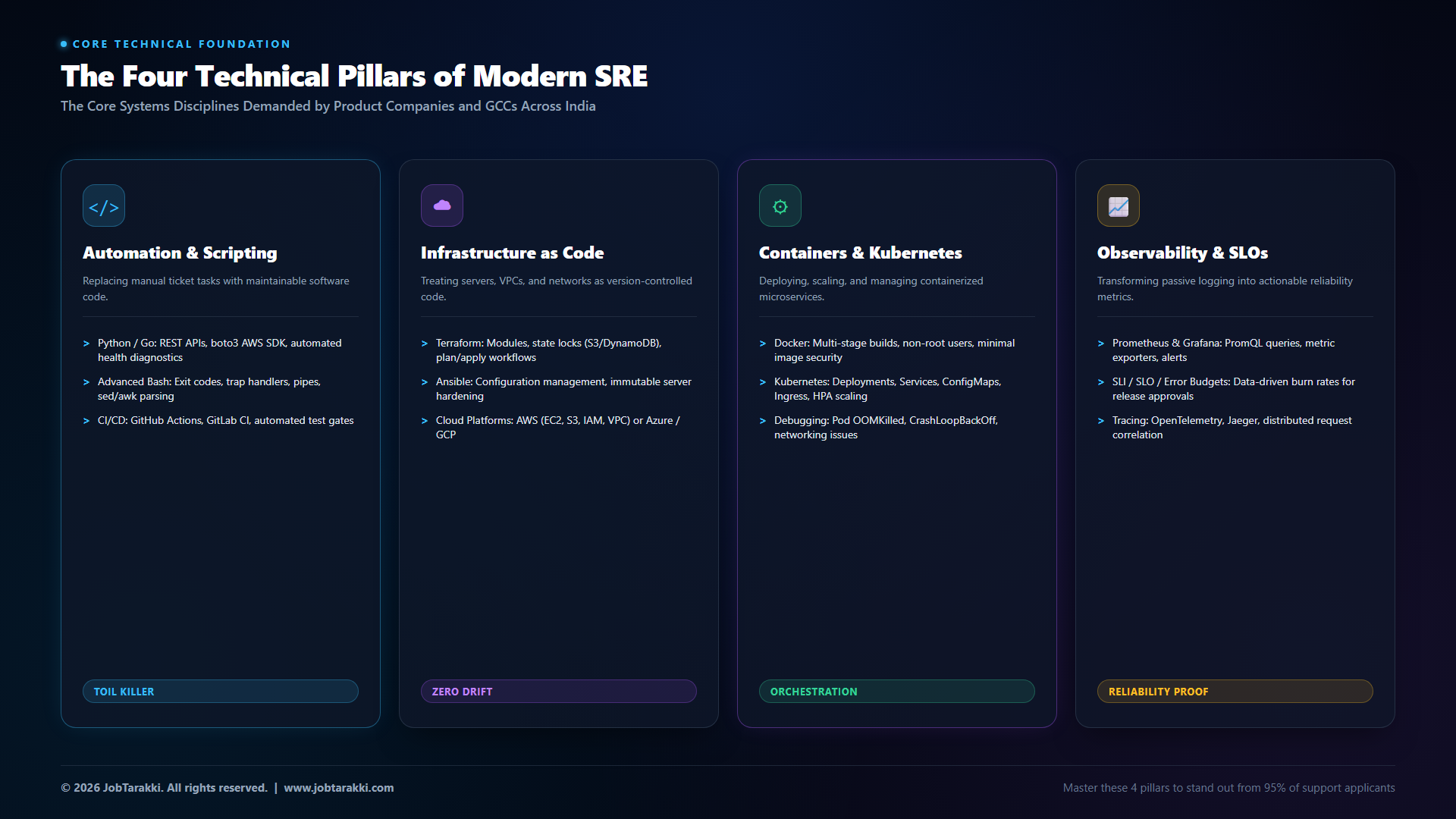
1. Automation & Scripting (Python / Go)
You do not need to build complex web applications with React or Spring Boot. However, you must be capable of writing production-grade scripts that interact with cloud APIs, parse unstructured log streams, and automate diagnostic tasks.
Focus on Python fundamentals: requests for HTTP APIs, boto3 for AWS automation, json / re for data manipulation, and clean exception handling with exit codes.
2. Infrastructure as Code (Terraform)
In modern tech organizations, no engineer is permitted to manually click buttons in the AWS or Azure management console to launch an EC2 instance or RDS database. Everything is defined in version-controlled code.
You must understand how Terraform constructs dependency graphs, manages state files in remote S3 backends with DynamoDB locking, and uses input variables and output modules for reusable cloud infrastructure.
3. Containerization & Kubernetes (K8s)
Monolithic applications hosted on traditional Linux virtual machines are rapidly migrating to microservices orchestrated by Kubernetes. As an SRE, you will be expected to diagnose why a pod is stuck in CrashLoopBackOff, why an application was OOMKilled, and how to configure Horizontal Pod Autoscaling (HPA) to handle traffic spikes smoothly.
4. Observability & Error Budgets (Prometheus & Grafana)
Traditional monitoring asks: “Is the CPU utilization over 80%?” (which often produces noisy, useless alerts).
SRE observability asks: “Are 99.9% of user checkout requests completing in under 300 milliseconds over a rolling 30-day window?”
Understanding Service Level Indicators (SLIs), Service Level Objectives (SLOs), and how to calculate Error Budget burn rates with Prometheus and PromQL is the single biggest separator between support and SRE candidates in technical interviews.
Case Study: Turning Support Toil into SRE Automation
To understand how this looks in practice, consider a common production issue that occurs in enterprise banking applications across India:
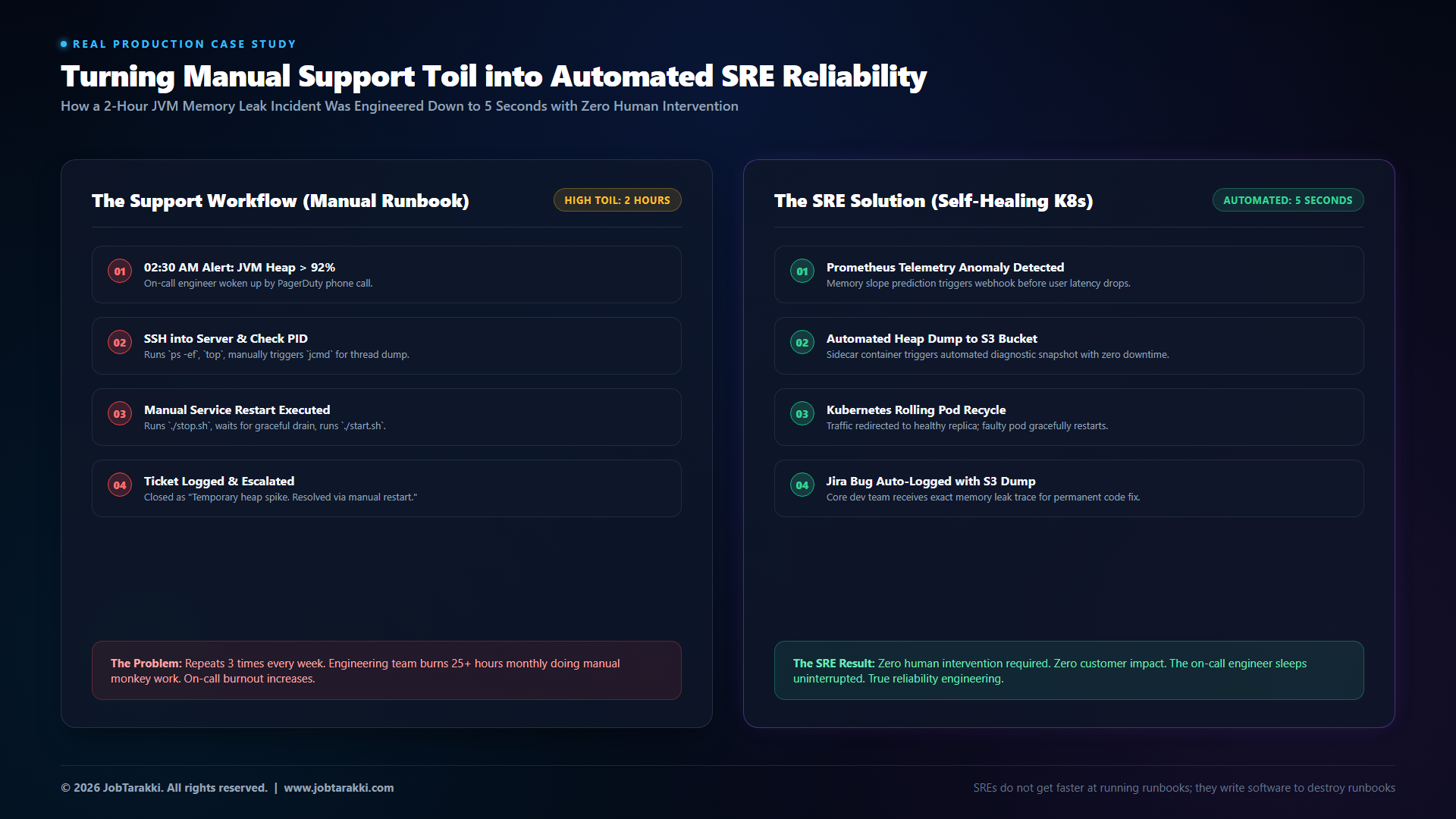
The Incident: A legacy core service experiences an intermittent memory leak under high month-end load. The JVM heap breaches 92%, threads freeze, and API latency climbs.
The Traditional Support Workflow:
- At 02:30 AM, PagerDuty calls the on-call support engineer.
- The engineer logs into the VPN, SSHs into the production VM, runs
topandps -ef, and executesjcmdto capture a thread dump. - They run the manual restart script (
./stop.shfollowed by./start.sh). - They monitor the server for 20 minutes to verify logs are green, log a ticket, and go back to sleep.
- The Result: 2 hours of human time consumed, night-shift fatigue, and the same incident repeats three nights later.
The SRE Self-Healing Approach:
- The SRE deploys the application inside Kubernetes with precise memory resource limits and calibrated Liveness / Readiness probes.
- A Prometheus alert rule calculates the memory gradient. When memory consumption trends toward critical without garbage collection recovery, a webhook triggers a sidecar container to capture an automated heap dump directly to an encrypted AWS S3 bucket.
- Kubernetes gracefully spins up a healthy replica, reroutes incoming live traffic, and terminates the unhealthy pod.
- A Jira defect ticket is automatically created via API with the S3 dump link attached, allowing core software developers to debug the leak during normal business hours.
- The Result: 0 minutes of downtime. 0 customer transactions lost. The on-call engineer sleeps through the night undisturbed.
Wondering how your current operational experience translates into SRE capability? Use the JobTarakki Resume Analyzer to reframe your support achievements into quantified reliability engineering impact.
The 9-Month Support to SRE Transition Roadmap
Transitioning while working full-time in shifts requires structure, not heroic 14-hour study sprints. Dedicate 8 to 10 focused hours per week across these four structured phases:
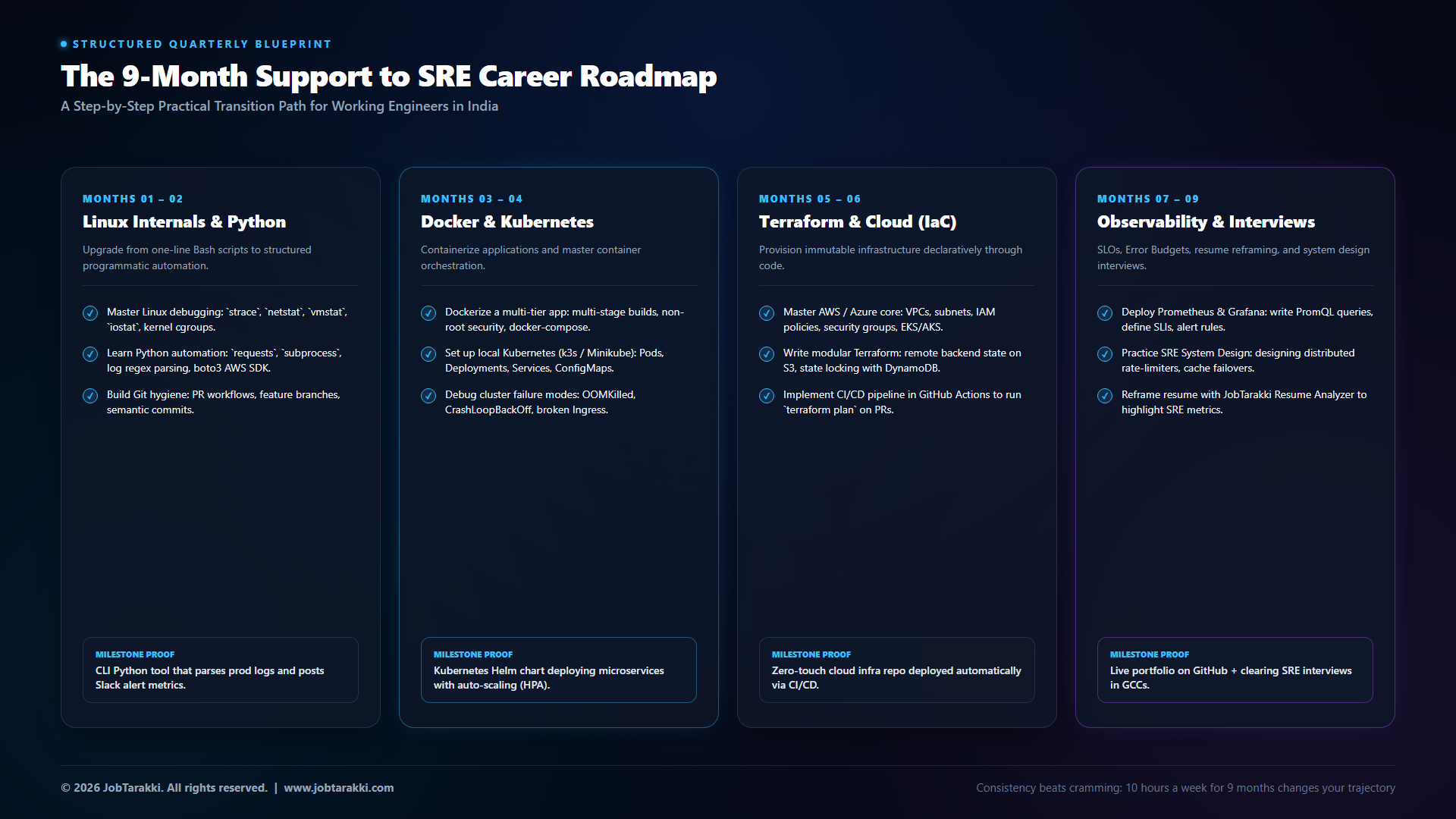
| Phase & Timeline | Curriculum Focus | Weekly Hands-On Milestones | Concrete Deliverable |
|---|---|---|---|
| Phase 1: Months 1–2 Linux Internals & Python Automation |
Transition from one-liner bash scripts to structured programmatic scripting and OS internals. | • Linux debugging deep dive: strace, lsof, ss, vmstat, memory management.• Python programming: functions, OOP, requests, boto3, regex parsing.• Git hygiene: PRs, feature branches, semantic versioning. |
A custom Python CLI tool that parses production log files, extracts 5xx error spikes, and posts automated Slack alerts with metrics. |
| Phase 2: Months 3–4 Docker & Kubernetes Orchestration |
Master containerization and modern microservice orchestration. | • Dockerfile optimization: multi-stage builds, non-root users, distroless images. • Local K8s (k3s / Minikube): Pods, Deployments, Services, ConfigMaps, Secrets. • Cluster failure triage: Debugging CrashLoopBackOff, OOMKilled, and ingress timeouts. |
A production-grade Kubernetes Helm chart deploying a multi-tier microservice app with Horizontal Pod Autoscaling (HPA). |
| Phase 3: Months 5–6 Cloud (AWS/Azure) & Terraform (IaC) |
Provision infrastructure declaratively with version control and remote state. | • Cloud networking: Multi-AZ VPCs, public/private subnets, NAT gateways, IAM security. • Terraform core: Resource blocks, modules, S3 remote backends, DynamoDB state locking. • CI/CD integration: GitHub Actions pipeline running terraform plan and security linting. |
A public GitHub repository containing automated Terraform modules that spin up a production-ready VPC and Kubernetes cluster from scratch. |
| Phase 4: Months 7–9 Observability, SLOs & Interview Prep |
Master modern reliability telemetry, system design, and interview storytelling. | • Prometheus & Grafana: PromQL queries, metric exporters, alert rules. • Defining SLIs/SLOs and configuring Error Budget burn-rate dashboards. • SRE System Design: Designing distributed rate-limiters, circuit breakers, and cache fallbacks. • Resume reframing and mock technical interviews. |
Active GitHub homelab portfolio + clearing technical screening and architecture rounds at top GCCs and tech firms. |
3 Homelab Projects That Prove SRE Competence on GitHub
The biggest mistake support engineers make when applying for SRE roles is listing a string of buzzwords (“Kubernetes, Terraform, AWS, Docker”) on their resume without evidence.
Hiring managers at top tech firms ignore buzzword lists. They look for public GitHub repositories with clean code, README architecture diagrams, and running deployments.
Build these three projects to make your candidacy undeniable:
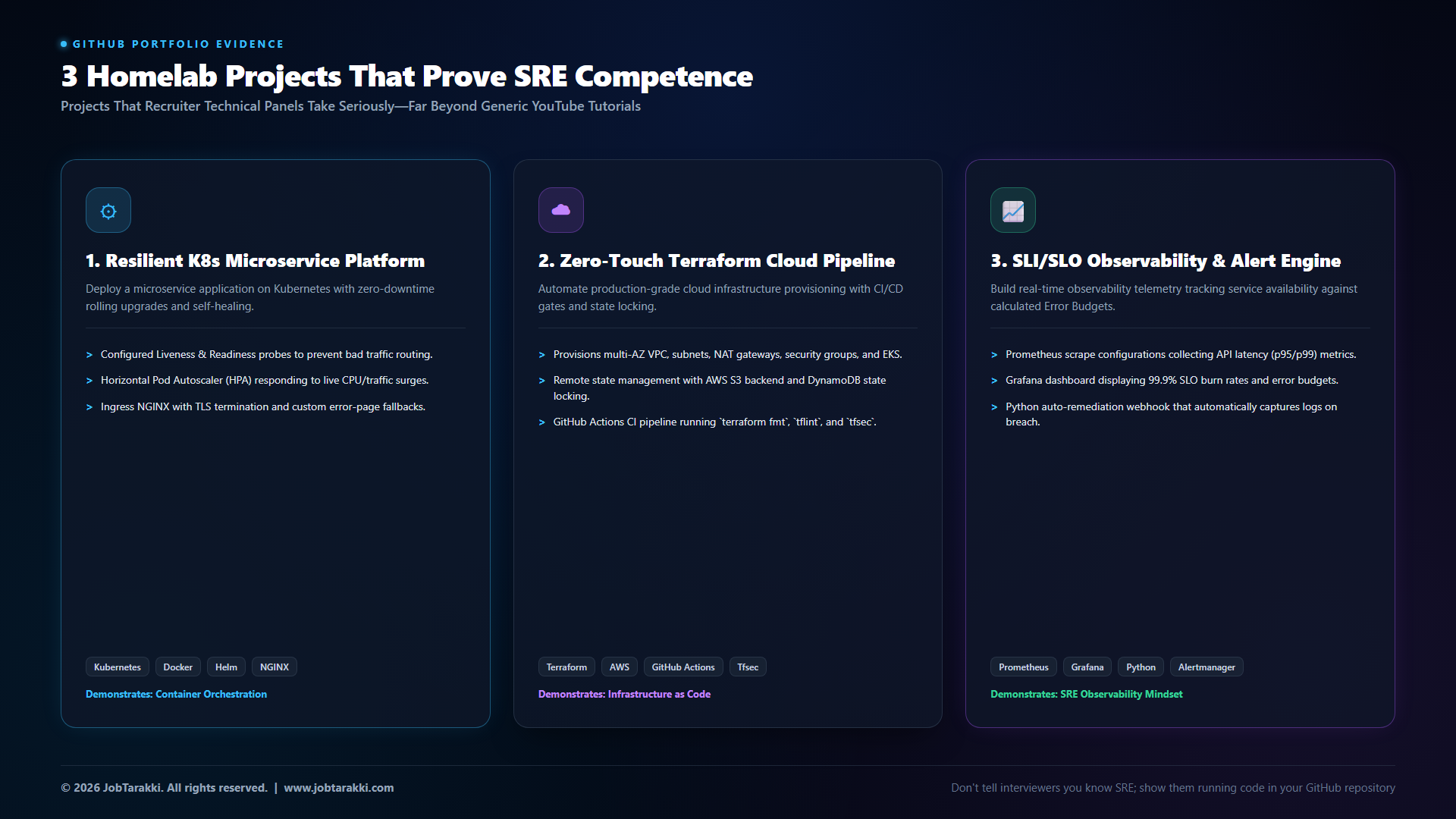
Project 1: Resilient Kubernetes Microservice Platform
- Take an open-source multi-tier app (e.g., Python Flask API + Redis cache + PostgreSQL database).
- Write optimized Dockerfiles using multi-stage builds to produce lightweight, secure images.
- Deploy on a local Kubernetes cluster using Helm. Implement Liveness and Readiness probes, resource requests/limits, and a Horizontal Pod Autoscaler (HPA) configured to scale pods when request volume increases.
- What it proves to interviewers: You understand container networking, cluster resilience, and autoscaling.
Project 2: Zero-Touch Terraform Cloud Infrastructure
- Write modular Terraform configurations that provision a complete multi-tier AWS environment: custom VPC, public and private subnets across two Availability Zones, an Internet Gateway, NAT Gateways, and an Elastic Kubernetes Service (EKS) cluster.
- Configure an S3 backend for remote state storage with DynamoDB state locking to prevent concurrent overwrite errors.
- Set up a GitHub Actions workflow that automatically runs
tflint,tfsec, andterraform planon every pull request. - What it proves to interviewers: You can manage cloud infrastructure professionally without manual portal clicks.
Project 3: Production SLI/SLO Observability Stack
- Instrument your microservices using Prometheus client libraries to expose custom application metrics (request duration histograms, 2xx/5xx counters).
- Build a Grafana dashboard visualizing latency percentiles (p50, p95, p99) and availability against a target 99.9% SLO.
- Configure Alertmanager to trigger alerts only when the Error Budget burn rate indicates an imminent SLO breach, eliminating alert fatigue.
- What it proves to interviewers: You think like a Google/Meta SRE, using data to govern release reliability.
Compensation & Career Trajectory Benchmarks in India
The financial and career return on transitioning from Support to SRE is dramatic. In the Indian technology market, compensation in traditional production support scales linearly, while SRE compensation scales exponentially:
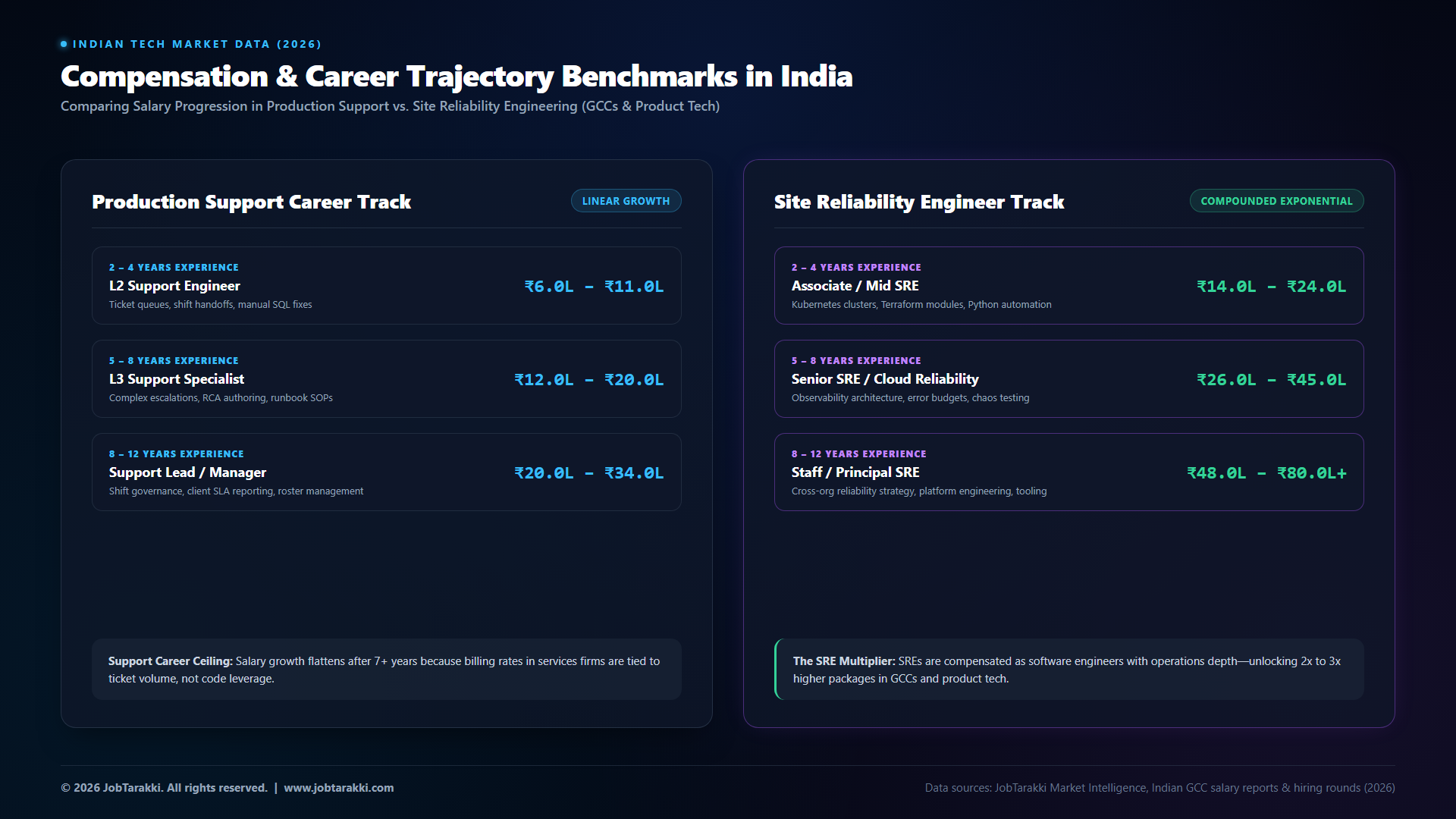
| Experience Tier | Production Support Benchmark (India) | Site Reliability Engineering Benchmark (GCCs & Product Tech) |
|---|---|---|
| Junior / Associate (2–4 Years) | ₹6.0L – ₹11.0L Ticket queues, shift handoffs, manual SQL fixes |
₹14.0L – ₹24.0L Kubernetes clusters, Terraform modules, Python automation |
| Mid / Senior (5–8 Years) | ₹12.0L – ₹20.0L Complex escalations, RCA authoring, runbook SOPs |
₹26.0L – ₹45.0L Observability architecture, error budgets, chaos testing |
| Lead / Staff (8–12+ Years) | ₹20.0L – ₹34.0L Shift governance, client SLA reporting, roster management |
₹48.0L – ₹80.0L+ Cross-org reliability strategy, platform engineering, tooling |
Why the massive pay disparity?
In IT service companies, production support is billed on headcount and ticket volume. There is little commercial incentive for an IT service vendor to automate tickets out of existence because reducing tickets reduces billable hours.
In product companies and GCCs, SREs are compensated as software engineers who specialize in systems. A single SRE who automates away a chronic failure across 50 microservices creates millions of dollars in saved downtime and engineering leverage. You are compensated for your architectural leverage, not the hours you sat on a shift.
How to Reframe Your Resume from “Support” to “Reliability”
Most support resumes get filtered out by Applicant Tracking Systems (ATS) or rejected by hiring managers within six seconds because they read like an operations duty checklist:
| Weak Support Bullet Point (What Gets Rejected) | High-Impact SRE Reframing (What Gets Interviews) |
|---|---|
| “Responsible for monitoring production alerts in Splunk and resolving L2 tickets within SLA.” | “Managed production reliability across 14 high-throughput microservices, analyzing Splunk telemetry to diagnose and resolve 40+ P1/P2 incidents with a 99.8% SLA adherence.” |
| “Executed manual restart scripts for WebLogic and Tomcat servers during outages.” | “Diagnosed JVM thread contention and memory leaks using jstack/jmap; authored automated shell recovery scripts that reduced MTTR by 35%.” |
| “Worked on on-call shift rotation and created incident reports.” | “Led technical war rooms as Incident Commander for critical banking outages; authored blameless Root Cause Analyses (RCAs) and partnered with development leads to implement preventative fixes.” |
| “Performed SQL queries to verify database issues.” | “Investigated database deadlocks, row-lock contentions, and slow queries in PostgreSQL, collaborating with DBAs to optimize index structures and connection pool sizing.” |
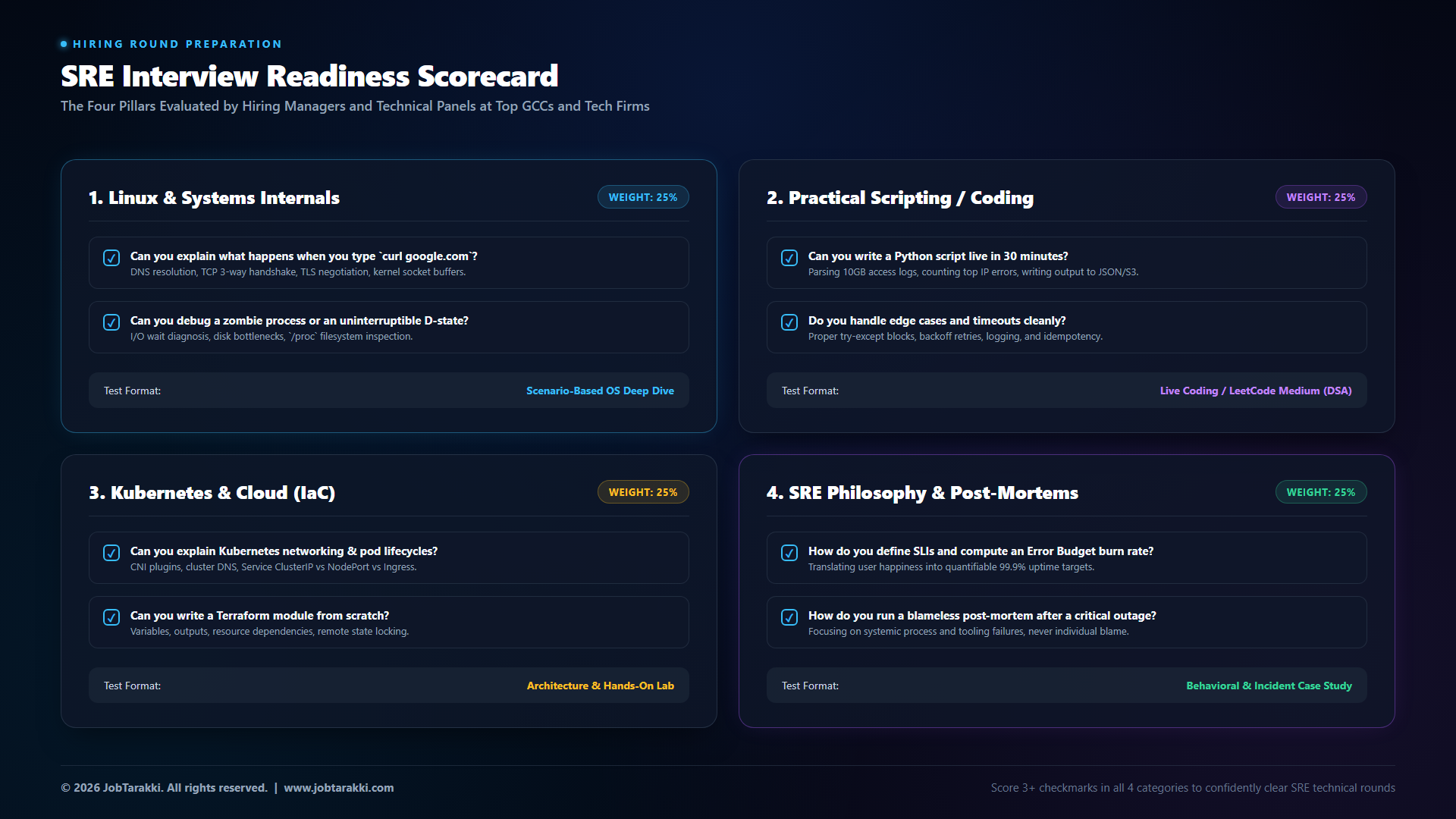
SRE Interview Readiness Scorecard
Before scheduling technical rounds, benchmark yourself against the four pillars that hiring panels evaluate:
| Evaluation Pillar | Common Interview Questions | Readiness Benchmark |
|---|---|---|
| 1. Linux & Systems Internals | • “Walk me through everything that happens from the moment you hit Enter on curl https://api.bank.com.”• “A process is stuck in Uninterruptible Sleep (D-state). What does that mean and how do you diagnose it?” |
Comfortable explaining DNS resolution, TCP handshake, TLS negotiation, kernel cgroups, and I/O bottlenecks without guessing. |
| 2. Live Scripting / Coding | • “Write a Python script that parses a 10GB Apache access log, finds the top 5 IP addresses returning 500 errors, and writes a summary report.” • Basic data structures: Hash maps, queues, string manipulation. |
Can write clean, working Python code live in a 30-minute coding round with proper error handling and clean syntax. |
| 3. Kubernetes & Cloud (IaC) | • “A Kubernetes pod is in CrashLoopBackOff. Walk me through your triage steps.” • “How do you structure Terraform modules to avoid duplicate code across dev, staging, and prod?” |
Understands Pod lifecycles, Ingress routing, cluster networking (CNI), and Terraform state locking. |
| 4. SRE Philosophy & Incident Case Study | • “How would you define an SLI and SLO for a payments gateway? How do you calculate Error Budget burn rate?” • “Tell me about a time you led an incident response where the root cause was initially unknown.” |
Can articulate reliability trade-offs, blameless post-mortem culture, and how to balance feature velocity with system uptime. |
Conclusion: The Best Time to Start Is on Your Next Shift
Transitioning from Production Support to SRE is not an overnight leap. It is an intentional 9-month investment that permanently changes your career trajectory.
The next time you log in for an on-call shift, do not just close tickets and move on.
Look at the next manual task assigned to you.
Ask yourself: “How would an SRE solve this with code so it never happens again?”
Write a Python script to automate the health-check. Containerize your diagnostic tool in Docker. Define your cloud infrastructure in Terraform. Publish the code to your GitHub repository.
You don't need permission from your manager to start learning SRE. In modern engineering, the skills always precede the title.
Ready to benchmark your current skills and plan your transition? Use JobTarakki Career Check to identify your exact skill gaps and build a personalized roadmap to SRE.