Introduction
Imagine two Production Support Engineers working in a high-stakes banking platform at an Indian Global Capability Center (GCC) in Bengaluru.
Both have five years of experience in enterprise application support.
Both close their tickets well within strict SLA windows.
Both know their application architectures, log directories, and daily runbooks inside out.
Yet when the annual appraisal cycle arrives, only one gets promoted to L3.
Why?
Because leadership and promotion panels rarely ask: “Who resolved the highest volume of tickets this quarter?”
Instead, they ask:
- Who stops the same Sev1/Sev2 incident from happening again next month?
- Who takes charge of an ambiguous bridge call without waiting for an engineering lead to tell them what to do?
- Who improves the runbook so junior shifts stop making triage mistakes?
- Who makes the whole on-call rotation calmer and more predictable, not just their own queue?
This reality catches many engineers by surprise. The execution skills that got you promoted from L1 to L2 (speed, adherence to runbooks, ticket velocity) are not the skills that get you promoted to L3. This guide breaks down what actually changes, the technical and architectural depth required, and a battle-tested 12-month roadmap for engineers in Indian IT services, GCCs, and product companies.
Why L3 Is a Different Job, Not Just “Senior L2”
Many engineers treat L3 as simply “an L2 engineer with more gray hair and more tickets resolved.”
It isn't.
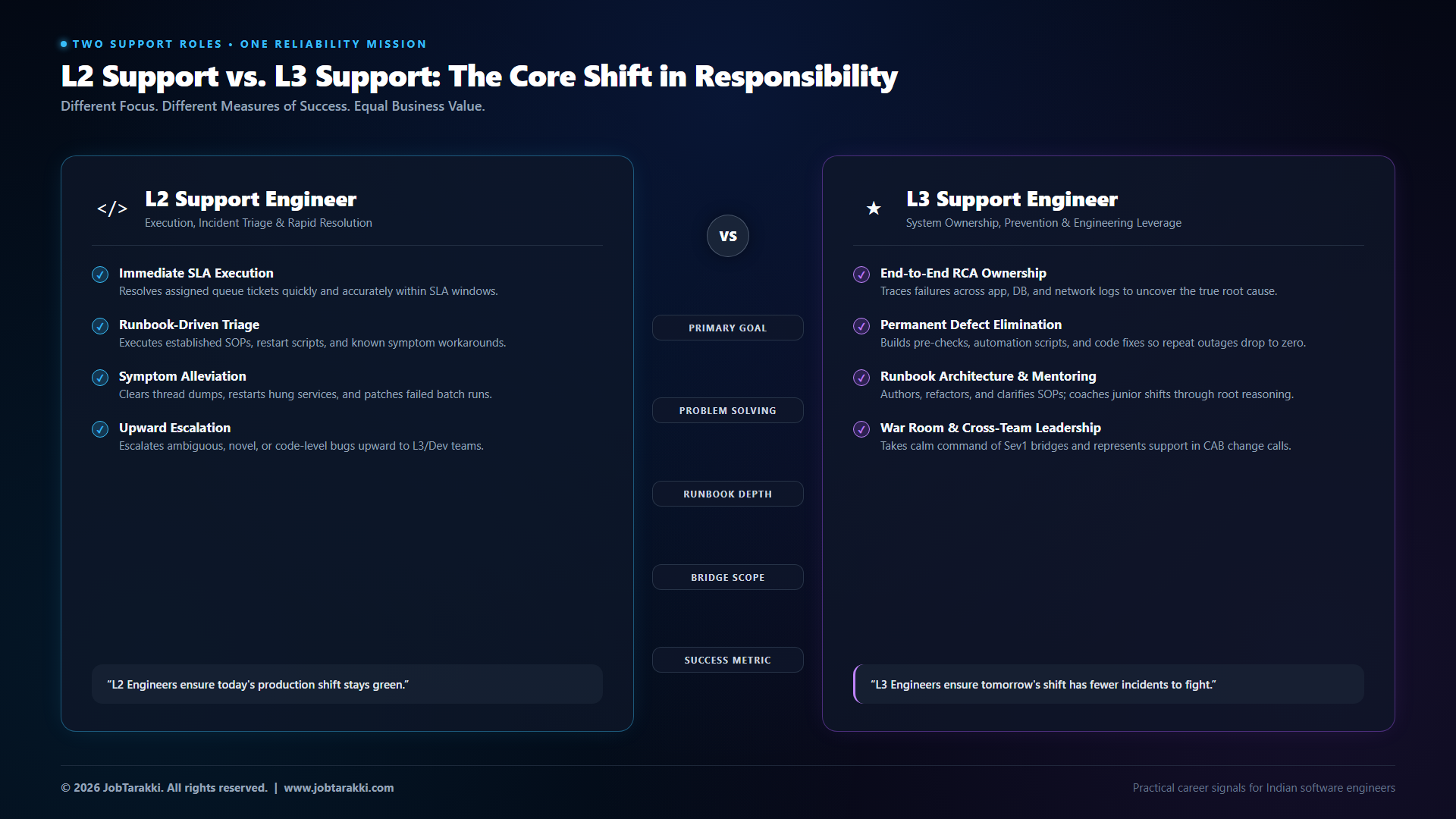
L2 is measured primarily by execution: How quickly, independently, and correctly you diagnose and resolve incidents assigned to your queue.
L3 is measured primarily by ownership and prevention: Whether incidents in your domain decline over time, whether systemic risks are flagged before they cause downtime, and whether the engineering team operates with higher reliability because you are on the team.
Fixing issues is still part of the role. But fixing stops being the primary scorecard of success.
Understanding the Support & Reliability Career Ladder
In Indian IT services (TCS, Infosys, Wipro, Cognizant), BFSI firms, and GCCs (JPMorgan, Morgan Stanley, Barclays, Standard Chartered), the support ladder generally progresses across five distinct operational layers:
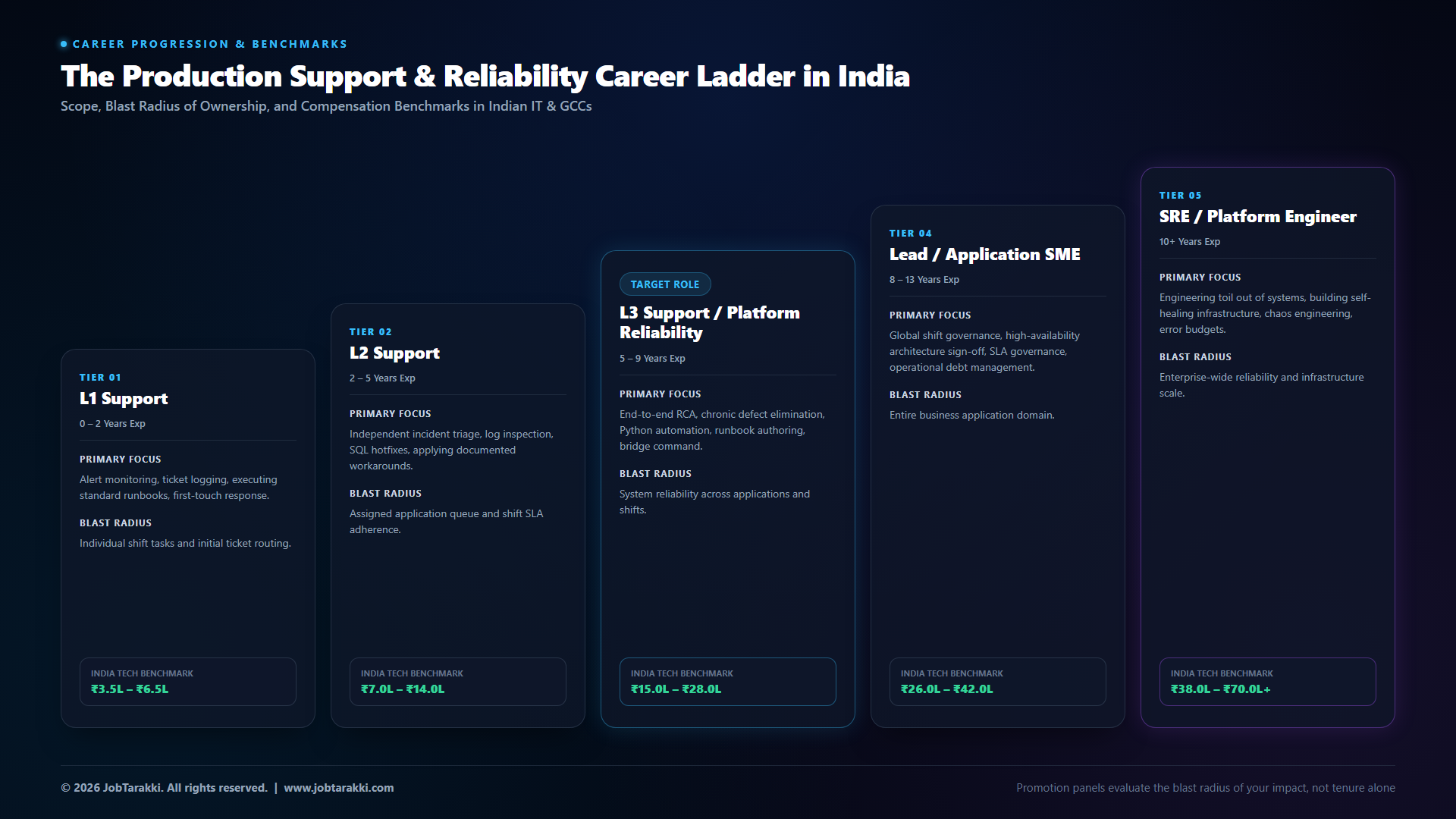
| Level | Typical Focus & Scope | Typical Failure Metric | India Compensation Benchmark |
|---|---|---|---|
| L1 Support | Monitor telemetry (Dynatrace, AppDynamics), triage initial alerts, execute documented SOPs, route tickets. | High MTTA (Mean Time to Acknowledge), breached initial SLA. | ₹3.5L – ₹6.5L |
| L2 Support | Independently troubleshoot incidents, analyze app logs, execute SQL hotfixes/data patches, handle minor escalations. | High MTTR (Mean Time to Resolve), inability to resolve without L3 escalation. | ₹7.0L – ₹14.0L |
| L3 Support / Platform Reliability | End-to-end Root Cause Analysis (RCA), recurring incident elimination, building custom diagnostic scripts, shift mentoring, change advisory. | High incident recurrence rate, weak RCA depth, brittle runbooks. | ₹15.0L – ₹28.0L |
| Lead / Application SME | Owns application uptime, SLA governance across global shifts, architectural sign-off for production rollouts. | Unplanned release downtime, chronic operational debt. | ₹26.0L – ₹42.0L |
| SRE / Platform Engineer | Engineers toil out of the system; builds automated self-healing systems, CI/CD observability, and chaos resilience. | Breached error budgets and system availability SLOs. | ₹38.0L – ₹70.0L+ |
Each step up the ladder expands your blast radius of influence—moving from individual ticket handling to team-wide stability.
The Five Things That Separate L2 from L3
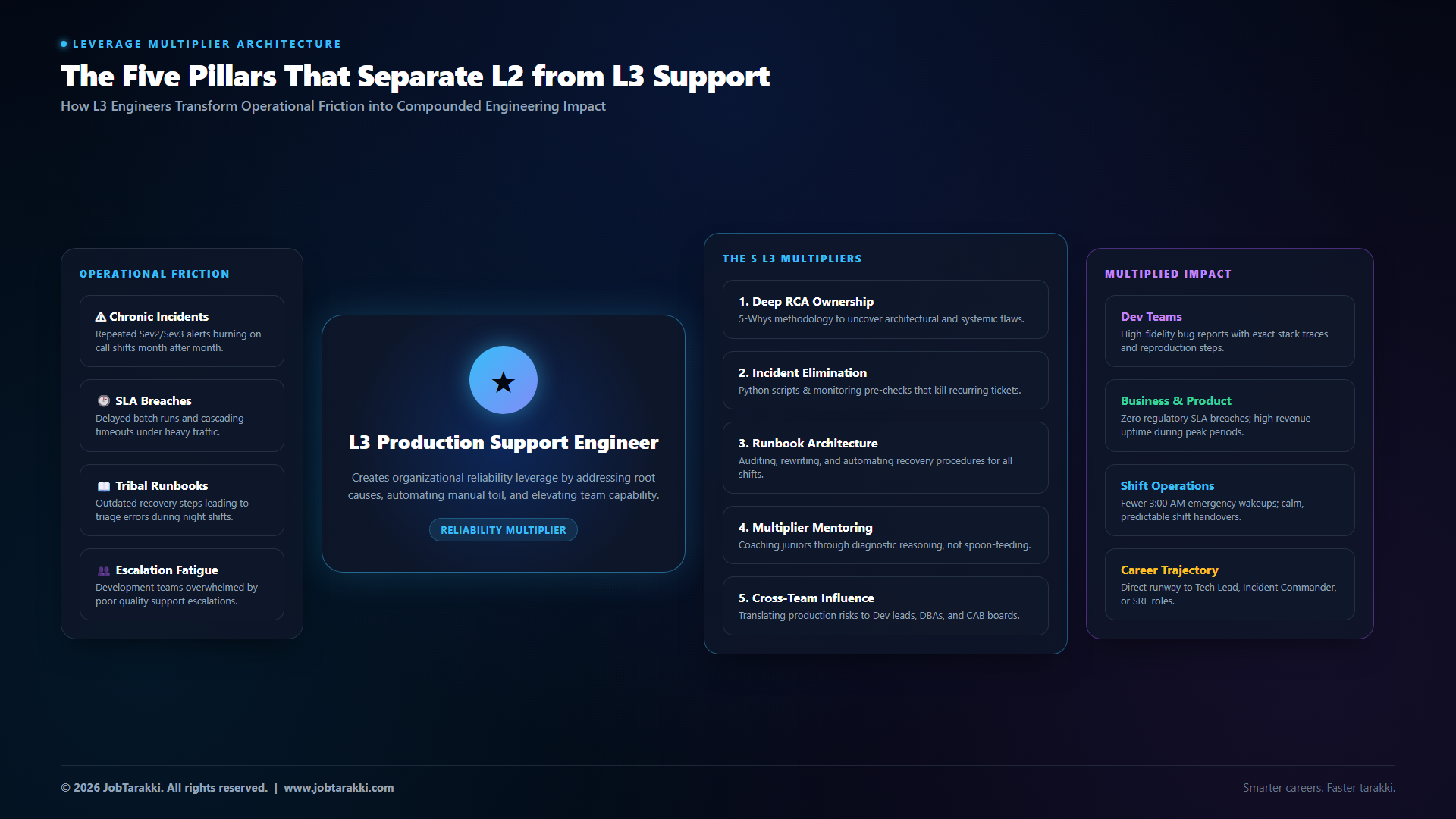
1. They Own the RCA, Not Just the Hotfix
An L2 engineer often stops at symptom alleviation: “WebLogic server restarted, connection pool cleared, orders flowing again, ticket closed.”
An L3 engineer investigates the underlying chain of failure: “Why did the database pool exhaust at 14:15? Was it a long-running batch job locking rows? Did an upstream microservice change its retry backoff without a jitter? Could this repeat on Friday's volume surge?”
2. They Systematically Eliminate Repeat Incidents
Instead of becoming faster at fixing the same broken process, an L3 engineer works to ensure it never happens again:
- Adding automated pre-checks that abort batch jobs cleanly before bad data pollutes tables.
- Writing a Python watchdog to auto-recycle stuck threads before heap memory breaches 90%.
- Refining noisy Splunk/Datadog alert thresholds to prevent on-call fatigue.
- Pushing bug fixes directly to the core development team with exact log lines and reproduction steps.
3. They Build the Runbook Instead of Just Reading It
L2 engineers depend on runbooks. L3 engineers audit runbooks, rewrite ambiguous recovery steps, automate manual copy-paste scripts, and ensure that even an L1 engineer can handle complex failures safely during night shifts.
4. They Mentor Without Becoming a Bottleneck
A common trap for talented L2 engineers is becoming the “hero” who personally fixes everything. L3 engineers foster team capability:
- They teach juniors how to reason through system logs rather than dictating commands.
- They peer-review RCA drafts before submission to senior management.
- They maintain calm, objective leadership on critical P1 incident bridge calls.
5. They Communicate With Cross-Functional Stakeholders
L2 engineers communicate mainly within their shift. L3 engineers represent production reality to Product Owners, Development Leads, and Change Advisory Boards (CAB), articulating risks in business terms: “If this deployment goes live without an index on the transaction table, batch settlement will breach our 4:00 AM RBI/SEBI regulatory window.”
Preparing for an L3 appraisal or interview? Use the JobTarakki Resume Analyzer to ensure your incident ownership and automation impact stand out on your profile.
A Real-World Production Scenario
The Incident:
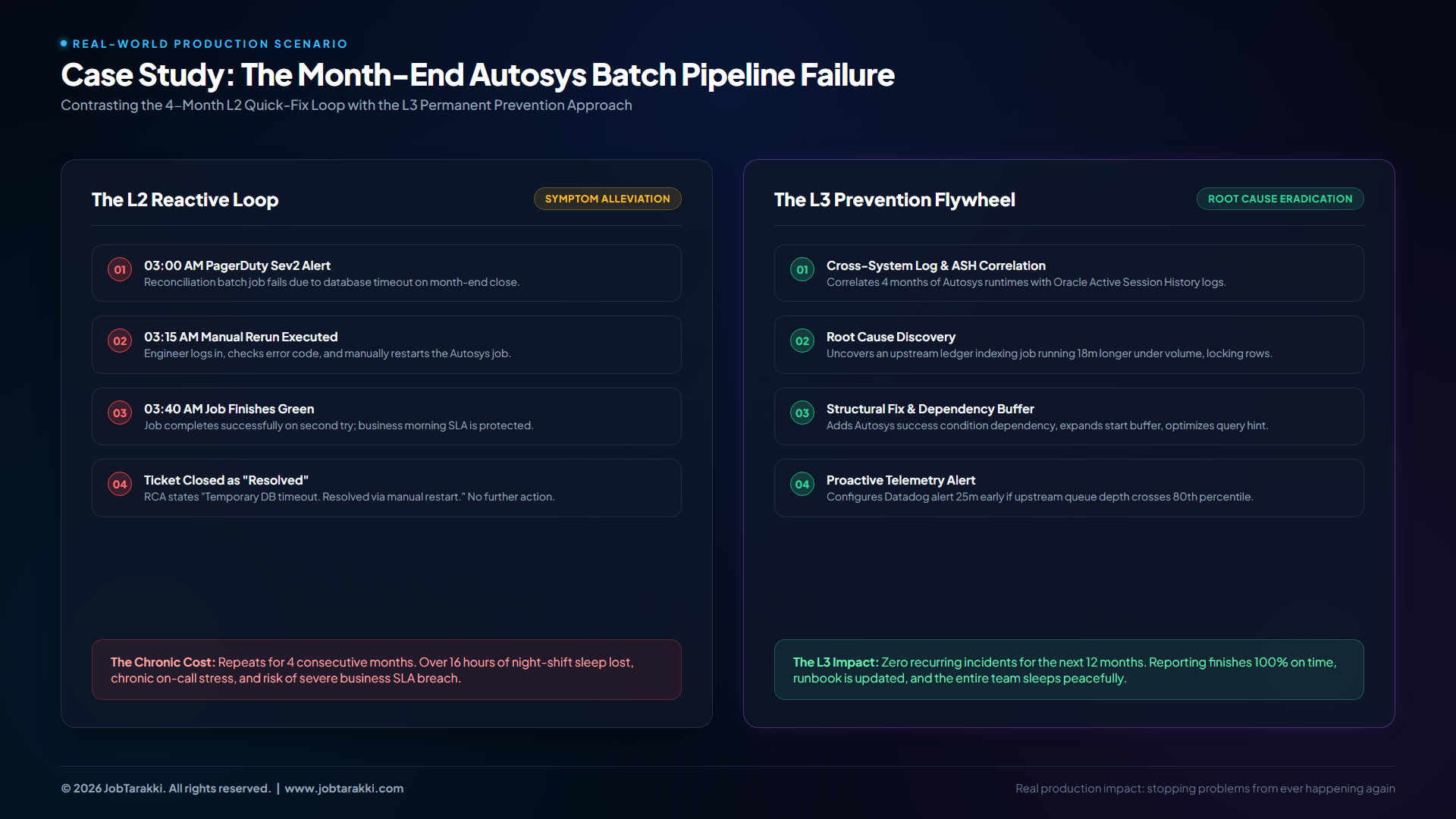
An enterprise banking core has six interdependent batch jobs running on Autosys. On the final day of each month, the reconciliation job intermittently times out, holding up business reporting. For four months, on-call engineers have kept SLAs green by waking up at 3:00 AM to manually rerun the job.
The L2 Approach:
The engineer responds promptly to the PagerDuty alert, verifies the failure code in Autosys, runs the manual restart command, monitors it until it turns green, logs the ticket, and goes back to sleep. The ticket is marked “Resolved via restart”—and repeats the following month.
The L3 Approach:
- Log Correlation: Correlates timestamps across Autosys, Oracle DB active session history (ASH), and application logs over the previous four failure cycles.
- Root Cause Identification: Discovers that month-end transaction volume causes an upstream indexing job to run 18 minutes longer, creating an Oracle row lock contention on the ledger table when the reconciliation job fires.
- Long-Term Fix: Implements an Autosys dependency condition (pre-check job status), increases the start buffer, and adds a query hint to optimize the lock timeout.
- Early Warning: Configures an observability alert 25 minutes prior to the SLA breach window if upstream volume exceeds the 80th percentile.
- Documentation: Updates the master architecture wiki and delivers an RCA to the database and batch engineering teams.
The Outcome: The incident never recurs. The shift team gains back uninterrupted sleep, and business reporting completes consistently on time. That is L3 impact.
Technical Depth Expected at L3
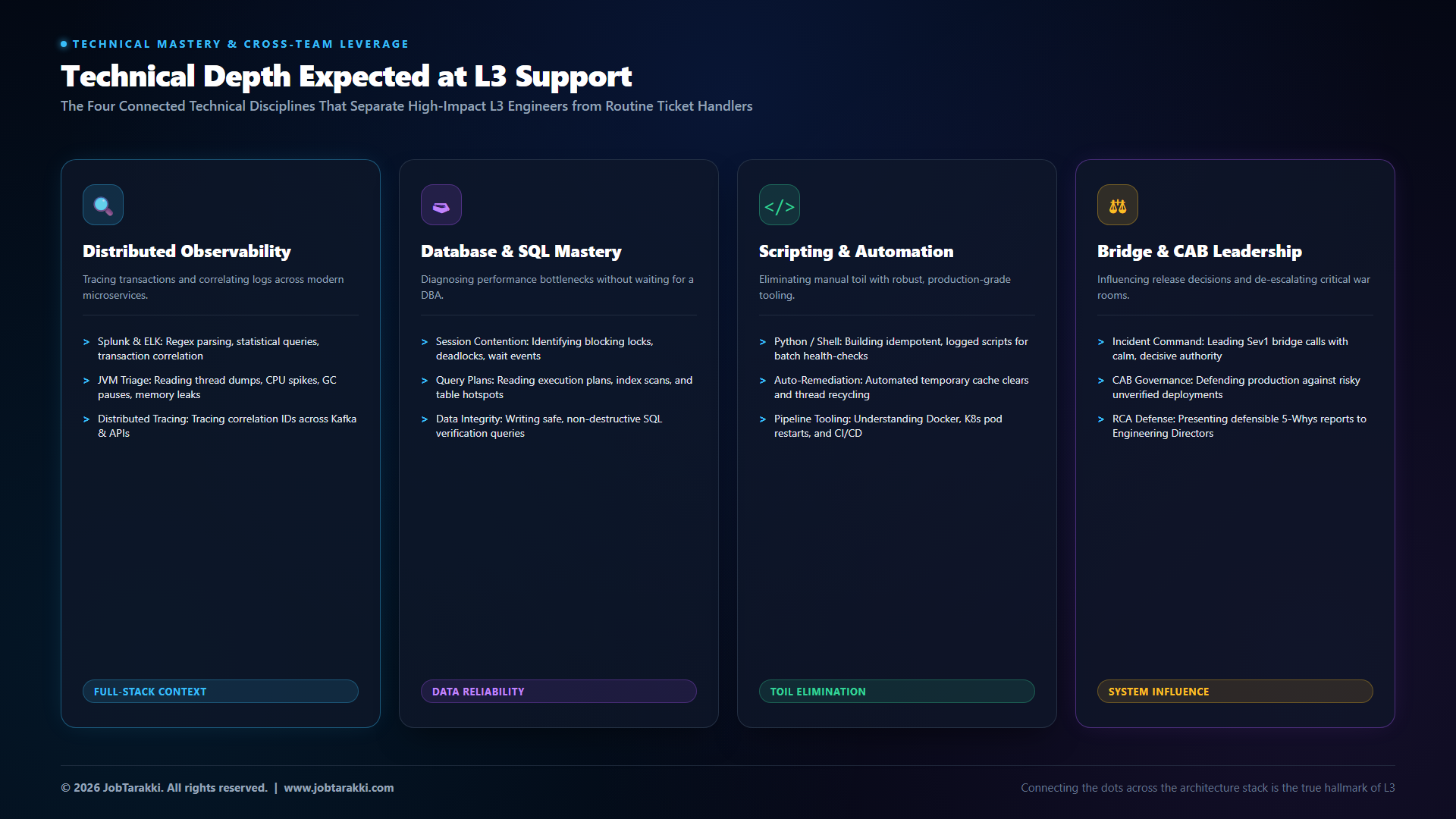
Moving to L3 doesn't require becoming a full-stack software engineer, but it demands connected systems thinking across four primary areas:
1. Cross-System Log Correlation & Observability
- Tracing single transaction IDs across distributed microservices (API Gateway → App Server → Kafka Queue → DB).
- Writing complex log search queries in Splunk, ELK, or Datadog using regex, statistical aggregations, and transaction correlation.
- Diagnosing JVM issues (reading thread dumps, identifying thread starvation, detecting memory leaks from GC logs).
2. Database & SQL Mastery
- Diagnosing blocking sessions, deadlock graphs, table locks, and index degradation without having to wait for a DBA during a live Sev1.
- Writing non-destructive SQL verification scripts to validate corrupted data state safely.
3. Automation & Scripting
- Writing production-grade Bash/Shell or Python scripts with proper exception handling, logging, and idempotency.
- Automating health checks, cache warmups, and routine operational runbooks.
4. Infrastructure & Cloud Awareness
- Diagnosing Linux system bottlenecks: analyzing CPU load averages, I/O wait (`iostat`, `vmstat`), memory buffers, and network socket exhaustion (`netstat`, `ss`, `lsof`).
- Understanding containerized deployments (Docker commands, Kubernetes pod lifecycle, crashloop backoffs, ingress health).
Common Trade-offs L3 Engineers Must Navigate
Senior engineers are defined by their judgment during high-pressure situations:
- Mitigate Now vs. Deep Dive Later: In a Sev1, your immediate duty is restoring service (rolling back, scaling pods, failing over). You do not keep production down to debug a live stack trace. You capture heap/thread dumps, restore service, and investigate in staging.
- Automate vs. Standardize: Knowing when a manual task is worth 20 hours of Python scripting versus when standardizing the SOP for L1 execution is sufficient.
- Defending Production vs. Speed to Market: Having the courage to reject an emergency production release that lacks a valid rollback plan or validation script.
L2 to L3 Promotion Readiness Checklist
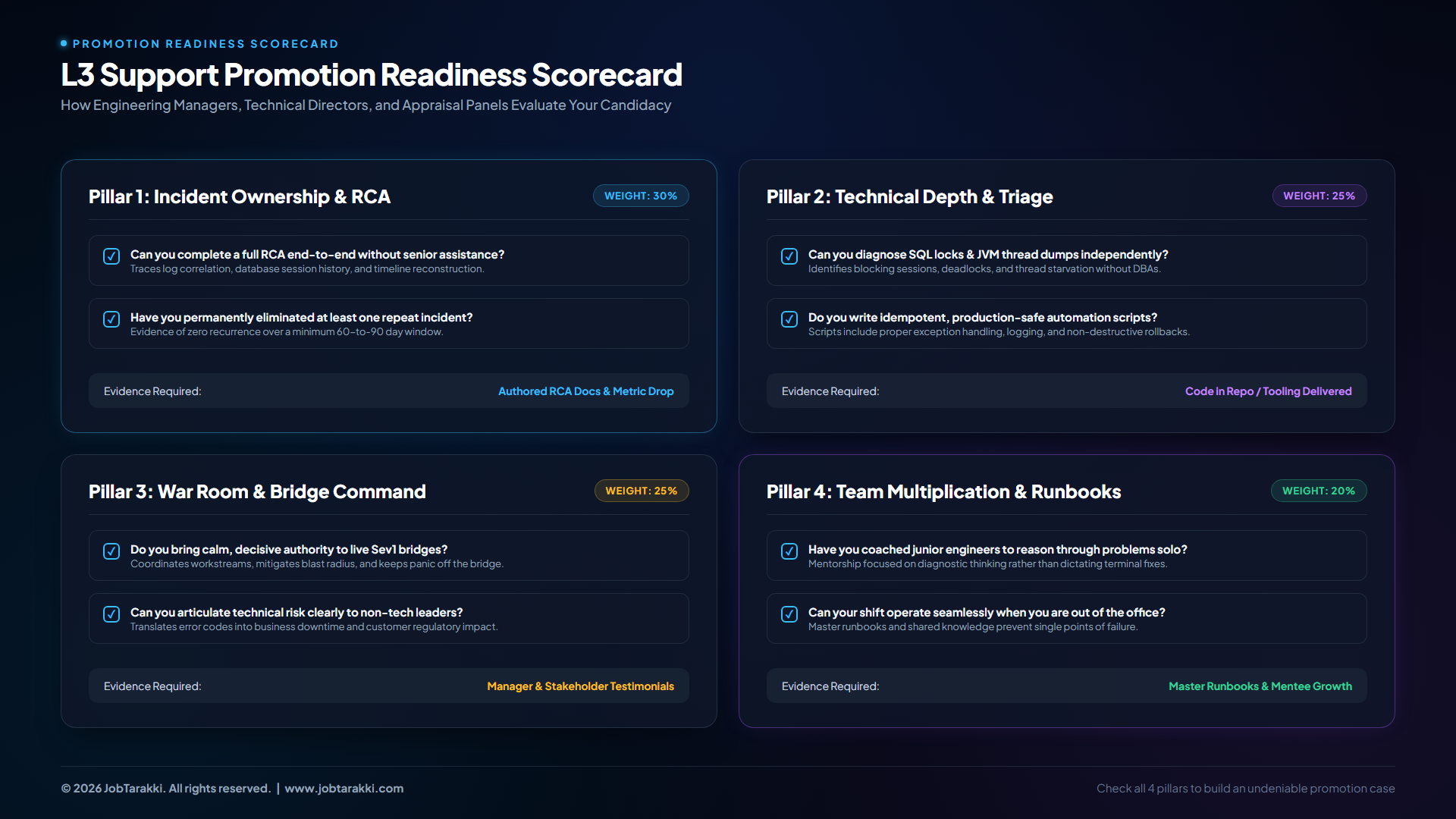
Before putting your name forward for an L3 role, benchmark yourself against this scorecard:
| Pillar | Readiness Criteria | Self-Check Question |
|---|---|---|
| Incident Ownership | Authored comprehensive RCAs end-to-end; eliminated at least 2 repeat incidents this year. | “Can I trace a Sev1 failure to its root cause without relying on an external dev team?” |
| Technical Depth | Fluent in cross-system log correlation, SQL lock diagnosis, and Python/Shell automation. | “Do I understand the architecture of our upstream and downstream dependencies?” |
| Communication | Delivers calm bridge leadership; translates complex technical failures into clear business impact. | “Can I explain this outage to a Director of Technology without technical jargon?” |
| Mentorship | Actively onboarded team members; conducted RCA peer reviews; improved team runbooks. | “Can the shift operate smoothly when I am on annual leave?” |
A Practical 12-Month Roadmap
| Timeline | Milestone Focus | Concrete Deliverables |
|---|---|---|
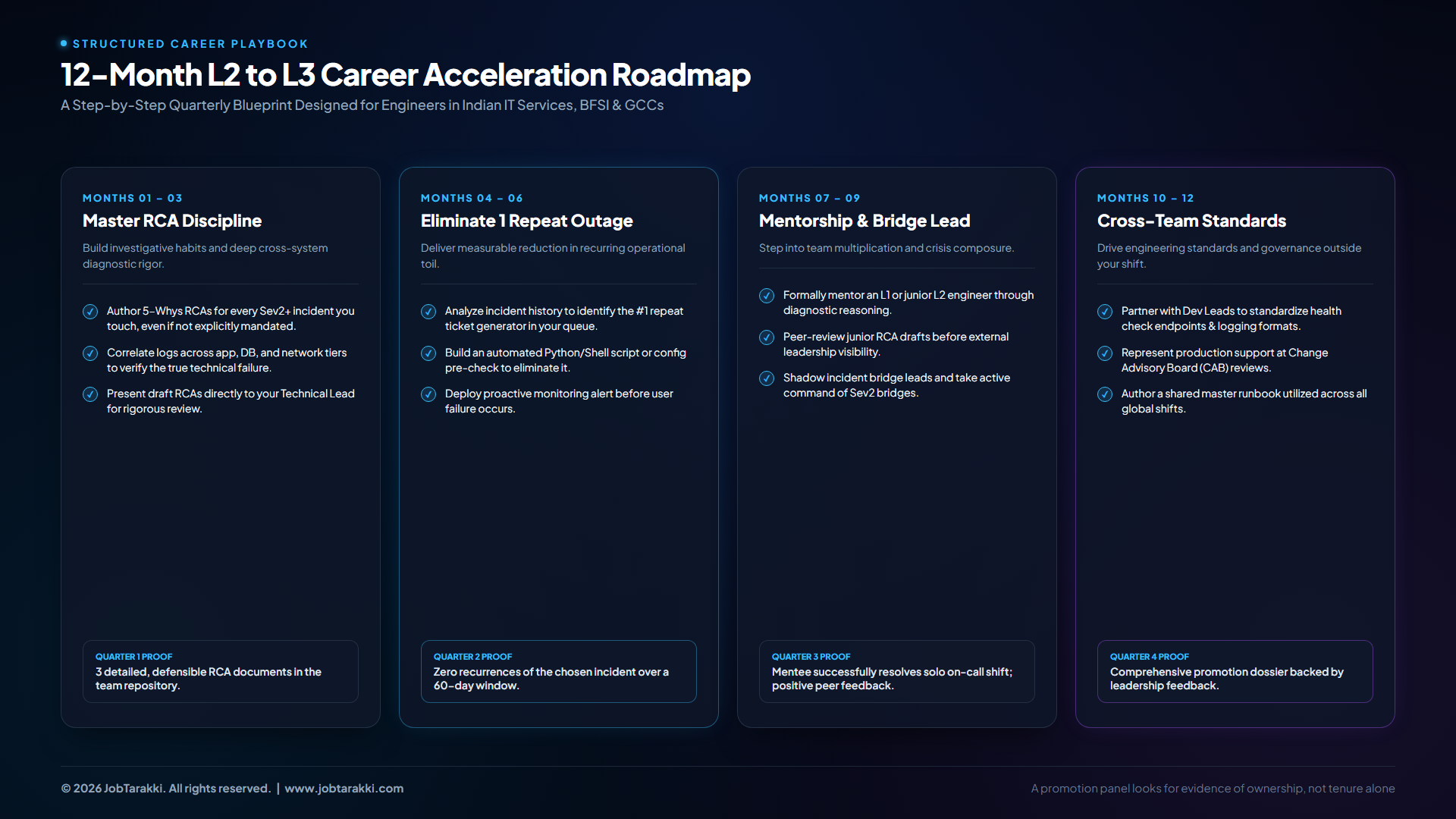
| Months 1–3: Master RCA Discipline | Build investigative rigour and deep diagnostic habits. | Write detailed 5-Whys RCAs for every major incident you touch. Include exact logs, timeline reconstruction, and remediation items. |
| Months 4–6: Eliminate One Chronic Repeat Issue | Deliver measurable reduction in operational toil. | Identify the top repeat ticket generator in your queue. Build an automation script or config adjustment to eradicate it permanently. |
| Months 7–9: Step Into Mentorship & Bridge Leadership | Build team multiplication and crisis composure. | Shadow Sev1 incident bridge coordinators. Lead handoffs across global shifts. Mentor a junior engineer through their first solo on-call rotation. |
| Months 10–12: Drive Cross-Team Visibility | Influence engineering, CAB, and platform reliability. | Present recurring operational bottlenecks to development leads. Propose preventative health-check standards at Change Advisory Boards. |
Frequently Asked Questions
What is the core difference between L2 and L3 in production support?
L2 focuses on independent incident resolution, basic log triaging, and executing SOPs to maintain immediate SLAs. L3 focuses on root cause ownership, permanent incident elimination, automation tooling, cross-shift runbook architecture, and cross-team incident command.
How many years of experience does an L2 engineer need in India to become L3?
In Indian IT services and GCCs, engineers typically spend 2 to 4 years in L2 roles before moving to L3. However, promotion is driven by demonstrated system ownership, proactive automation, and bridge leadership—not tenure alone.
Do I need to be a software developer to become an L3 engineer?
No. You do not need to build full-stack enterprise applications. However, you must be comfortable writing robust Python or Shell scripts, reading stack traces, and writing intermediate SQL queries to diagnose data integrity issues.
Is L3 Production Support the same as Site Reliability Engineering (SRE)?
Not identical, but closely linked. L3 support focuses on application stability, incident response, and root-cause fixes within established systems. SRE applies software engineering principles to automate operations at scale. Transitioning from L3 support to SRE is one of the most common and rewarding career paths in modern IT.
Can I achieve an L3 promotion within my existing company?
Yes. Because L3 relies on deep application domain knowledge and established trust during high-severity outages, internal promotions are very common when an engineer proves they can prevent incidents rather than just close tickets.
Conclusion
Moving from L2 to L3 in production support isn't about working longer shifts or clicking faster inside ticketing tools.
It is about shifting your mental model from reactive resolution to proactive prevention, and from individual contribution to team-wide reliability.
Start today: pick the most annoying, recurring ticket in your sprint backlog, uncover its true root cause, automate it out of existence, and document the fix for your entire team. You don't need a new designation to begin doing L3 work—in production support, the impact always precedes the title.
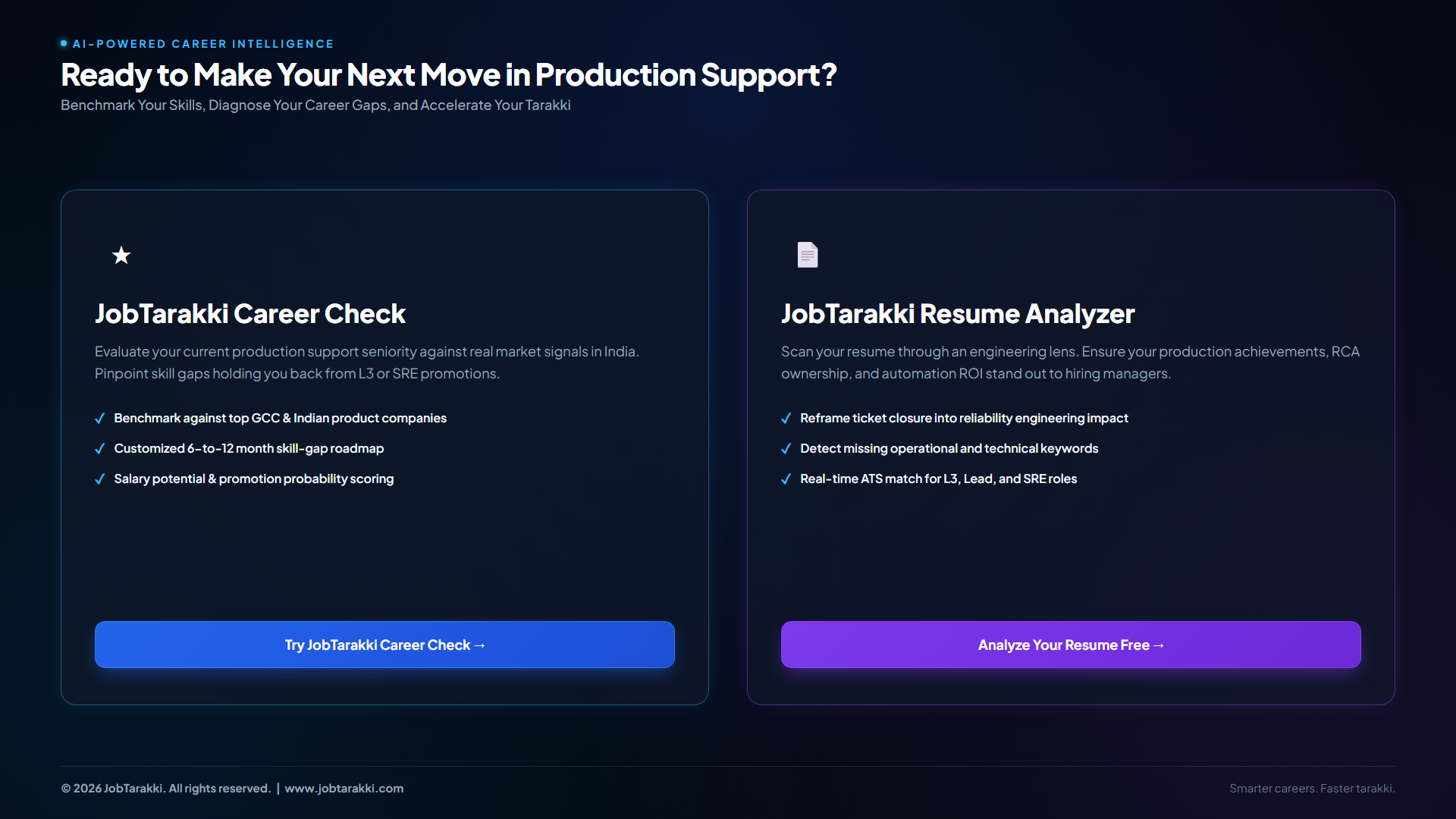
Ready to plan your next career step in software operations and engineering? Use JobTarakki Career Check to benchmark your skills and build a clear path forward.