
What Is a Forward Deployed Engineer?
A Forward Deployed Engineer sits close to the intersection of software engineering, customer problems, and product deployment.
The "forward deployed" idea comes from placing engineers close to the environment where the technology is being used.
Instead of receiving a fully defined specification and building it entirely inside the engineering organization, an FDE may start with a problem such as:
"Our operations team spends hours reviewing these documents every day. Can we automate part of this workflow?"
The FDE investigates the workflow, understands the underlying systems and constraints, builds a working solution, and helps put it into production.
The exact role differs between companies. Some FDEs are highly focused on software development, while others have broader responsibilities involving deployment, data, integrations, and customer relationships.
What Does a Forward Deployed Engineer Do?
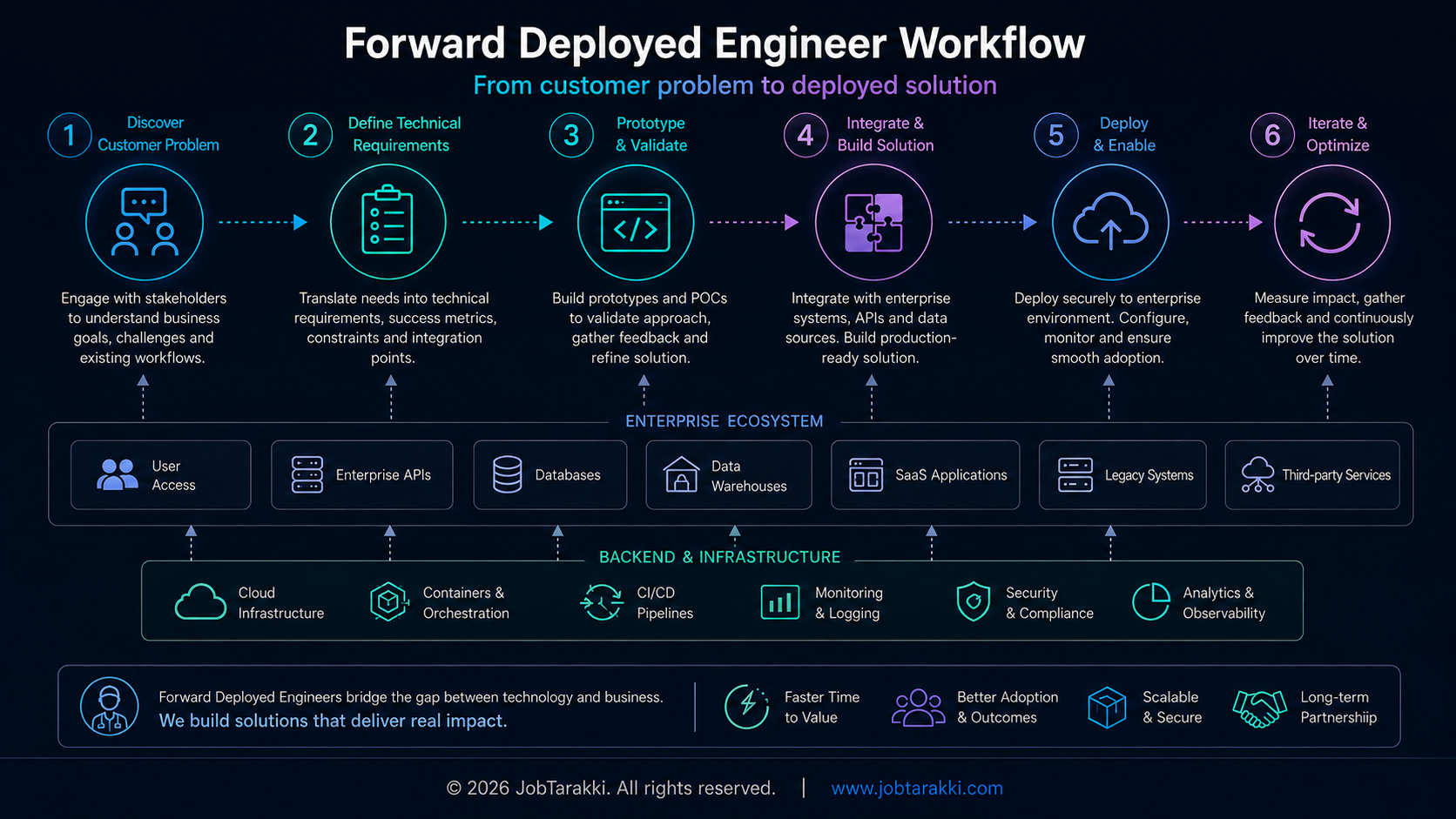
An FDE's work can change significantly from one customer or project to another.
Typical responsibilities include:
- Understanding customer workflows and technical requirements
- Prototyping solutions quickly
- Building integrations with existing systems
- Developing backend services and automation
- Working with APIs and databases
- Deploying applications into customer environments
- Building AI-powered workflows where appropriate
- Debugging production issues
- Explaining technical decisions to customers
- Sharing recurring customer problems with product and engineering teams
The common thread is turning a customer's real-world problem into a working technical solution.
A Typical FDE Project
Imagine an enterprise has thousands of internal documents and wants employees to ask questions about them using natural language.
An FDE might need to:
- Understand how the company stores its documents.
- Determine which data employees are allowed to access.
- Connect to existing storage systems.
- Build a document ingestion pipeline.
- Create retrieval and search functionality.
- Integrate an LLM or AI platform.
- Implement access controls.
- Build an interface or API.
- Deploy the solution.
- Monitor how users interact with it.
- Iterate based on customer feedback.
This is why FDE work can involve several areas of engineering in a single project.
FDE vs Traditional Software Engineer
The biggest difference is often where the engineer sits in the product-development loop.
| Traditional Software Engineer | Forward Deployed Engineer |
|---|---|
| Primarily builds core product | Builds solutions around the core platform |
| Often works from defined requirements | Frequently discovers requirements directly |
| Usually focuses on reusable product functionality | Often handles customer-specific requirements |
| Works mainly with internal engineering teams | Works closely with customers |
| Longer product development cycles may be common | Rapid iteration is often important |
| Product scalability is a major concern | Customer outcomes and deployment are also critical |
This doesn't mean FDEs don't write production-quality software.
Good FDE teams still need maintainable, secure, and reliable systems.
The difference is the proximity to the customer problem.
FDE vs Solutions Engineer
The distinction between these roles depends heavily on the company.
A Solutions Engineer commonly focuses on activities such as:
- Technical discovery
- Product demonstrations
- Proofs of concept
- Technical evaluation
- Customer architecture discussions
An FDE typically goes further into building and deploying the solution.
An FDE may write substantial amounts of production code and work directly with the customer's technical environment.
There can be significant overlap, however. Job titles aren't standardized across the technology industry.
The FDE Technical Stack
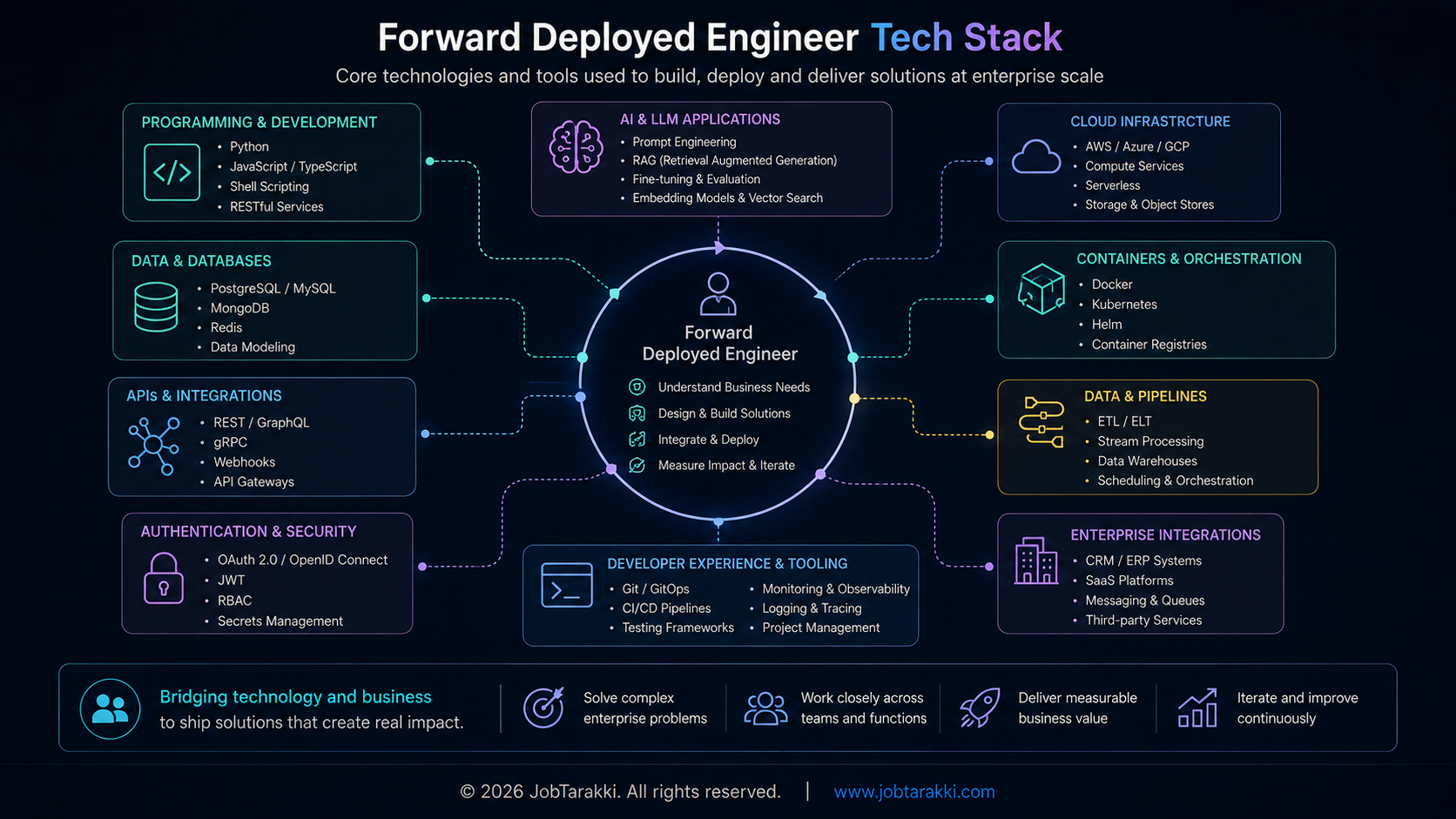
There isn't one universal FDE tech stack.
The right stack depends on the company, customers, and problems being solved.
Python
Python is useful for:
- Backend services
- Automation
- Data processing
- AI/ML applications
- Prototyping
- API integrations
For AI-focused FDE roles, Python is particularly useful because of the breadth of AI and data tooling available in the ecosystem.
SQL and Databases
FDEs frequently work with customer data.
You should be comfortable with:
- SQL
- Relational databases
- Data modeling
- Query optimization
- PostgreSQL or similar systems
Understanding how data is structured is often more important than memorizing a particular database product.
APIs and Integrations
Enterprise environments rarely exist in isolation.
You may need to integrate with:
- REST APIs
- GraphQL
- Authentication systems
- Internal services
- SaaS platforms
- Data warehouses
- Legacy applications
Understanding HTTP, authentication, webhooks, retries, rate limits, and error handling is valuable.
Docker and Cloud
Depending on the role, you may work with:
- Docker
- Kubernetes
- AWS
- Azure
- Google Cloud
- CI/CD
- Infrastructure configuration
You don't necessarily need to be a Kubernetes expert before applying to every FDE position.
The required infrastructure depth depends on the company.
AI and LLMs
AI-focused FDE roles increasingly involve technologies such as:
- LLM APIs
- Retrieval-Augmented Generation (RAG)
- Embeddings
- Vector databases
- Tool calling
- Agentic workflows
- Evaluation
- Prompt design
- AI application observability
The important skill isn't simply knowing how to call an LLM API.
You need to understand where AI actually improves a workflow and where deterministic software is the better solution.
Soft Skills Matter More Than Many Engineers Expect
An FDE can be technically excellent and still struggle if they cannot work effectively with customers.
Important skills include:
Communication
You need to translate between technical and non-technical language.
A customer may describe a business problem rather than an engineering requirement.
The FDE has to discover the technical implications.
Comfort With Ambiguity
Requirements can change after the first customer conversation.
You may start with:
"Build an AI assistant."
and discover that the real problem is:
"Employees can't find information across four disconnected systems."
The second problem requires a very different solution.
Speed of Iteration
FDEs often need to demonstrate value quickly.
A small working prototype can reveal more than weeks of assumptions.
Domain Adaptability
One project might involve finance.
The next might involve healthcare, manufacturing, retail, or defense.
You don't need to become an industry expert overnight, but you need to learn quickly.
If you're preparing for an FDE role, you can also use the JobTarakki Resume Analyzer to see how clearly your engineering experience, skills, and impact are represented on your resume.
How to Become a Forward Deployed Engineer
There isn't one fixed route into FDE.
A practical path is to develop strong engineering fundamentals plus customer-facing problem-solving ability.
Step 1: Become a Strong Software Engineer
Start with fundamentals:
- Data structures and algorithms
- HTTP and networking
- Databases
- APIs
- Git
- Testing
- Debugging
- Linux
- Basic system design
You don't need to know every technology.
You need to be able to build and troubleshoot real systems.
Step 2: Learn Backend Development
Pick a language and build real applications.
Python, Go, Java, TypeScript, or another production language can work depending on your target companies.
Focus on:
- APIs
- Authentication
- Databases
- Queues
- Caching
- Background jobs
- Observability
Step 3: Learn Deployment
Build something and actually deploy it.
Learn:
- Docker
- Cloud fundamentals
- CI/CD
- Logging
- Monitoring
- Secrets management
- Basic networking
An FDE needs to understand what happens after the code works on a laptop.
Step 4: Build Integration-Heavy Projects
Avoid building another isolated CRUD application.
Instead, build something that connects several systems.
For example:
Slack → Backend → PostgreSQL → LLM → External API
This teaches you the kind of integration thinking that appears frequently in real-world FDE work.
Step 5: Build an AI Application
If you're targeting AI-focused FDE roles, build something beyond a simple chatbot.
For example:
An internal support agent that retrieves company documentation, calls approved tools, applies authorization rules, records actions, and exposes an API.
Now you're dealing with:
- Retrieval
- APIs
- Authentication
- Data
- AI
- Deployment
- Evaluation
- Failure handling
That is much closer to real engineering work.
Step 6: Practice Problem Discovery
Don't start every project with:
"I want to build an AI agent."
Start with:
"What problem am I solving?"
Then determine whether AI, automation, traditional software, or a combination is appropriate.
This mindset is particularly valuable for FDE work.
What Should an FDE Portfolio Look Like?
Your portfolio doesn't need ten projects.
Two or three deep, well-documented projects can demonstrate much more.
For each project, explain:
Problem
What real-world problem were you solving?
Constraints
What limitations existed?
Architecture
Why did you choose your design?
Implementation
What did you actually build?
Deployment
Where does it run?
Failure Cases
What happens when dependencies fail?
Trade-offs
Why did you choose this approach over alternatives?
Outcome
What did the system accomplish?
A recruiter should be able to see that you can move from problem → solution → deployment, not just write code.
Common Mistakes When Preparing for FDE Roles
Building Only CRUD Projects
CRUD projects can teach fundamentals, but they don't demonstrate much about integration, deployment, or ambiguity.
Building an AI Wrapper
Calling an LLM API and placing a chat interface on top isn't enough to demonstrate FDE-level engineering.
Show the surrounding system.
Ignoring Deployment
If the project only works locally, you're missing an important part of the learning experience.
Overengineering
Don't introduce Kubernetes, Kafka, microservices, and ten databases into a project that doesn't need them.
Good FDE work often involves finding the simplest solution that works.
Ignoring the Customer
A technically impressive solution can still fail if it doesn't solve the customer's actual workflow.
FDE Career Roadmap
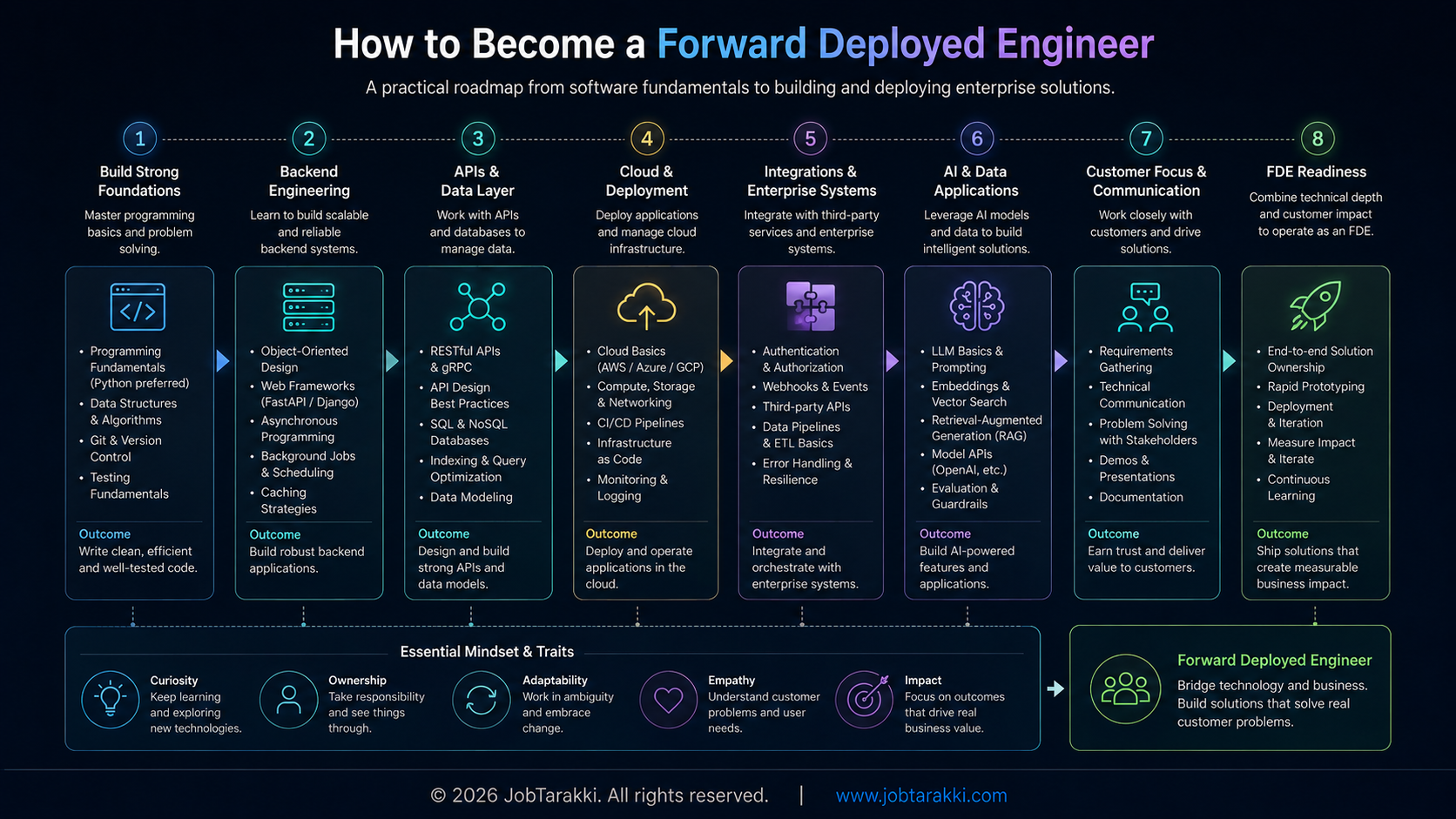
A simplified learning roadmap looks like this:
| Stage | Focus |
|---|---|
| Foundation | Programming, Git, Linux, networking |
| Backend | APIs, databases, services |
| Deployment | Docker, cloud, CI/CD |
| Integration | APIs, authentication, data pipelines |
| AI | LLMs, RAG, tools, agents |
| Customer skills | Discovery, communication, requirements |
| FDE readiness | Build → deploy → iterate on real problems |
You don't need to master everything simultaneously.
Build progressively complex systems and learn technologies when the project requires them.
FDE Readiness Checklist
Before applying for an FDE role, ask yourself:
Engineering
- Can I build a production-style backend?
- Can I work comfortably with SQL?
- Can I integrate third-party APIs?
- Can I debug unfamiliar systems?
- Can I deploy an application?
- Can I work with Docker?
- Do I understand basic cloud infrastructure?
AI
- Can I integrate an LLM API?
- Do I understand embeddings and retrieval?
- Can I build a basic RAG system?
- Do I understand tool calling?
- Can I evaluate whether an AI solution is actually working?
Customer & Communication
- Can I turn an ambiguous problem into technical requirements?
- Can I explain technical trade-offs clearly?
- Can I communicate with non-engineers?
- Can I adapt when requirements change?
- Can I present a working prototype?
You don't need every checkbox for every FDE role. Job requirements vary significantly.
Want to know how close you are to your target career level? Try JobTarakki Career Check to assess your current career position and identify areas to work on next.
Is Forward Deployed Engineering a Good Career?
FDE can be an attractive path for engineers who enjoy both building software and solving customer problems.
It may be less suitable if you strongly prefer:
- Working exclusively on internal systems
- Long uninterrupted development cycles
- Minimal customer interaction
- Highly predictable requirements
The role can expose engineers to different industries, technical environments, and business problems.
But that variety also means the work can be less predictable than a traditional product-engineering role.
The right choice depends on how you prefer to work.
FAQs
What is a Forward Deployed Engineer?
A Forward Deployed Engineer works closely with customers to build, customize, integrate, and deploy technical solutions using a company's core platform or technology.
What does FDE stand for in software engineering?
FDE stands for Forward Deployed Engineer. The term describes an engineering role focused on applying technology directly to customer problems and environments.
Is a Forward Deployed Engineer a software engineer?
Yes, many FDE roles involve substantial software engineering. However, the exact balance between coding, deployment, technical discovery, and customer interaction varies by company.
What programming language is best for FDE roles?
There is no universal language. Python is particularly useful for AI and automation-focused roles, while Go, Java, TypeScript, and other languages may be preferred depending on the company's technology stack.
Do FDEs need AI skills?
Not every FDE role requires AI expertise. For AI-focused FDE positions, however, understanding LLMs, RAG, APIs, tool calling, evaluation, and AI application development can be valuable.
Do FDEs need customer-facing skills?
Yes. Customer communication is often a significant part of the role because FDEs need to understand workflows, clarify requirements, explain solutions, and gather feedback.
Is FDE the same as a Solutions Engineer?
Not necessarily. Solutions Engineers often focus on technical discovery, demonstrations, and solution design, while FDEs may have greater responsibility for actually building and deploying the solution. Companies can define these roles differently.
Is Forward Deployed Engineering suitable for fresh graduates?
Some companies hire early-career engineers for FDE roles, while others prefer candidates with prior software engineering experience. Strong programming, problem-solving, communication, and project experience can help.
What projects should I build for an FDE portfolio?
Integration-heavy projects are particularly useful. Consider building systems that combine APIs, databases, authentication, cloud deployment, automation, and AI where appropriate.
What is the difference between an FDE and a backend engineer?
A backend engineer usually focuses on building and maintaining backend systems, while an FDE often works closer to customer problems and deployments. There can be substantial overlap in the technical work.
Do FDEs need Kubernetes?
Not necessarily. Kubernetes can be useful for certain enterprise and infrastructure-heavy FDE roles, but requirements vary. Learn it when the roles you're targeting actually require it.
Conclusion
Forward Deployed Engineering sits at an interesting intersection of software engineering, AI, deployment, and customer problem-solving.
The role isn't simply about being a developer who talks to customers.
A strong FDE needs to take an ambiguous problem, understand the technical environment, build a practical solution, deploy it, and iterate based on what actually happens in the real world.
If that combination sounds interesting, start by building projects that force you to work across APIs, data, backend systems, deployment, and real user workflows.
You don't need to learn every technology listed in an FDE job description.
Learn to solve problems end-to-end.
Thinking about your next career move? Use JobTarakki Career Check to understand where you stand today and what you could focus on next.